


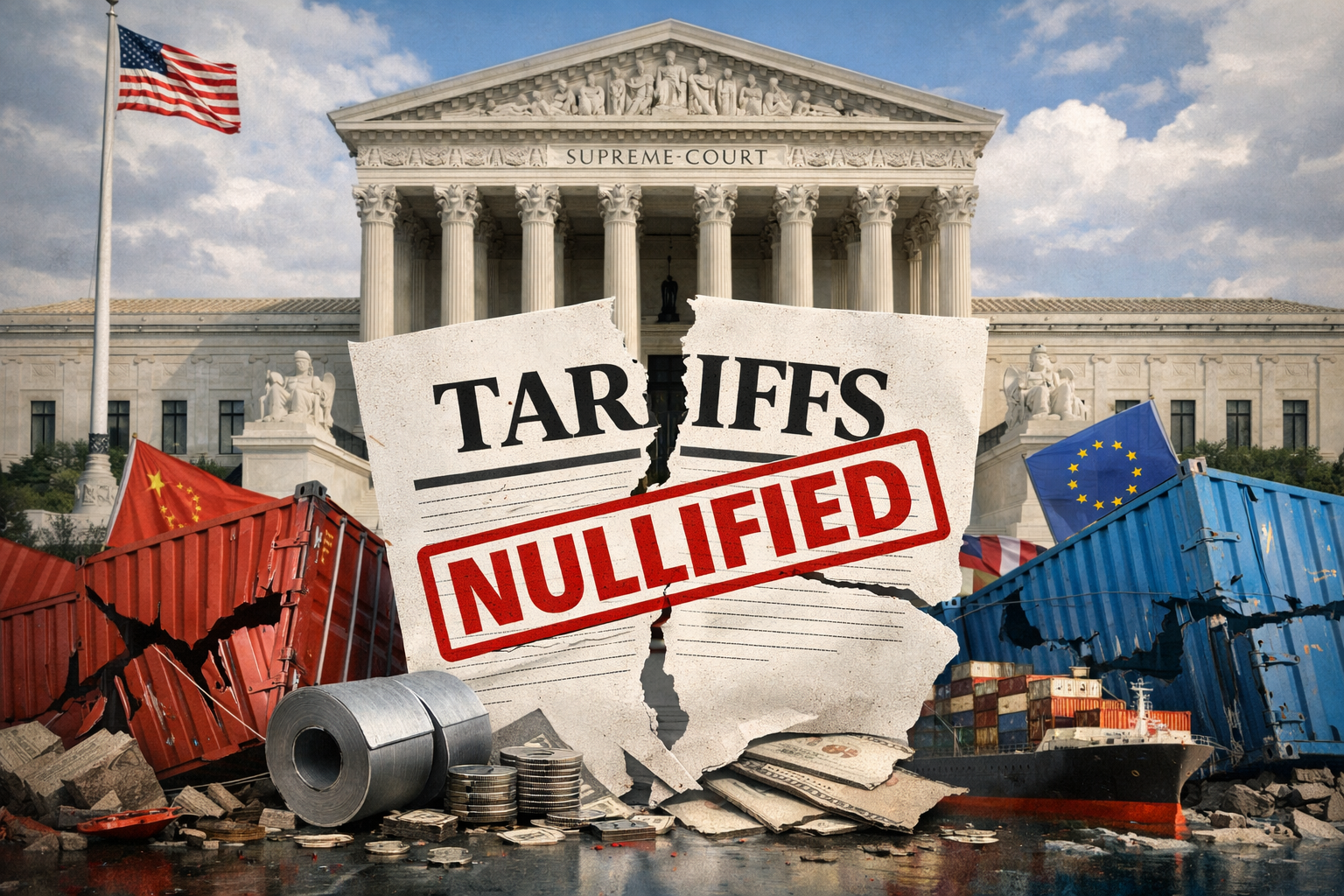

US Supreme Court Nullifies Trump-Era Tarriffs 
The decision to nullify the tariffs imposed during the Trump administration marks a significant turning point in U.S. trade policy.
This ruling not only impacts domestic industries but also alters the landscape of global markets, fostering a more competitive environment for international trade. Stakeholders across various sectors are now reassessing their strategies in light of this ruling, as the implications of this decision will reverberate throughout the economy. The shift away from protectionist measures signals a potential return to more collaborative trade relations with global partners. a Tariffs, Reshaping U.S. Trade and Global Markets The recent Supreme Court
In a landmark decision that could redefine U.S. trade policy for years to come, the United States Supreme Court has struck down a series of tariffs originally imposed during former President Donald Trump’s administration. The ruling effectively nullifies the controversial import duties on a range of foreign goods, sending immediate ripples through global markets, domestic industries, and political circles.
The decision, handed down in a sharply watched case involving constitutional authority and executive power, centered on whether the Trump administration overstepped legal boundaries in imposing sweeping tariffs under national security justifications. The Court ruled that the tariffs, implemented under expansive interpretations of executive trade authority, did not fully comply with statutory requirements and exceeded permissible limits.
The ruling marks one of the most consequential judicial interventions in U.S. trade policy in decades.
Immediate Economic Impact
Within hours of the decision, global markets reacted. Shares of major manufacturing and retail companies surged as investors anticipated reduced import costs and improved supply chain stability. Companies that rely heavily on imported raw materials and finished goods stand to benefit most from the removal of tariffs that had raised production costs for years.
U.S. importers, particularly in sectors such as automotive manufacturing, electronics, and consumer goods, welcomed the ruling. Many had long argued that the tariffs increased operational costs, forced price hikes on consumers, and complicated supply chains.
Retailers are expected to see a gradual reduction in wholesale prices, which could translate into lower consumer prices over time. However, analysts caution that the full effect will depend on how quickly trade policies and supply chains adjust.
Relief for Global Trade Partners
Internationally, the decision has been received as a significant development in U.S. trade relations. Several countries affected by the tariffs had filed complaints with global trade bodies and pursued diplomatic channels seeking relief. The Supreme Court’s ruling effectively removes a major point of contention in trade negotiations.
Economists believe the decision could reopen doors for renewed trade agreements and cooperation. Some foreign governments have already signaled interest in revisiting stalled trade talks, viewing the ruling as an opportunity to reset economic relationships with the United States.
For global exporters, particularly in Asia and Europe, the removal of tariffs may restore competitive access to the American market. Industries that had faced declining U.S. demand due to higher import costs are expected to regain market share.
Domestic Industry Concerns
Not all reactions have been positive. Certain U.S. industries that benefited from tariff protections expressed concern that the decision could expose them to renewed foreign competition.
Steel and aluminum producers, among others, had relied on tariffs to shield domestic production from lower-cost imports. Industry leaders warn that removing those protections could lead to price pressures and potential job losses if cheaper imports flood the market.
Labor unions representing workers in protected sectors have also raised alarms, urging policymakers to consider alternative safeguards to support domestic manufacturing.
The ruling therefore sets the stage for renewed debates in Washington over how to balance free trade with domestic industry protection.
Political and Legal Implications
Beyond economics, the Supreme Court’s decision carries significant political and constitutional implications. At its core, the case tested the limits of presidential authority in shaping trade policy without explicit congressional approval.
Legal experts say the ruling reinforces the principle that sweeping economic measures, even under national security justifications, must adhere closely to statutory and constitutional boundaries. The decision could constrain future administrations from unilaterally imposing broad tariffs without clearer legislative backing.
Some analysts predict Congress may now move to clarify trade laws and redefine the scope of executive authority in this area. Lawmakers from both parties have previously expressed concern over the concentration of trade powers within the executive branch.
The ruling is also likely to become a central issue in upcoming political debates, with policymakers divided over whether tariffs serve as necessary economic tools or harmful trade barriers.
Implications for Consumers
For everyday Americans, the long-term impact may be felt most directly at the checkout counter. Tariffs often function as indirect taxes on imports, with costs frequently passed down to consumers. Their removal could ease price pressures on a range of goods, from electronics to household items.
However, economists caution that price changes may not be immediate. Supply chains and contracts established under tariff conditions may take months to adjust. Still, the decision is widely seen as a potential step toward stabilizing prices in key consumer sectors.
A Turning Point in U.S. Trade Policy
The Supreme Court’s nullification of Trump-era tariffs represents more than a legal victory or policy reversal. It marks a turning point in how the United States navigates trade, executive authority, and economic globalization.
Businesses, lawmakers, and global partners are now watching closely to see how the federal government responds. Whether the ruling leads to more open trade policies or new legislative frameworks remains to be seen.
One thing is certain: the decision has reshaped the landscape of U.S. trade and set the stage for a new era of economic policy debates.
