


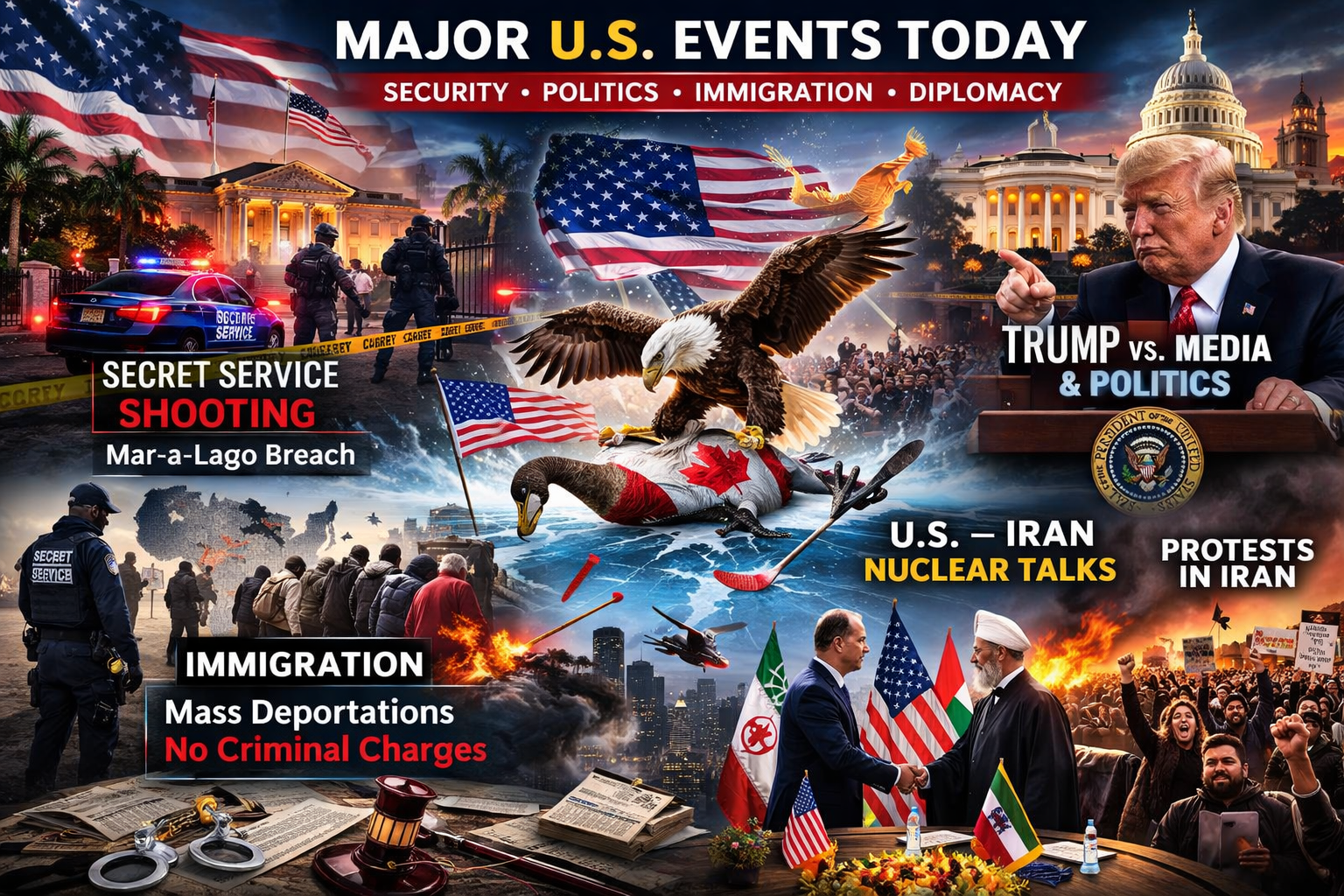

America Today: On a day marked by a striking convergence of security tension, political messaging, immigration scrutiny, corporate confrontation, and renewed diplomatic maneuvering abroad, the United States moved through another cycle of events that underscored both the volatility and complexity of its current national moment. February 23 unfolded with developments that, while varied in subject, collectively revealed a country navigating a heightened atmosphere of political symbolism, institutional assertion, and global engagement.
The most immediate and dramatic episode occurred in Florida, where U.S. Secret Service agents fatally shot an armed man who breached the perimeter of Donald Trump’s Mar-a-Lago residence. Federal authorities confirmed that the individual, carrying a weapon and attempting to enter restricted grounds, was confronted by agents and killed after failing to comply with commands. Trump himself was not present at the property at the time. Law enforcement officials described the incident as a serious security breach, noting that protective protocols were followed and that investigations are underway to determine motive and background. The episode quickly reverberated across the political landscape, not only because of its proximity to a former president but because it illustrated the increasingly fraught security environment surrounding American political figures.
Security analysts interviewed by major outlets emphasized that threats against high-profile political actors have risen sharply in recent years, driven by political polarization, online radicalization, and the broader climate of distrust toward institutions. While such incidents remain relatively rare, each occurrence reinforces the perception that American political life is now operating within a more volatile and potentially dangerous framework. The Mar-a-Lago breach also served as a reminder of the constant protective burden placed on federal agencies tasked with securing political leaders, even outside formal government settings.
At the same time, Trump remained a central actor in a series of political and cultural developments that extended beyond the security sphere. In a post that circulated widely across social media, he shared an image of a bald eagle dominating a goose shortly after the United States defeated Canada in a high-profile international ice hockey match. Supporters interpreted the image as a symbolic affirmation of American strength and competitive dominance, while critics viewed it as another instance of combative nationalist messaging. Though seemingly symbolic, the episode underscored how modern political communication increasingly blends cultural events, sports rivalries, and national identity into a single narrative framework. The use of visual symbolism in political messaging has become a hallmark of contemporary leadership, shaping public perception and reinforcing ideological alignment through images that travel rapidly across digital platforms.
More consequentially, new documentation released through investigative reporting has intensified debate over U.S. immigration enforcement practices. Records reviewed by journalists revealed that the majority of immigrants targeted for deportation in 2025 had no criminal charges on record, challenging long-standing assertions that enforcement priorities focus primarily on individuals with serious criminal histories. Immigration advocates argued that the findings highlight a shift toward broader enforcement strategies centered on status violations rather than public safety concerns. Policy analysts noted that such an approach may carry significant implications for community relations, particularly in jurisdictions where local authorities rely on cooperation with immigrant populations for public safety initiatives.
Supporters of stricter enforcement maintain that consistent application of immigration law is necessary to maintain the integrity of the system, regardless of criminal background. However, the data has intensified calls from some lawmakers and advocacy groups for a reassessment of enforcement priorities and greater transparency regarding deportation criteria. The revelations come at a time when immigration remains one of the most polarizing issues in American politics, with debates extending from border policy and asylum procedures to labor market dynamics and humanitarian considerations. As Congress and federal agencies continue to grapple with these questions, the latest disclosures are likely to shape both legislative proposals and public discourse in the months ahead.
Trump also turned his attention to the media and corporate sector, issuing a warning directed at Netflix over the presence of a prominent Democratic figure on its board. He suggested that the streaming company could face “consequences” if it failed to remove the individual, though he did not specify what form those consequences might take. The remark drew immediate attention from legal scholars and media commentators, who noted the growing entanglement between political leadership and private sector institutions. In an era where media platforms wield significant cultural and informational influence, the boundaries between political rhetoric and regulatory pressure have become increasingly blurred. Analysts observed that public statements targeting specific companies can carry reputational and market implications even in the absence of formal regulatory action, illustrating the evolving relationship between government authority and corporate governance.
Beyond domestic developments, the United States continued to engage with international challenges that carry both strategic and humanitarian dimensions. Washington confirmed that additional nuclear talks with Tehran are scheduled to proceed, even as protests have reemerged across several Iranian cities. The decision to maintain diplomatic engagement reflects a longstanding U.S. policy of preserving negotiation channels with adversarial states while pursuing nonproliferation objectives. However, the resurgence of protests within Iran adds complexity to the diplomatic landscape. Analysts note that internal unrest can influence a government’s negotiating posture, potentially strengthening hardline elements or prompting concessions aimed at stabilizing domestic conditions.
For U.S. policymakers, the dual reality of pursuing nuclear restraint while addressing human rights concerns presents a delicate balancing act. The continuation of talks signals a recognition that sustained dialogue remains essential to managing nuclear risk and regional stability, even as domestic developments within Iran generate international scrutiny. The outcome of these negotiations will likely shape broader U.S. foreign policy priorities in the Middle East, particularly in relation to allies concerned about nuclear proliferation and regional security dynamics.
Taken together, the day’s events illustrate a nation operating within a multifaceted environment of challenge and adaptation. The security breach at Mar-a-Lago underscores the tangible risks accompanying political leadership in a polarized era. Immigration data disclosures reveal ongoing tensions between enforcement objectives and humanitarian considerations. Corporate-government interactions highlight the evolving boundaries of political influence in the private sector. Meanwhile, diplomatic engagement with Iran reflects the enduring complexity of U.S. global responsibilities.
What binds these developments is not a single policy thread but a shared context of institutional testing and national recalibration. The United States continues to navigate a period in which questions of authority, legitimacy, and public confidence intersect with practical governance challenges. Each development, whether domestic or international, contributes to an evolving narrative about the country’s direction and the resilience of its democratic institutions.
As the nation moves forward, several issues will command close attention. Investigations into the Mar-a-Lago security breach will seek to determine whether the incident represents an isolated act or part of a broader pattern of threats. Immigration policy debates are likely to intensify as lawmakers and advocacy groups respond to newly surfaced data. Corporate responses to political pressure may signal shifting norms in the relationship between business and government. And ongoing nuclear talks with Iran will continue to test the effectiveness of diplomacy in an environment shaped by both geopolitical competition and internal instability.
February 23 thus stands as another chapter in a broader national story defined by complexity and consequence. The interplay of security concerns, political messaging, institutional dynamics, and international diplomacy reflects a United States grappling with the demands of leadership in a rapidly changing world. How these forces interact in the days ahead will shape not only policy outcomes but also the public’s understanding of governance and national direction in an era of persistent uncertainty.
