


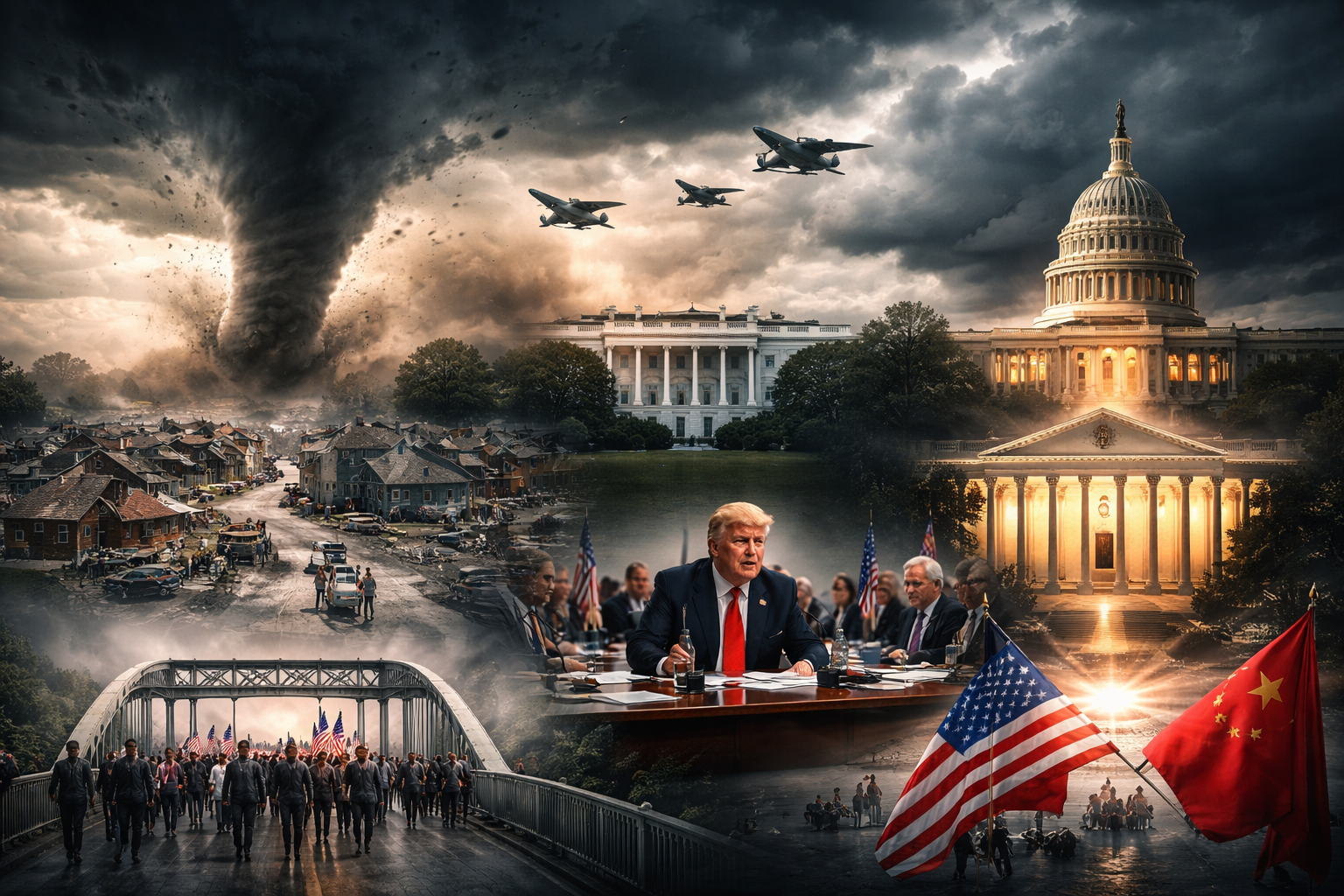

America in the Last 24 Hours
The United States experienced another intense news cycle over the last 24 hours, marked by destructive natural disasters, geopolitical tensions, domestic political battles, and renewed debate about the country’s democratic foundations. From the storm-battered towns of the Midwest to diplomatic corridors in Washington and global tensions involving Iran and China, the past day reflects a country navigating complex and often overlapping challenges.
Across multiple states, powerful storms and tornadoes carved destructive paths through communities, leaving death, injury, and widespread devastation in their wake. Entire neighborhoods were reduced to debris as emergency responders worked through the night searching for survivors and helping displaced families.
The violent storm system developed along a volatile weather front stretching across the central United States. Meteorologists warned earlier that atmospheric conditions were primed for severe weather, but the scale of destruction still caught many communities off guard. In several areas, homes were flattened, vehicles overturned, and power lines ripped from the ground as tornadoes tore through residential districts.
Local authorities reported fatalities and dozens of injuries as rescue operations unfolded. Emergency shelters were quickly established to accommodate families whose homes were destroyed or rendered uninhabitable. Utility crews also began the difficult process of restoring electricity to thousands of residents left without power.
For communities in the storm’s path, the coming days will focus on recovery and rebuilding. For the country as a whole, the storms serve as a reminder of the increasing frequency and intensity of severe weather events affecting large portions of the nation.
While natural disaster dominated headlines domestically, international tensions continued to shape the broader geopolitical landscape confronting the United States.
Washington remains deeply engaged in a rapidly escalating conflict involving Iran and Israel. Military operations targeting Iranian military infrastructure have intensified in recent days, raising fears that the confrontation could spiral into a broader regional conflict.
Officials in Washington say the strikes are intended to weaken Iran’s ability to threaten American forces and allies in the region. Iranian leaders, however, have condemned the attacks and vowed retaliation, launching missile and drone strikes against targets linked to U.S. allies across the Middle East.
Global observers warn that the situation remains dangerously unstable. Any miscalculation or further escalation could widen the conflict, drawing additional regional actors into the confrontation.
The geopolitical consequences of the conflict are already being felt beyond the battlefield. Energy markets have reacted nervously to the growing tensions, with oil prices fluctuating amid concerns about potential disruptions to global supply routes.
At the same time, the White House has been pursuing a different type of international engagement closer to home.
President Donald Trump hosted a gathering of leaders from across Latin America and the Caribbean aimed at addressing one of the most persistent challenges facing the Western Hemisphere: the growing influence of powerful drug cartels.
Speaking at the summit, Trump described transnational criminal organizations as a “cancer” spreading across the region and urged leaders to pursue stronger cooperation in dismantling the networks responsible for drug trafficking, human smuggling, and organized violence.
The meeting brought together officials from several countries to discuss coordinated strategies targeting the financial structures and logistical networks that allow cartels to operate across borders.
Security experts say the summit reflects an evolving approach by the United States to treat cartel activity not merely as a criminal issue but as a broader regional security threat. Governments across the hemisphere are increasingly recognizing that drug trafficking organizations operate with resources and sophistication that rival traditional armed groups.
While international security dominated one part of the political agenda, another major battle unfolded in American courtrooms.
A growing coalition of Democratic state attorneys general has launched a series of lawsuits challenging several policies advanced by the Trump administration. The cases span a wide range of issues, including economic tariffs, immigration enforcement policies, and funding changes affecting federal programs.
Several federal courts have already issued temporary rulings blocking certain policies while the legal challenges proceed. Analysts say the courts are becoming a central arena in the political struggle between the administration and its critics.
With Congress sharply divided along partisan lines, judicial rulings are increasingly determining whether major federal initiatives can proceed or must be halted.
Legal experts say the coming months could see a cascade of major decisions from federal courts that will shape the direction of national policy in areas ranging from trade to immigration.
Amid these political and legal battles, Americans also paused to remember one of the most defining moments in the nation’s civil rights history.
Thousands gathered in the historic city of Selma to commemorate the anniversary of the civil rights march that helped lead to the passage of the landmark Voting Rights Act of 1965.
The annual commemoration carries deep historical significance, recalling the moment when civil rights activists crossed the Edmund Pettus Bridge in 1965 in a demonstration that shocked the nation and accelerated the passage of federal voting protections.
This year’s gathering, however, also carried a strong contemporary message. Civil rights leaders used the anniversary to warn that voting rights remain under pressure in the modern political landscape.
Speakers emphasized ongoing legal disputes over electoral district boundaries and voting access laws. Many urged lawmakers and citizens alike to remain vigilant in protecting the principles of democratic participation that earlier generations fought to secure.
For participants in Selma, the march remains both a historical memory and a continuing symbol of the struggle to preserve equal access to the ballot box.
Meanwhile, beyond the United States, signals from Beijing suggested the possibility of a shift in the tense relationship between the world’s two largest economies.
Chinese officials indicated that they hope the coming year could mark a turning point in relations with Washington. Diplomats on both sides are reportedly discussing the possibility of high-level meetings aimed at stabilizing economic ties and easing geopolitical tensions.
Trade disputes, technology competition, and regional security concerns have strained relations between the United States and China in recent years. Even so, analysts say renewed dialogue could help prevent further deterioration in the relationship between the two global powers.
Taken together, the developments of the past 24 hours reveal the complex environment confronting the United States at home and abroad.
Natural disasters have reminded Americans of the vulnerabilities facing communities across the country. International tensions highlight the delicate balance of power shaping global security. Political disputes continue to play out in courtrooms and legislative chambers, while historic civil rights anniversaries remind the nation of the ongoing work required to sustain its democratic ideals.
In a single day, the United States has once again confronted the intersection of domestic challenges and global responsibilities that define its place in the modern world.
