


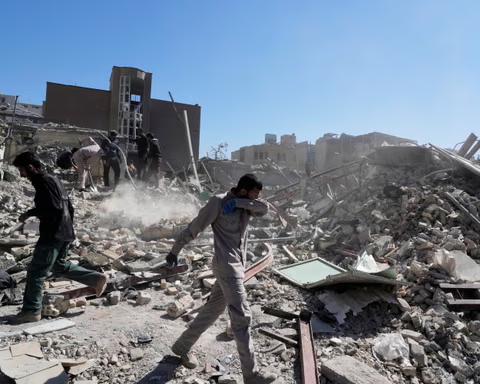

US–Israel–Iran War Update
The rapidly evolving conflict involving the United States, Israel, and Iran continues to intensify, with new developments over the past 24 hours underscoring the growing scale and complexity of the war. From leadership changes inside Iran to rising American casualties and mounting economic consequences worldwide, the conflict is reshaping the geopolitical landscape of the Middle East while sending ripple effects across global markets.
The latest developments illustrate how the war has moved beyond an isolated confrontation and into a broader regional crisis with international implications.
Iran Appoints New Supreme Leader
One of the most dramatic developments in the conflict has been the leadership transition inside Iran following the death of longtime supreme leader Ali Khamenei.
Iran’s ruling establishment has now elevated Mojtaba Khamenei to the position of supreme leader, a move that signals continuity within the country’s political and military structure during wartime.
Ali Khamenei was killed during the early phase of coordinated military operations conducted by the United States and Israel targeting Iranian military infrastructure and leadership networks. The strikes marked one of the most consequential escalations in the confrontation between Iran and its long-standing adversaries.
Iran’s leadership transition is expected to have profound implications for the direction of the war. Analysts say Mojtaba Khamenei is widely viewed as a hardliner who is likely to maintain a confrontational posture toward both Washington and Tel Aviv.
Iranian officials have vowed to continue retaliatory operations against what they describe as aggression by foreign powers.
American Casualties Mount
Meanwhile, the United States confirmed that another American service member has died from injuries sustained during Iranian retaliatory attacks earlier in the conflict.
The announcement brings the total number of American casualties in the conflict to seven, according to officials in the United States Department of Defense.
Several additional service members remain hospitalized with serious injuries following attacks on American military installations across the Gulf region.
The deaths highlight the increasingly direct toll the conflict is taking on U.S. forces stationed in the Middle East. Military analysts warn that further escalation could expose additional American personnel to risk, particularly if Iran expands its retaliation against U.S. bases in neighboring countries.
The United States maintains thousands of troops across strategic locations in the region, including bases in Saudi Arabia, Bahrain, Qatar, and the United Arab Emirates.
Israeli Airstrikes Intensify
Israeli military operations have also expanded in recent days as Israel seeks to weaken Iran’s military capabilities and disrupt its ability to launch missile attacks.
Israeli warplanes have targeted several key facilities believed to support Iran’s military operations, including fuel depots, command centers, and weapons storage sites.
The strikes are part of a broader campaign designed to degrade Iran’s missile systems and command infrastructure.
Israel argues that the strikes are necessary to prevent further attacks on Israeli territory and to dismantle Iran’s regional military network.
However, the expanding Israeli operations have also raised fears among diplomats that the war could spread beyond Iran and Israel, drawing in additional regional actors and potentially destabilizing the wider Middle East.
Global Oil Markets React
The conflict has also begun to produce significant economic consequences far beyond the battlefield.
Global oil markets have reacted sharply to the growing instability in the region, with prices surging toward $120 per barrel amid fears of disruptions to energy production and transportation routes.
One of the central concerns is the security of the Strait of Hormuz, a narrow waterway through which a significant portion of the world’s oil supply is transported.
Approximately one-fifth of global oil shipments pass through the strait each day, making it one of the most critical chokepoints in international energy markets.
Iran has threatened to restrict shipping through the waterway if the conflict intensifies, a move that could trigger severe economic consequences for countries heavily dependent on imported energy.
Energy analysts say even limited disruptions in the region could send shockwaves through global markets, raising fuel prices and increasing inflation pressures in many economies.
Aviation Disruptions Spread
The conflict has also disrupted international air travel across the Middle East.
Several airlines have suspended flights or rerouted aircraft to avoid potentially dangerous airspace amid fears of missile launches or drone attacks.
The Middle East sits at the crossroads of major global flight corridors connecting Europe, Asia, and Africa. As a result, even localized security threats can force airlines to reroute flights over longer distances, increasing travel times and operational costs.
Aviation safety agencies continue to monitor the situation closely while advising airlines to exercise caution when operating in affected regions.
Diplomatic Pressure Builds
As the war continues, international pressure is growing for a diplomatic solution that could prevent further escalation.
Several European leaders have expressed concern about the potential humanitarian and economic consequences of a prolonged conflict.
Some officials have called for an immediate ceasefire and renewed negotiations aimed at de-escalating tensions in the region.
However, diplomatic efforts face significant challenges as both sides remain committed to their military objectives.
For Iran, the conflict has become a matter of national sovereignty and resistance against foreign intervention. For Israel and the United States, the military campaign is framed as an effort to eliminate security threats and prevent further attacks.
The result is a dangerous standoff that shows little sign of immediate resolution.
A Conflict With Global Consequences
What began as a series of targeted military strikes has quickly evolved into a confrontation with potentially far-reaching consequences.
The war now affects multiple dimensions of international life, from global energy markets to airline routes and diplomatic relations between major powers.
As the conflict unfolds, governments around the world are closely monitoring developments while preparing for the economic and political impacts that could follow.
For the United States, the stakes are particularly high. The involvement of American forces and the broader implications for regional security ensure that the conflict will remain a central focus of national policy discussions.
For now, the situation remains fluid. Military operations continue, diplomatic efforts struggle to gain traction, and global markets react to each new development.
What happens next may determine not only the future of the Middle East but also the stability of the international system in the months and years ahead.
