


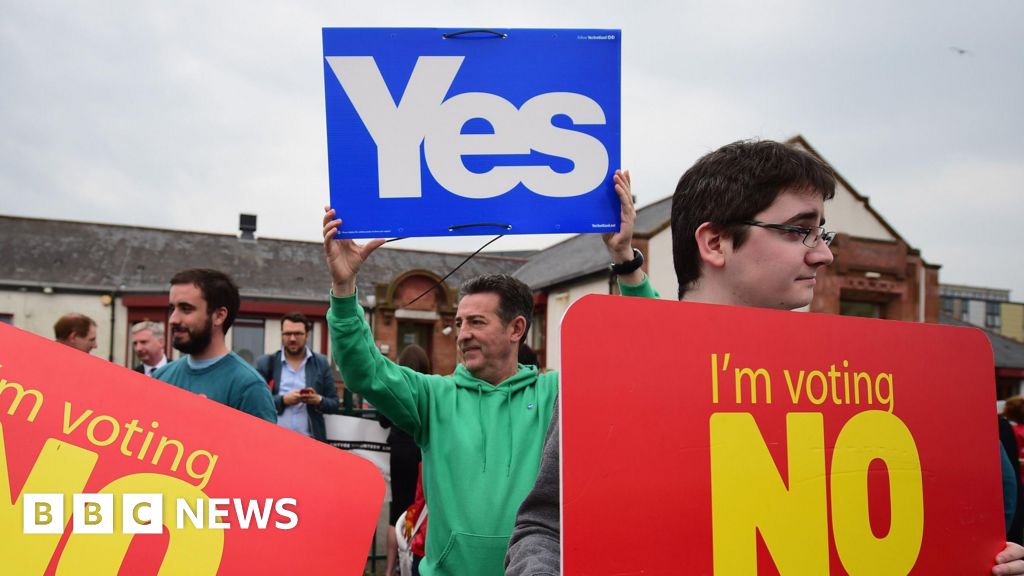

Scotland’s Independence Divide Persists Over a Decade After Historic Referendum
A decade after Scotland’s landmark independence referendum, the nation remains deeply divided on the question of its future, with public opinion split almost evenly between those who support independence and those who favor remaining part of the United Kingdom. The enduring stalemate underscores the complexity of the issue and its profound implications for Scotland’s political, economic, and social landscape.
In 2014, Scotland held its first independence referendum, with 55% of voters choosing to remain in the UK and 45% opting to leave. While the vote was initially seen as a decisive moment, the issue has remained at the forefront of Scottish politics, fueled by Brexit, shifting political dynamics, and growing discontent with Westminster’s governance.
Recent polling data reveals that support for independence continues to hover around 47% to 52%, with slight fluctuations depending on the timing and methodology of the surveys. This persistent divide reflects a nation grappling with its identity, its place in the UK, and its relationship with the European Union. Critics argue that the lack of a clear majority demonstrates the challenges of achieving consensus on such a polarizing issue, while proponents of independence see the figures as evidence of an ongoing appetite for self-determination.
Brexit’s Impact on the Independence Debate
One of the most significant drivers of renewed interest in Scottish independence has been the UK’s decision to leave the European Union in 2016. Scotland voted overwhelmingly to remain in the EU, with 62% backing continued membership. The disconnect between Scotland’s pro-European stance and the UK-wide decision to leave has galvanized independence supporters, who argue that Scotland’s voice has been sidelined in Westminster.
First Minister Nicola Sturgeon, leader of the Scottish National Party (SNP), has been one of the most vocal advocates for independence, citing Brexit as a key reason for revisiting the issue. Sturgeon has consistently pushed for a second referendum, known as “IndyRef2,” but has faced resistance from the UK government. Prime Minister Rishi Sunak and his Conservative Party have maintained that the 2014 referendum was a “once-in-a-generation” event and have refused to grant the legal authority needed for a second vote.
Economic Concerns and Public Sentiment
The economic implications of independence remain a central issue in the debate. Proponents argue that an independent Scotland could thrive as a sovereign nation, leveraging its natural resources, particularly oil and gas from the North Sea, and rejoining the EU to boost trade and investment. However, critics warn of economic instability, pointing to Scotland’s deficits and the challenges of transitioning to independence amid global economic uncertainty.
Public sentiment is further complicated by generational and regional divides. Younger voters tend to be more supportive of independence, driven by aspirations for progressive policies and greater European integration. In contrast, older voters, who are often more cautious about economic risks, tend to favor maintaining the union. Urban areas like Glasgow and Edinburgh show stronger support for independence, while rural regions and the Scottish Borders lean more toward unionism.
Legal and Political Roadblocks
The push for a second referendum has also faced significant legal hurdles. In 2022, the UK Supreme Court ruled that Scotland cannot unilaterally hold an independence referendum without Westminster’s approval. The decision dealt a blow to the SNP’s strategy and forced Sturgeon to reassess her approach. While the SNP continues to push for independence, it has shifted its focus to building broader public support and exploring alternative routes to achieve its goal.
The SNP’s recent electoral performance has also fueled the debate. The party remains dominant in Scottish politics, securing a majority in the Scottish Parliament in 2021. This has strengthened its mandate for independence, even as the UK government continues to oppose a referendum.
Why It Matters
Scotland’s independence debate is not just a local issue; it has far-reaching implications for the UK and Europe. A Scottish exit from the UK would reshape the political map of Britain, potentially triggering similar movements in Wales and Northern Ireland. It would also raise questions about Scotland’s membership in international organizations, including NATO and the EU, and its ability to manage its economy and currency independently.
For Scotland, the decision is existential. Independence advocates argue it would allow the nation to chart its own course on issues like healthcare, education, and climate change, free from Westminster’s influence. Opponents, however, caution that independence could lead to economic instability and weaken Scotland’s position on the global stage.
Looking Ahead
As Scotland approaches the 10th anniversary of the 2014 referendum, the independence question remains unresolved. Political leaders on both sides are preparing for a prolonged battle, with the SNP vowing to continue its campaign for independence and unionist parties working to strengthen ties with the UK.
The outcome of the next general election could prove pivotal. A Labour victory might shift the dynamics, as the party has signaled a willingness to engage with Scotland’s concerns, though it remains opposed to independence. Meanwhile, the SNP is likely to intensify its efforts to build momentum for IndyRef2, potentially using elections as a proxy for a referendum.
What is clear is that Scotland’s independence debate is far from over. As the nation grapples with its identity and future, the rest of the UK and the international community will be watching closely, recognizing that the stakes are high for Scotland and beyond.
