


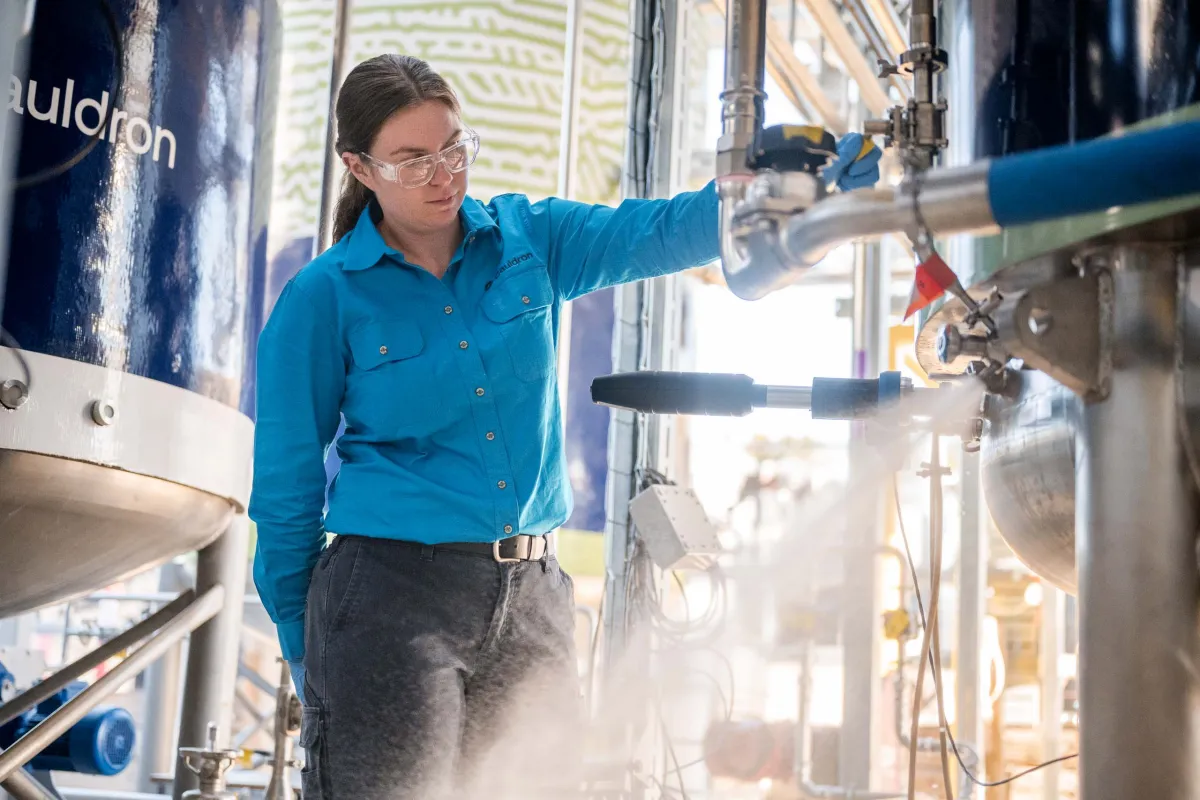

Revolutionizing Food Production: Cauldron Ferm Harnesses Decades-Old Tech to Feed a Hungry Planet
In a world grappling with climate change, population growth, and food insecurity, one startup is quietly rewriting the rules of food production. Cauldron Ferm, a biotech company with roots stretching back to the mid-20th century, is leveraging a groundbreaking fermentation technology to tackle one of humanity’s most pressing challenges: how to sustainably feed billions of people. With a recent $13.25 million Series A2 funding round, the company is poised to scale its innovative “hyper fermentation” process, promising to transform industries from agriculture to alternative proteins.
A Vision Decades in the Making
The origins of Cauldron Ferm trace back to David and Polly McLennan, a visionary couple who dreamed of revolutionizing food systems through microbiology. In the 1960s or 1970s—the exact timeline remains unclear—the McLennans began experimenting with fermentation processes to produce protein from microbes. Unlike traditional batch fermentation, which stops and starts like brewing beer or making wine, they envisioned a continuous process that could operate like a never-ending assembly line.
For decades, the McLennans refined their methods, operating as a small, fee-for-service business. Their work remained under the radar, but their persistence laid the foundation for what would later become Cauldron Ferm. Their dream was simple yet audacious: to make microbial fermentation scalable, cost-effective, and widely accessible for food production.
The Birth of a Biotech Startup
The turning point came in 2012 when Michele Stansfield, now CEO and co-founder of Cauldron Ferm, joined the McLennans’ company. Initially, she admits, she didn’t fully grasp the potential of their technology. “We didn’t know what we had,” Stansfield told TechCrunch in an exclusive interview. It wasn’t until she delved deeper into the challenges of continuous fermentation in synthetic biology that she realized the McLennans’ work was far ahead of its time.
Determined to unlock its potential, Stansfield transformed the company from a modest operation into a high-growth startup. In 2024, she raised an initial $6.5 million seed round, acquiring the intellectual property, physical assets, and business operations. This marked the official launch of Cauldron Ferm as a modern biotech enterprise.
Hyper Fermentation: A Game-Changer
At the heart of Cauldron Ferm’s innovation is its proprietary “hyper fermentation” technology. Unlike traditional batch fermentation, which requires frequent interruptions to harvest products, hyper fermentation keeps microbes in a maximally productive state, enabling continuous output. This process can be adapted to existing batch fermenters with minimal facility modifications, making it accessible to a wide range of industries.
Customers bring their own microbes and strains, and Cauldron Ferm optimizes their growing conditions—such as nutrient supply—to maintain peak efficiency. The result is a scalable, cost-effective solution for producing essential food ingredients like fats and proteins.
“Sixty percent of all inputs to the global economy can be produced from biology,” Stansfield explained. While the company initially focused on food—such as whey protein, which seamlessly integrates into supply chains—it is now diversifying into other sectors. The potential applications range from alternative proteins to biofuels, pharmaceuticals, and beyond.
Securing the Future
This month, Cauldron Ferm announced a $13.25 million Series A2 funding round, led by Main Sequence Ventures with participation from Horizons Ventures, NGS Super, and SOSV. This latest injection of capital brings the company’s total funding to nearly $20 million. According to Stansfield, the funds will be used to “increase the technology moat”—deepening the company’s competitive edge by further refining its processes and expanding its capabilities.
The timing couldn’t be better. As global demand for sustainable food sources grows, Cauldron Ferm’s technology offers a promising solution. The United Nations estimates that the world’s population will reach 9.7 billion by 2050, requiring a 50% increase in food production. Traditional agriculture, however, is already straining under environmental pressures, from deforestation to water scarcity. Microbial fermentation presents a sustainable alternative, requiring fewer resources and producing fewer greenhouse gases.
A Global Opportunity
Cauldron Ferm’s potential extends far beyond food. As Stansfield notes, biology-based production could revolutionize entire industries, offering eco-friendly alternatives to petrochemicals, plastics, and other resource-intensive materials. This aligns with broader trends in the biotech sector, which has seen explosive growth in recent years. From lab-grown meat to biodegradable plastics, companies are harnessing biology to address some of the world’s most urgent challenges.
Yet Cauldron Ferm’s journey also highlights the challenges of bringing groundbreaking technology to market. The company’s roots in the McLennans’ decades-long research underscore the importance of patience, persistence, and vision in driving innovation.
A Balancing Act
As Cauldron Ferm scales its operations, it faces the dual challenge of maintaining its technological edge while ensuring affordability. The cost of fermentation has long been a barrier to its widespread adoption, particularly in food production. Stansfield acknowledges this but remains optimistic. “We’ve come a long way from the days when fermentation was prohibitively expensive,” she said. “Our goal is to make it accessible to everyone.”
The company’s success will depend on its ability to balance innovation with practicality, scaling its technology without compromising its core mission. As Stansfield puts it, “Food was where we started, but now we’re starting to really diversify.”
Looking Ahead
Cauldron Ferm’s story is a testament to the power of perseverance and the potential of biotechnology to reshape the world. From its humble beginnings in a small-scale operation to its emergence as a leader in hyper fermentation, the company exemplifies how innovative thinking can turn decades-old ideas into transformative solutions.
As the global community grapples with the urgent need for sustainable food systems, Cauldron Ferm offers a glimmer of hope. Whether it can deliver on its ambitious promises remains to be seen, but one thing is clear: the future of food production is being rewritten, one microbe at a time.
Whether Cauldron Ferm’s technology becomes a cornerstone of the global food system or a niche solution, its journey reflects the broader quest for sustainability in an increasingly complex world. As Stansfield aptly notes, “The possibilities are endless—if we’re willing to think big.”
