


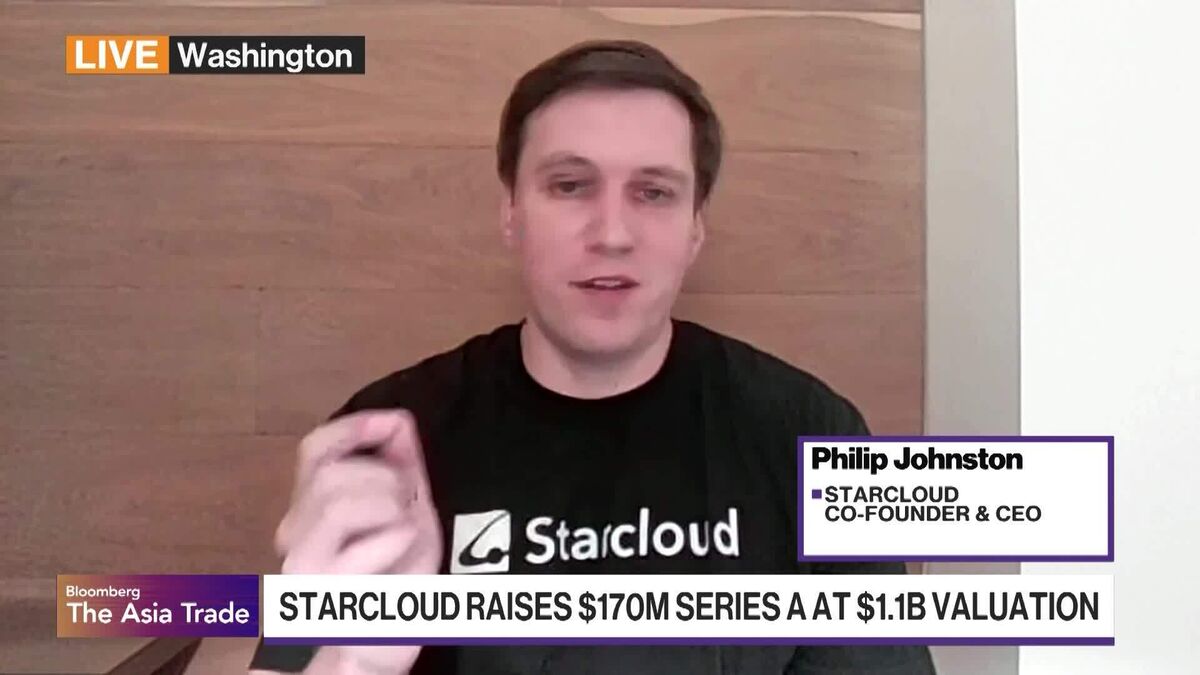

Space Infrastructure Startup Starcloud Secures $170M Series A Funding, Reaches $1.1B Valuation
Ambitious Startup Joins Space Tech’s Elite With Major Investment Boost
In a landmark deal for the commercial space industry, Starcloud, a next-generation space infrastructure startup, has raised $170 million in a Series A funding round, catapulting its valuation to an impressive $1.1 billion. The investment underscores growing confidence in private space ventures as demand for satellite-based services, deep-space exploration, and orbital logistics surges.
Led by undisclosed institutional investors, the funding round positions Starcloud among an elite group of space-tech unicorns. The company’s co-founder and CEO, Philip Johnston, revealed in an exclusive interview with Bloomberg: The Asia Trade that the capital will accelerate satellite deployment, expand R&D, and forge strategic partnerships to solidify its position in the rapidly evolving space economy.
The Rise of Starcloud: A Disruptor in Space Infrastructure
Founded in 2020, Starcloud has rapidly emerged as a key player in the burgeoning space infrastructure sector, specializing in modular satellite systems, in-orbit servicing, and next-gen communications networks. Unlike traditional aerospace firms, the company leverages AI-driven automation and cost-efficient manufacturing to deliver scalable solutions for both government and commercial clients.
The $170 million injection follows a year of significant milestones, including successful test launches and early contracts with telecom providers seeking to enhance global connectivity. Industry analysts note that Starcloud’s agile approach—combining cutting-edge software with lightweight hardware—has allowed it to outpace legacy competitors in speed and affordability.
Strategic Vision: Where Will the Funding Go?
In his discussion with Bloomberg’s Shery Ahn and Haidi Stroud Watts, Johnston outlined a clear roadmap for deploying the fresh capital:
- Satellite Constellation Expansion – Starcloud plans to double its low-Earth orbit (LEO) satellite fleet by 2025, bolstering global broadband coverage and IoT connectivity.
- R&D Breakthroughs – A significant portion will fund advancements in propulsion systems and AI-powered orbital maintenance, reducing space debris risks.
- Global Partnerships – The startup is eyeing collaborations with Asian and European space agencies to co-develop next-gen launch vehicles.
- Talent Acquisition – With a hiring spree underway, Starcloud aims to attract top aerospace engineers and data scientists to maintain its innovation edge.
“This funding isn’t just about scaling—it’s about redefining how humanity interacts with space,” Johnston emphasized. “We’re building infrastructure that makes space more accessible, sustainable, and economically viable.”
The Bigger Picture: Private Space Tech’s Explosive Growth
Starcloud’s funding milestone reflects a broader trend in the space sector, where private investment has surged past $10 billion annually. Companies like SpaceX, Relativity Space, and Astra have demonstrated that venture-backed firms can compete with—and sometimes outperform—government-led programs.
Experts attribute this shift to several factors:
- Declining Launch Costs – Reusable rockets and miniaturized satellites have slashed entry barriers.
- Commercial Demand – Telecom, Earth observation, and defense sectors are driving unprecedented demand for space-based solutions.
- Government Support – NASA’s Commercial Lunar Payload Services (CLPS) and ESA partnerships have opened doors for private players.
However, challenges remain, including regulatory hurdles, space traffic management, and the long-term sustainability of orbital environments. Starcloud’s focus on debris mitigation and AI-driven navigation could set new industry standards.
What’s Next for Starcloud?
With unicorn status secured, Starcloud now faces heightened expectations. Analysts will closely monitor its ability to execute its ambitious plans while navigating supply chain constraints and geopolitical tensions affecting space collaborations.
Johnston remains optimistic, hinting at upcoming high-profile contracts and potential IPO plans. “We’re just getting started,” he said. “The next decade will prove that space isn’t just for governments—it’s for innovators.”
As the final frontier becomes increasingly crowded, Starcloud’s journey may well determine whether private enterprise can sustainably unlock the cosmos—or if the industry’s rapid ascent will face gravitational pullbacks.
