


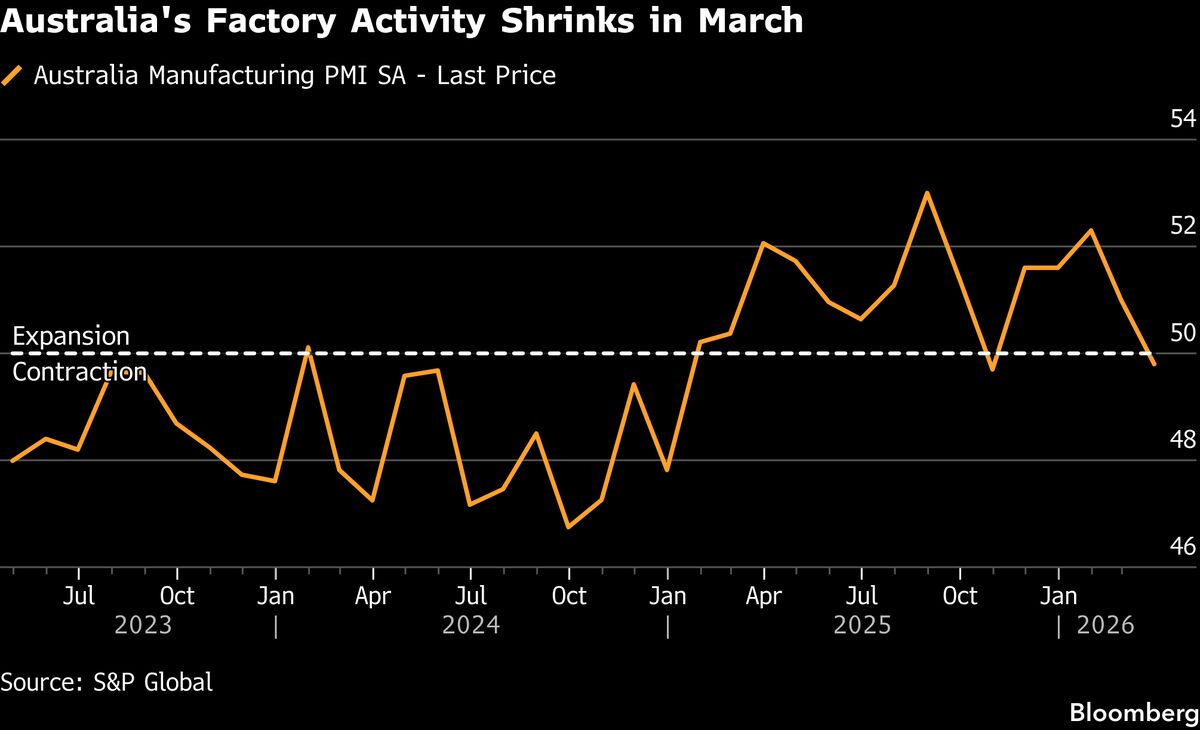

Australia’s Manufacturing Sector Contracts for First Time in Five Months Amid Weakening Demand and Rising Costs
Australia’s manufacturing sector has entered its first period of contraction in five months, as weakened demand and escalating cost pressures weigh heavily on the industry. The downturn, which follows months of modest growth, highlights the growing challenges facing businesses amid global economic uncertainty and geopolitical tensions, particularly the ongoing conflict in the Middle East.
The latest Purchasing Managers’ Index (PMI) data, released by the Australian Industry Group (Ai Group), indicates that the sector fell below the critical 50-point threshold in March, signalling contraction. The index dropped to 49.1, down from 52.5 in February, marking the first decline since October 2023. Analysts attribute the downturn to a combination of factors, including softer consumer demand, rising input costs, and supply chain disruptions exacerbated by international conflicts.
Global Geopolitical Tensions Amplify Economic Pressures
The escalating conflict in the Middle East has emerged as a significant driver of instability in global markets, directly impacting Australia’s manufacturing sector. Rising oil prices, driven by tensions in the region, have pushed up energy and transportation costs, squeezing profit margins for manufacturers. Additionally, disruptions to shipping routes and delays in raw material deliveries have further strained operations.
“The Middle East conflict has introduced a new layer of uncertainty into an already fragile global economy,” said Dr. Sarah Mitchell, an economist at the University of Sydney. “For Australia, this has translated into higher input costs and reduced export opportunities, particularly in industries reliant on global supply chains.”
The war’s ripple effects are not confined to Australia; manufacturing sectors across Europe and Asia have also reported slowdowns in recent months. However, Australia’s reliance on imported raw materials and its export-oriented manufacturing base make it particularly vulnerable to external shocks.
Domestic Challenges Compound Industry Woes
While global factors play a significant role, domestic challenges have also contributed to the sector’s contraction. Inflationary pressures, driven by rising wages and energy costs, have dampened consumer spending, leading to weaker demand for manufactured goods. The Reserve Bank of Australia’s (RBA) decision to maintain higher interest rates to combat inflation has further constrained household budgets, reducing discretionary spending.
“We’re seeing a perfect storm of external and internal factors,” said James Carter, CEO of the Australian Manufacturing Chamber. “Higher interest rates are squeezing consumers, while businesses are grappling with rising costs and tighter margins. It’s a challenging environment for manufacturers to navigate.”
The construction and automotive industries, key components of Australia’s manufacturing sector, have been particularly hard hit. Declining property market activity has reduced demand for building materials, while slower car sales have impacted automotive production.
Government and Industry Seek Solutions Amid Uncertainty
In response to the sector’s challenges, industry leaders are calling for targeted government intervention to support manufacturers. Measures under consideration include subsidies for energy-intensive industries, investment in workforce training, and incentives for innovation and automation.
“The government needs to take proactive steps to bolster the industry,” said Carter. “This includes reducing regulatory burdens, providing access to affordable energy, and fostering collaboration between businesses and research institutions.”
The Australian government has acknowledged the sector’s struggles but has yet to announce concrete measures. In a recent statement, Treasurer Jim Chalmers emphasized the need for a balanced approach, combining short-term relief with long-term structural reforms.
“We recognize the pressures facing Australian manufacturers and are committed to supporting the sector,” Chalmers said. “However, we must also ensure that any interventions are sustainable and aligned with our broader economic goals.”
Broader Economic Implications
The contraction of Australia’s manufacturing sector is a concerning development for the nation’s economy, which has already been grappling with sluggish growth and high inflation. Manufacturing accounts for approximately 6% of Australia’s GDP and employs over 900,000 people, making it a critical component of the country’s economic landscape.
Economists warn that a prolonged downturn in manufacturing could have broader implications, including reduced investment, job losses, and slower economic recovery. “Manufacturing is a bellwether for the overall economy,” said Mitchell. “A weak manufacturing sector often foreshadows wider economic challenges.”
Despite the current challenges, some analysts remain cautiously optimistic about the sector’s resilience. They point to Australia’s strong agricultural and mining sectors, which continue to perform well, as potential drivers of recovery. Additionally, the growing demand for renewable energy technologies presents opportunities for manufacturers to pivot towards new markets.
Looking Ahead: Navigating Uncertainty
As Australia’s manufacturing sector navigates this period of uncertainty, stakeholders are closely monitoring global developments and domestic economic indicators. The resolution of geopolitical tensions, stabilization of energy prices, and potential policy interventions could provide much-needed relief for the industry.
However, in the absence of immediate solutions, manufacturers are urged to focus on efficiency, innovation, and diversification to weather the storm. “This is a time for businesses to rethink their strategies and explore new opportunities,” said Carter. “Those that adapt will be better positioned to thrive in the long term.”
The coming months will be critical for Australia’s manufacturing sector as it seeks to overcome current challenges and regain momentum. While the road ahead is fraught with uncertainty, the industry’s resilience and adaptability offer hope for a brighter future.
As the global economy continues to grapple with volatility, Australia’s manufacturing sector serves as a reminder of the interconnectedness of markets and the far-reaching impact of geopolitical events. Whether the sector can rebound swiftly or faces an extended slump remains to be seen, but one thing is clear: the stakes are high for businesses, workers, and the broader economy.
In the words of Dr. Mitchell, “The path to recovery will require a combination of global stability, supportive policies, and innovative thinking from Australian manufacturers.” For now, the sector remains in a holding pattern, awaiting clearer skies ahead.
