


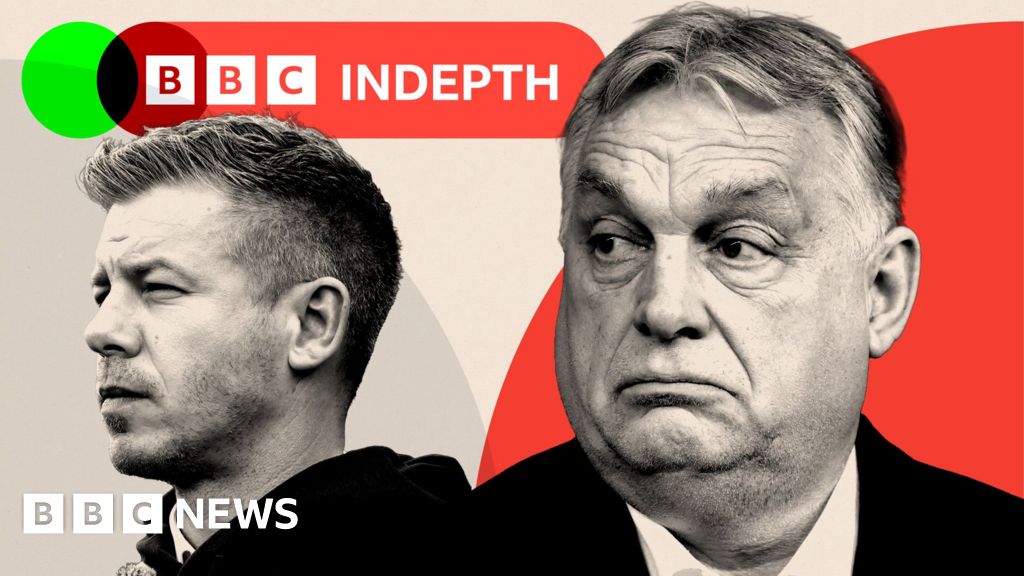

Hungary’s Political Landscape Shifts as New Challenger Emerges to Challenge Orbán
Budapest, Hungary — In the heart of Central Europe, Hungary stands at a crossroads. The once-unassailable reign of Prime Minister Viktor Orbán, Europe’s longest-serving leader, is facing an unexpected challenge. Enter Péter Magyar, a Budapest-born lawyer turned political maverick, whose unrelenting focus on domestic issues and tireless campaigning in rural areas has galvanized a nation weary of Orbán’s polarizing rhetoric. Magyar’s rise comes at a critical juncture for Hungary, a country deeply divided between urban progressives and conservative rural voters. As global tensions escalate and Europe grapples with war, migration, and economic instability, Hungary’s political trajectory could have far-reaching implications for the region and beyond.
A New Face in Hungary’s Political Arena
Péter Magyar, a sharp-dressed, articulate former lawyer, was once dismissed by critics as too urbane and polished to resonate with Hungary’s rural heartland. Orbán, by contrast, has long cultivated the image of a “village boy” who speaks the language of the countryside. Yet Magyar has defied expectations, crisscrossing Hungary’s rural areas for the past two years in a bid to bridge the urban-rural divide. His message—centered on healthcare, education, transport, and the urgent issue of rural depopulation—has struck a chord with voters disillusioned by Orbán’s fixation on global politics and cultural wars.
Magyar’s campaign strategy is a stark departure from Orbán’s playbook. While the prime minister often invokes themes of sovereignty, nationalism, and anti-globalism, Magyar has opted for a pragmatic, domestic-first approach. This shift in focus has drawn large crowds to his rallies, signaling a growing appetite for change in a country where Orbán’s Fidesz party has dominated for over a decade.
Global Context: Hungary’s Role in a Turbulent Europe
Hungary’s political upheaval unfolds against a backdrop of global uncertainty. Since Russia’s invasion of Ukraine in 2022, Europe has been grappling with the consequences of war, energy shortages, and economic instability. Orbán’s close ties with Russian President Vladimir Putin and his reluctance to support Ukraine have drawn criticism from EU leaders, further isolating Hungary on the international stage.
Magyar’s emergence as a credible challenger could recalibrate Hungary’s position within the European Union. His focus on domestic issues suggests a potential shift away from Orbán’s confrontational stance toward Brussels. For a bloc already strained by rising populism and economic disparities, a more cooperative Hungary could help stabilize the region.
Moreover, Hungary’s political transformation comes at a time when authoritarian leaders worldwide are facing unprecedented challenges. From Brazil to Turkey, voters are increasingly pushing back against entrenched regimes that prioritize power over progress. Magyar’s campaign, with its grassroots momentum and emphasis on accountability, mirrors this global trend.
Why It Matters: The Stakes for Hungary and Beyond
The political battle between Magyar and Orbán is more than just a domestic contest; it is a litmus test for democracy in Central Europe. Orbán’s Hungary has been criticized for eroding democratic institutions, stifling press freedom, and consolidating power through constitutional changes and gerrymandering. A victory for Magyar could signal a resurgence of democratic values in a country that has long been a poster child for autocratic governance.
For the European Union, a shift in Hungary’s political direction could bolster efforts to maintain unity amid external threats. Orbán’s alignment with Putin and his resistance to EU sanctions on Russia have strained relations with Brussels. Magyar’s potential leadership could pave the way for a renewed partnership between Hungary and the EU, strengthening the bloc’s resolve in confronting global challenges.
On a broader scale, Hungary’s political evolution underscores the enduring power of grassroots movements. In an era dominated by populist leaders who thrive on division, Magyar’s ability to connect with rural voters offers a blueprint for political renewal. His success—or failure—could inspire similar movements in countries grappling with the rise of authoritarianism.
The Road Ahead: A Nation Divided, Yet Hopeful
As Hungary heads toward its next election, the stakes could not be higher. Orbán, a seasoned politician with a formidable electoral machine, remains a formidable opponent. Yet Magyar’s relentless campaigning and focus on tangible issues have injected a sense of hope into a political landscape long defined by cynicism and polarization.
For Hungary’s rural communities, Magyar represents a chance to be heard after years of feeling marginalized. For urban progressives, he embodies the possibility of a more inclusive and accountable government. And for the world, Hungary’s political transformation offers a glimpse into the future of democracy in an increasingly fractured global order.
Closing Thoughts
Péter Magyar’s rise is a testament to the enduring power of resilience and determination. In a country long dominated by one man’s vision, he has dared to imagine a different future—one rooted in unity rather than division. As Hungary stands on the brink of change, the world watches closely. The outcome of this political contest will not only shape the fate of a nation but also send a powerful message about the resilience of democracy in an uncertain world. In the end, Hungary’s story is a reminder that even in the face of seemingly insurmountable odds, hope—and the will to fight for it—can prevail.
