


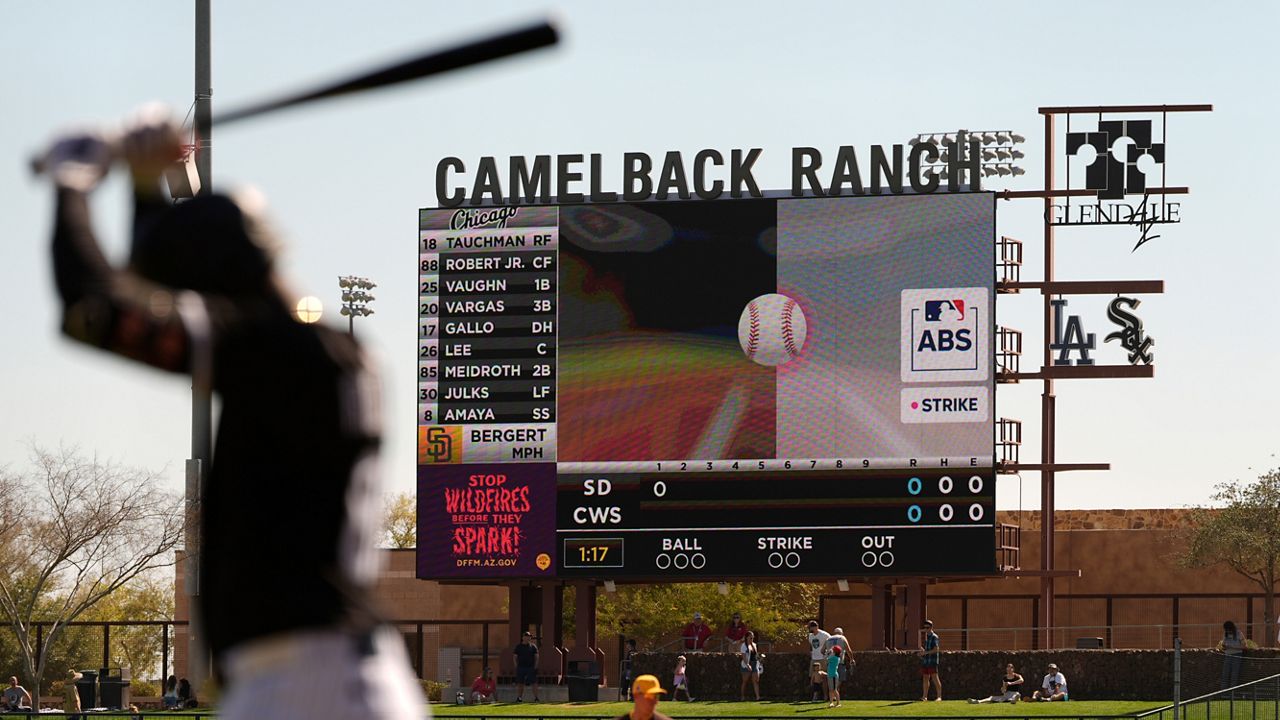

MLB’s New Automated Ball-Strike System Sparks Debate After Opening Day Drama
CINCINNATI — Major League Baseball’s introduction of the Automated Ball-Strike System (ABS) has already made waves, reshaping pivotal moments in games and leaving players and managers grappling with its implications. The technology, which uses Hawk-Eye cameras to track pitches with pinpoint accuracy, was put to the test during Opening Day, sparking both praise and frustration across the league.
The Cincinnati Reds’ 3-0 loss to the Boston Red Sox on March 28 showcased the system’s potential to dramatically alter outcomes. Two critical calls were overturned in the game, swinging momentum at crucial junctures. In the fourth inning, Eugenio Suárez’s full-count walk was reversed to a strikeout after an ABS challenge. Later, in the ninth inning, Reds pitcher Connor Phillips’ strikeout of Boston’s Roman Anthony was overturned to a walk, opening the door for the Red Sox to score two runs and seal their victory.
Reds manager Terry Francona acknowledged the challenges posed by the new system. “Our pitchers are going to have to get used to thinking an inning might be over, and then it’s not,” he said. “It’s like telling a guy, ‘Hey, great job, but can you get one more?’ You have to stay dialed in.”
Across the league, teams successfully challenged calls 61.3% of the time on Opening Day, going 19-for-31 in the first 12 games of the season. The ABS system, which measures pitches within one-sixth of an inch, has already proven its precision. However, its introduction has forced players and managers to rethink their strategies.
Red Sox manager Alex Cora praised the system despite its unpredictability. Boston went 2-for-3 on challenges, though Cora admitted he wished his designated hitter, Trevor Story, had contested a questionable called strike in the fifth inning. “We thought the pitch was up,” Cora said. “It changes the whole game. It’s a different ballgame now.”
One of the most impactful plays came in the bottom of the fifth inning when Red Sox catcher Carlos Narváez successfully challenged a ball call against Reds batter Eugenio Suárez. Instead of a walk, Suárez was called out on strikes, ending the inning. “He made a really good pitch there,” Suárez admitted. “I thought it was a ball, but with the new ABS, good for him.”
Meanwhile, Pittsburgh Pirates shortstop Oneil Cruz became the first player to have a ball-four call overturned to strike three during a game against the New York Mets. Mets catcher Francisco Alvarez’s challenge revealed that the pitch had caught the inside corner, reversing the call.
The Minnesota Twins and Chicago White Sox emerged as the most successful teams on Opening Day, both going 3-for-4 on challenges. Tampa Bay also had a perfect 2-for-2 record. However, not every challenge paid off. Philadelphia Phillies reliever Zach Pop’s eighth-inning challenge failed when a ball-four call was upheld, allowing Texas Rangers’ Brandon Nimmo to walk. Phillies manager Rob Thomson shrugged it off, saying, “It was a tenth of an inch off. Late in the game, you want to use that challenge.”
Players and managers alike recognize the ABS system as a game-changer, but its implementation has sparked debates about its impact on the sport. While it eliminates human error, it also introduces a new layer of strategy and unpredictability. As the season progresses, teams will need to adapt quickly to harness its potential while minimizing its pitfalls.
Roman Anthony, whose overturned strikeout led to Boston’s winning runs, summed it up best: “I knew it was a ball; I was pretty confident. It turned the game around. I trust my instincts and discipline at the plate.”
As MLB navigates this technological shift, fans can expect more moments of drama, controversy, and excitement as players and managers learn to play by the new rules.
— Reported by Nexio News
