


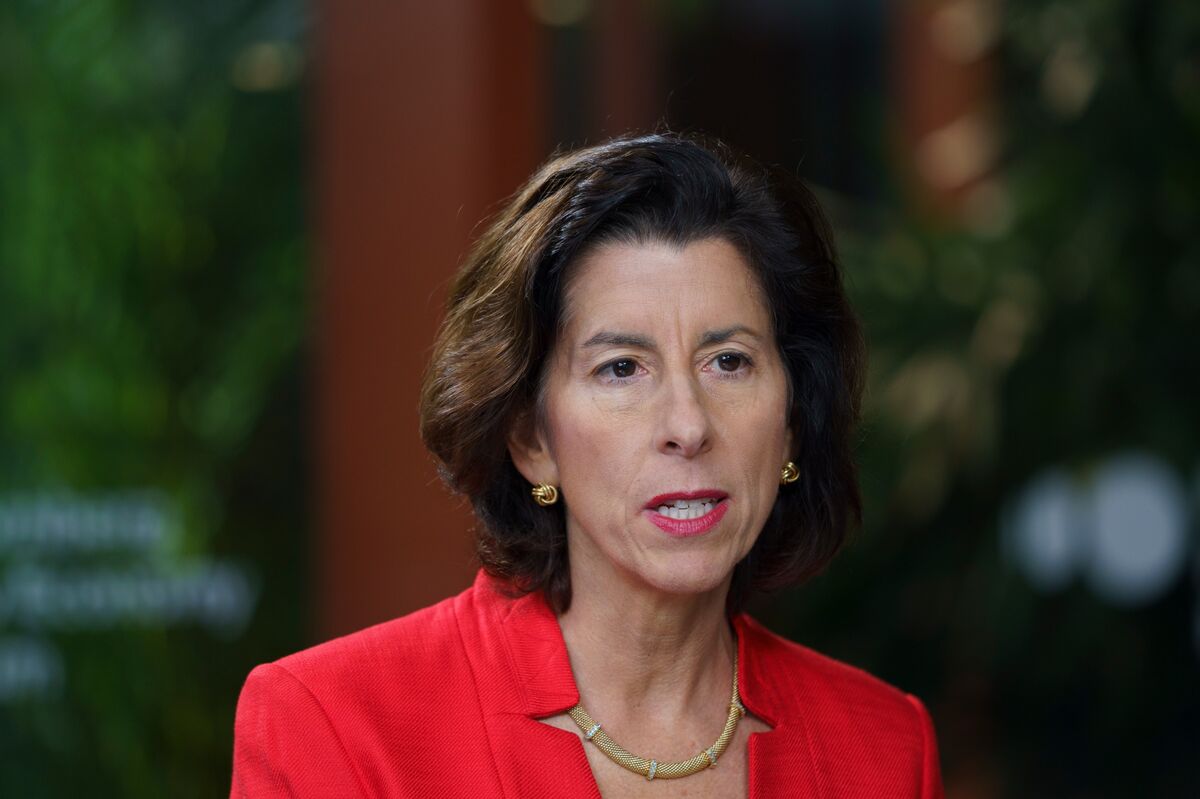

Former U.S. Commerce Secretary Delivers Keynote on Global Trade Challenges at CFR Event
New York, NY – In a high-profile address at the Council on Foreign Relations (CFR), former U.S. Commerce Secretary Gina Raimondo outlined the urgent challenges facing global trade, emphasizing the need for strategic alliances, technological resilience, and economic diplomacy in an era of escalating geopolitical tensions. The event, attended by policymakers, business leaders, and foreign diplomats, highlighted the delicate balance between competition and cooperation in international commerce.
Raimondo, who served under the Biden administration from 2021 to 2023, leveraged her extensive experience in both government and the private sector to dissect the shifting dynamics of globalization. Her remarks come at a critical juncture, as nations grapple with supply chain disruptions, technological decoupling, and the economic ramifications of conflicts in Europe and Asia.
The Erosion of Global Trade Norms
The former secretary opened with a stark assessment of the current trade landscape, noting that the post-World War II economic order—once defined by multilateral cooperation—is under unprecedented strain. “The rules-based system that fueled decades of prosperity is being tested like never before,” she said. “From tariffs to export controls, nations are increasingly turning inward, and the cost of fragmentation is rising.”
Raimondo pointed to recent trade disputes between the U.S. and China, as well as the European Union’s push for greater industrial self-sufficiency, as evidence of a broader retreat from globalization. She warned that without careful management, these trends could lead to higher consumer prices, slower innovation, and diminished economic growth worldwide.
Technology as the New Battleground
A significant portion of Raimondo’s speech focused on the race for technological supremacy, particularly in semiconductors, artificial intelligence, and clean energy. She stressed that while competition is inevitable, outright decoupling would be disastrous.
“Semiconductors are the lifeblood of modern economies,” she noted. “But if we sever supply chains entirely, we risk creating a world where innovation stagnates and costs skyrocket.” Raimondo praised recent U.S. efforts, such as the CHIPS and Science Act, which aims to bolster domestic semiconductor production, but cautioned that no single country can dominate the entire tech ecosystem.
Her comments come amid escalating U.S.-China tensions over advanced chip exports, with Washington imposing strict controls on sales of cutting-edge technology to Beijing. Raimondo acknowledged the national security imperatives behind these measures but urged policymakers to avoid overreach. “We must protect our interests without isolating ourselves from the global talent and collaboration that drive progress.”
The Role of Economic Diplomacy
To counterbalance rising protectionism, Raimondo called for renewed emphasis on economic diplomacy, particularly through forums like the Indo-Pacific Economic Framework (IPEF) and the G7. She argued that trade agreements should evolve to address modern challenges, including labor standards, climate change, and digital governance.
“Trade deals can no longer just be about tariffs,” she said. “They must also ensure fair wages, sustainable practices, and secure data flows.” Raimondo cited the recent U.S.-EU Trade and Technology Council as a promising model, where allies collaborate on standards for emerging technologies while maintaining open markets.
Supply Chains: Resilience Over Efficiency
The COVID-19 pandemic exposed the fragility of hyper-efficient, just-in-time supply chains, leading to shortages of everything from medical supplies to automobiles. Raimondo argued that businesses and governments must now prioritize resilience—even if it means higher short-term costs.
“Efficiency was the mantra of the past,” she said. “Resilience must be the mantra of the future.” She advocated for diversified sourcing, strategic stockpiling, and closer public-private partnerships to mitigate future disruptions.
A Call for Pragmatism
While Raimondo’s speech underscored the complexities of today’s trade environment, she struck an optimistic note, emphasizing that strategic cooperation remains possible. “The world is not destined for division,” she concluded. “But we must act with urgency, foresight, and a commitment to shared prosperity.”
Her remarks resonated with many attendees, though some questioned whether geopolitical rivalries would allow for meaningful collaboration. As the global economy stands at a crossroads, Raimondo’s message serves as both a warning and a roadmap—one that balances competition with the necessity of engagement.
The full implications of her vision will depend on whether world leaders choose confrontation or cooperation in the years ahead.
