


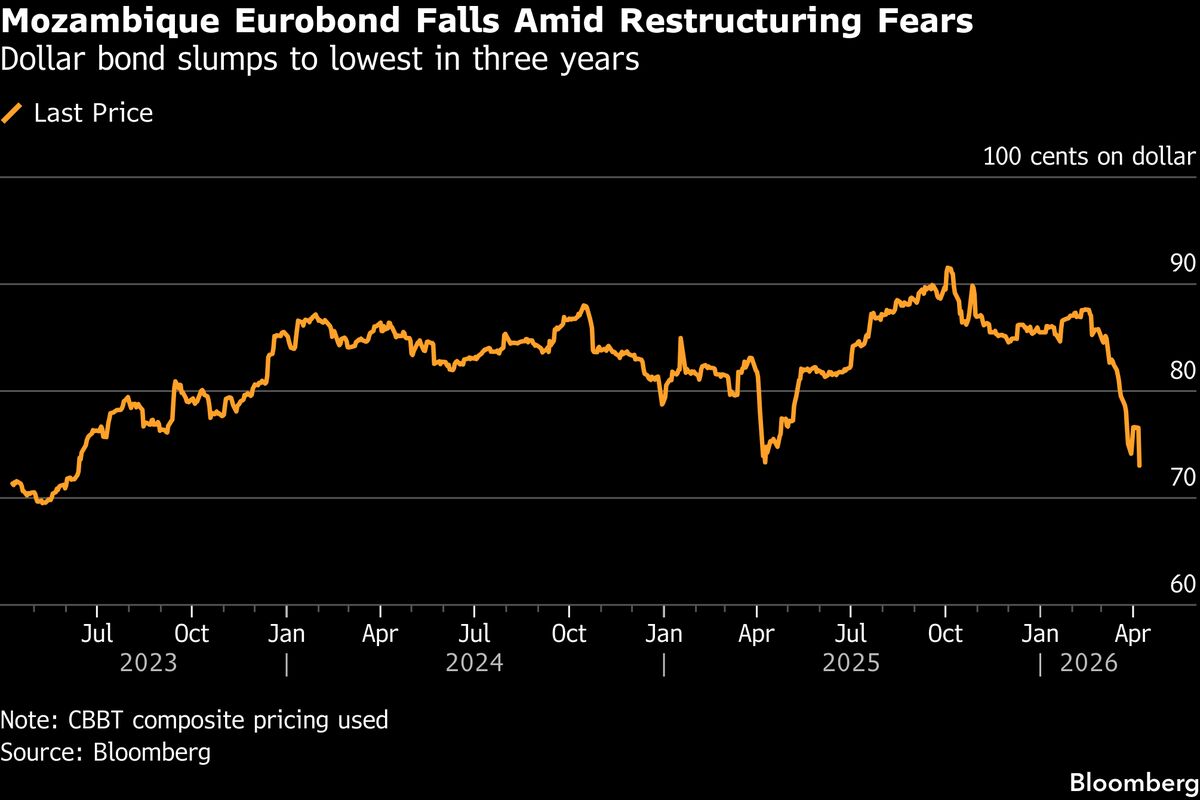

Mozambique Signals Debt Restructuring Plans, Sparking Market Concerns
Maputo, Mozambique — Mozambique’s sovereign dollar bonds plummeted to their lowest level in nearly three years this week, as the government announced its strongest indication yet of plans to enter into debt restructuring negotiations with creditors. The move has sparked widespread concern among investors and analysts, who fear the southern African nation may be preparing to default on its obligations amid ongoing economic challenges.
The sharp decline in bond prices reflects growing uncertainty over Mozambique’s financial stability, as the country grapples with the aftermath of a debt scandal, sluggish economic growth, and the lingering impacts of natural disasters and global economic headwinds. Analysts warn that the potential restructuring could further erode investor confidence in one of the world’s poorest nations, which has been struggling to regain its footing since a $2 billion “hidden debt” crisis in 2016 that plunged the country into financial turmoil.
A Troubled Economic Landscape
Mozambique’s financial woes date back to 2016, when it was revealed that the government had secretly borrowed $2 billion through state-owned companies to fund maritime projects, including a tuna fishing fleet and a coastal surveillance system. The loans, which were not disclosed to the International Monetary Fund (IMF) or other creditors, led to a suspension of donor aid and a collapse in investor confidence. The fallout triggered a currency crisis, soaring inflation, and a sharp economic downturn.
Although the country has since made efforts to stabilize its finances, including securing an IMF-backed program in 2022, progress has been slow. Economic growth remains subdued, hampered by frequent cyclones, high debt levels, and political instability in the resource-rich Cabo Delgado province, where a violent insurgency has disrupted vital gas projects. These challenges have compounded Mozambique’s fiscal pressures, leaving the government with limited room to maneuver.
The Debt Restructuring Signal
The latest development came as Mozambique’s Finance Ministry issued a statement acknowledging the need for “constructive dialogue” with creditors to address its debt sustainability issues. While the government stopped short of explicitly declaring a default, the language employed suggests that restructuring talks are imminent.
“We are committed to ensuring a sustainable debt trajectory that supports Mozambique’s long-term development goals,” the statement read. “To achieve this, we will engage proactively with our creditors to explore mutually beneficial solutions.”
Market reaction was swift and severe. Mozambique’s dollar-denominated bonds, which are widely held by international investors, saw their prices plummet by as much as 15%, reaching levels not seen since late 2020. Yields surged, reflecting heightened risk perceptions. Analysts interpreted the move as a clear indication that the government is preparing to seek debt relief, potentially through a formal restructuring process.
Investor Sentiment and Global Implications
The prospect of debt restructuring has reignited fears among investors, many of whom remain wary of Mozambique’s financial management following the 2016 scandal. Credit rating agencies have long flagged the country’s high debt burden and weak fiscal position as significant risks. In recent years, Mozambique’s external debt has ballooned to more than $14 billion, representing over 100% of its GDP, according to IMF estimates.
“The market reaction underscores the deep-seated concerns about Mozambique’s ability to service its debt,” said John Ashbourne, senior emerging markets economist at Capital Economics. “Creditors are clearly bracing for the possibility of losses.”
The situation also highlights broader challenges facing developing nations in the wake of the COVID-19 pandemic and rising global interest rates. Many low-income countries are grappling with unsustainable debt levels, exacerbated by sluggish growth and elevated borrowing costs. Mozambique’s potential restructuring could serve as a cautionary tale for other nations facing similar pressures.
Path Forward: Balancing Austerity and Growth
For Mozambique, the road ahead is fraught with difficult choices. The government must strike a delicate balance between addressing its debt obligations and maintaining fiscal stability while also fostering economic growth. Key to this effort will be the successful implementation of gas projects in Cabo Delgado, which have the potential to transform the country’s economy by generating billions in export revenues.
However, delays in these projects, coupled with ongoing security concerns, have cast doubt on their near-term viability. Meanwhile, the government’s fiscal consolidation measures, including subsidy cuts and tax hikes, have sparked public discontent, raising the risk of social unrest.
“Mozambique’s economic recovery hinges on its ability to unlock its vast natural resource potential while managing its debt burden,” said Robert Besseling, CEO of Pangea Risk, a consultancy specializing in African markets. “The government faces a tough task in restoring investor confidence without undermining its development goals.”
A Test of Credibility
The impending debt restructuring talks will also test Mozambique’s credibility on the global stage. In the wake of the 2016 scandal, the government has worked to rebuild trust with international partners, including the IMF and World Bank. A transparent and collaborative approach to debt negotiations will be critical to maintaining these relationships.
“Mozambique must demonstrate a commitment to fiscal discipline and accountability,” said Liesl Louw-Vaudran, a senior researcher at the Institute for Security Studies. “Failure to do so risks further alienating investors and donors at a time when the country can ill afford it.”
Conclusion
As Mozambique braces for what could be a contentious debt restructuring process, the stakes could not be higher. The government’s ability to navigate this challenge will have far-reaching implications for the country’s economic future and its standing in the global financial system. While the path ahead is uncertain, one thing is clear: Mozambique’s creditors, investors, and citizens alike will be watching closely as the government seeks to chart a course toward sustainable debt and inclusive growth.
In an era of mounting economic pressures for developing nations, Mozambique’s journey serves as a stark reminder of the delicate interplay between fiscal responsibility and development aspirations. How the country navigates this crisis will not only shape its own future but also offer lessons for others walking a similar tightrope.
