



Breakthrough Fusion Startup Inertia Enterprises Partners with Lawrence Livermore National Lab to Commercialize Laser-Based Reactor Technology
In a landmark move that could accelerate the race to harness fusion energy, California-based startup Inertia Enterprises has announced a trio of agreements with the Lawrence Livermore National Laboratory (LLNL) aimed at commercializing laser-driven fusion reactor technology. This collaboration, unveiled on Tuesday, positions Inertia as a frontrunner in the burgeoning fusion energy sector, leveraging the groundbreaking work of LLNL’s National Ignition Facility (NIF), which last year achieved a historic milestone by demonstrating that controlled fusion reactions could produce more energy than they consume to ignite.
The partnership marks a significant step forward in the decades-long quest to unlock fusion energy—a clean, abundant, and virtually limitless power source that could revolutionize global energy systems. With its recent $450 million Series A funding round, Inertia has emerged as one of the most well-capitalized players in the fusion industry. Now, its collaboration with LLNL, a federally funded research facility renowned for its pioneering fusion experiments, could give the startup a critical edge over competitors in the race to bring fusion power to market.
The Science Behind the Breakthrough
At the heart of the technology is inertial confinement fusion (ICF), a method distinct from the more commonly known magnetic confinement approach. While magnetic confinement relies on powerful magnetic fields to contain superheated plasma until atomic nuclei fuse, inertial confinement compresses a tiny fuel pellet using external forces—in this case, laser beams—to create the extreme conditions necessary for fusion.
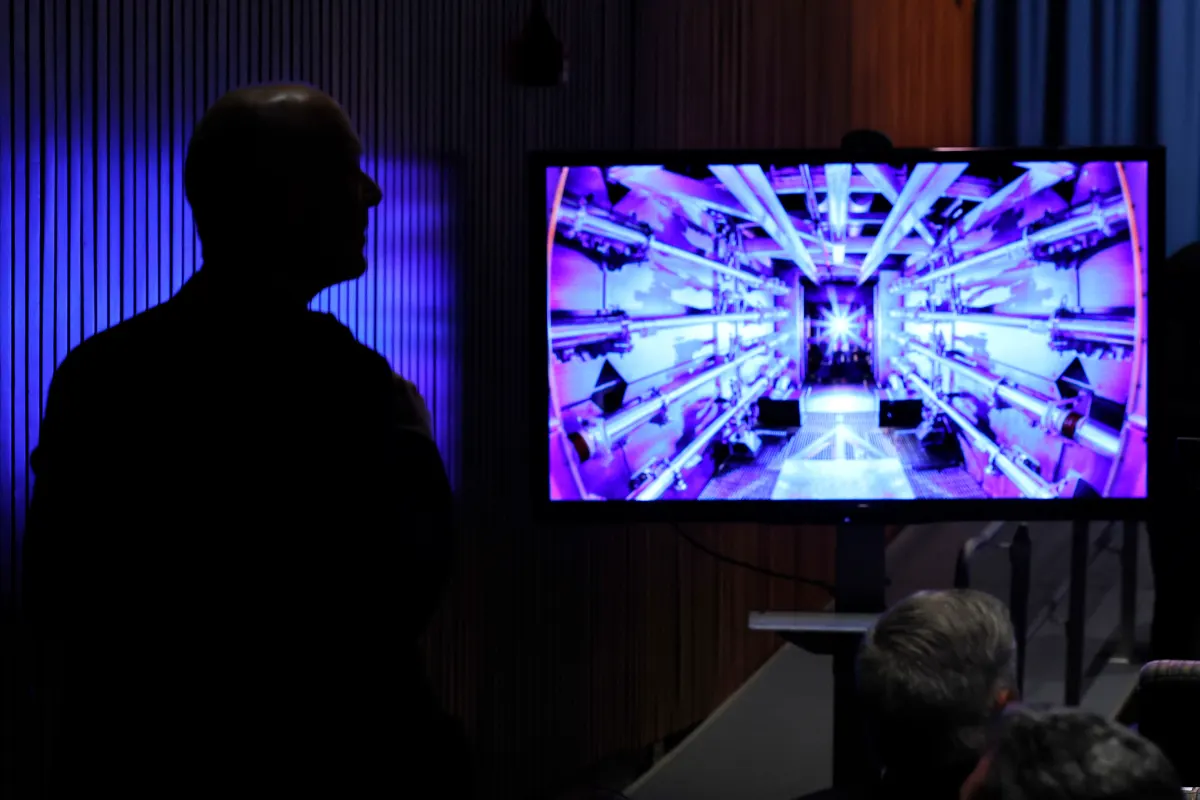
LLNL’s NIF facility, which began construction in 1997 and achieved scientific breakeven in 2022, exemplifies this approach. Its system employs 192 high-energy laser beams directed into a massive vacuum chamber, where they converge on a gold cylinder known as a hohlraum. Inside the hohlraum lies a diamond-coated fuel pellet about the size of a BB. When the lasers strike the hohlraum, it vaporizes, emitting X-rays that bombard the pellet. The diamond coating turns into plasma, expanding outward and compressing the deuterium-tritium fuel within. If scaled up, this process could theoretically produce enough energy to power homes, industries, and cities—without the greenhouse gas emissions associated with fossil fuels.
However, the challenges are immense. For fusion to become commercially viable, the process must occur multiple times per second, requiring significant advancements in laser efficiency and fuel pellet manufacturing. This is where Inertia’s collaboration with LLNL comes into play.
A Strategic Partnership
The three agreements between Inertia and LLNL encompass two strategic partnership projects and one cooperative research and development agreement. Together, the organizations aim to refine the laser-driven fusion process, focusing on developing more advanced lasers and optimizing fuel pellet designs. Additionally, Inertia has secured licensing rights to nearly 200 patents held by LLNL, providing the startup with exclusive access to critical intellectual property.
The collaboration builds on a shared history. Annie Kritcher, co-founder and chief scientist of Inertia, played a pivotal role in designing the NIF experiment that achieved scientific breakeven in 2022. Her dual role—as a scientist at LLNL and an entrepreneur at Inertia—was made possible by the 2022 CHIPS and Science Act, which facilitates public-private partnerships in advanced technologies. Kritcher’s expertise bridges the gap between LLNL’s experimental breakthroughs and Inertia’s commercialization efforts, making her a key figure in this venture.
The Fusion Race Heats Up
Inertia is not alone in its pursuit of laser-driven fusion. Other startups, including Xcimer Energy, Focused Energy, and First Light Fusion, are also racing to scale up the technology. What sets Inertia apart is its substantial funding, strategic partnership with LLNL, and access to cutting-edge research.
The broader fusion industry has seen a surge of interest and investment in recent years, driven by growing awareness of the climate crisis and the urgent need for clean energy solutions. Fusion power, if realized, could provide a sustainable alternative to fossil fuels, offering a nearly inexhaustible energy supply without the long-lived radioactive waste associated with nuclear fission.
Despite the excitement, significant hurdles remain. The NIF’s lasers, based on decades-old technology, are notoriously inefficient, consuming vast amounts of energy to achieve fusion. Inertia and its peers are banking on next-generation lasers to reduce energy input and improve the practicality of fusion reactors. Moreover, the cost and complexity of building commercial-scale power plants pose formidable challenges.
A Vision for the Future
For Inertia, the partnership with LLNL is more than just a scientific collaboration—it’s a stepping stone toward a future powered by fusion energy. By leveraging LLNL’s expertise and intellectual property, the startup aims to overcome technical barriers and bring laser-driven fusion reactors from the lab to the grid.
While the journey ahead is fraught with uncertainty, the potential rewards are immense. Fusion energy could transform the global energy landscape, offering a clean, safe, and virtually limitless power source. As Inertia CEO John Doe remarked, “This partnership represents a critical milestone in our mission to make fusion energy a reality. We’re not just building a reactor—we’re building a new energy future.”
The road to commercial fusion power remains long and arduous, but Inertia’s collaboration with LLNL signals a hopeful step forward. As the world watches, the fusion race continues—fueling dreams of a sustainable energy revolution.
Whether this partnership will lead to the breakthrough humanity has long awaited remains uncertain, but one thing is clear: the pursuit of fusion energy has never been more promising—or more urgent.
