


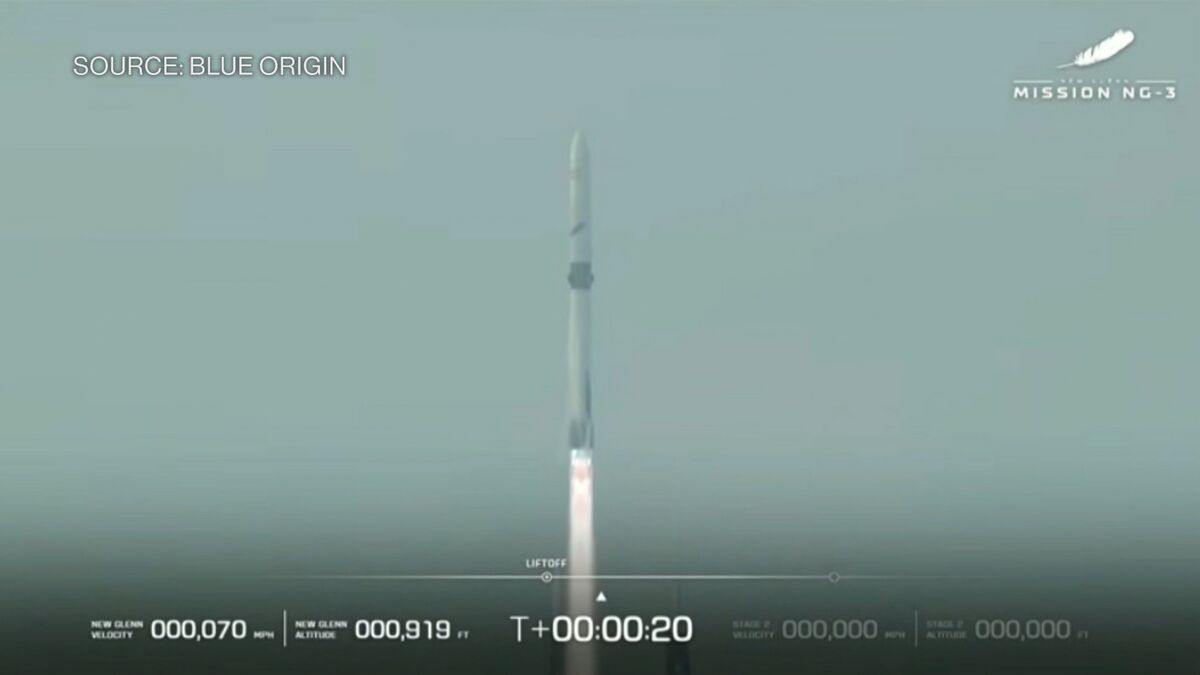

Blue Origin Achieves Major Milestone with Successful Booster Recovery of New Glenn Rocket
In a significant leap forward for the commercial space industry, Blue Origin, the aerospace company founded by Amazon billionaire Jeff Bezos, successfully reused and recovered the booster of its New Glenn rocket on Sunday. This achievement marks a critical milestone for the company, showcasing its growing technical prowess and positioning it as a formidable competitor in the increasingly crowded space race. The reusable booster technology, a cornerstone of modern rocket design, could dramatically enhance Blue Origin’s launch capabilities, reduce costs, and intensify its rivalry with SpaceX, the industry leader founded by Elon Musk.
The successful recovery of the New Glenn booster underscores Blue Origin’s commitment to sustainable space exploration, a goal that has become a defining feature of the new era of spaceflight. By mastering the reuse of rocket components, Blue Origin aims to replicate the success of SpaceX, which has revolutionized the industry with its reusable Falcon 9 rockets. This latest achievement could pave the way for more frequent and cost-effective launches, enabling Blue Origin to secure a larger share of the lucrative satellite and space exploration markets.
The Anatomy of the New Glenn Rocket
Named after John Glenn, the first American to orbit the Earth, the New Glenn rocket represents Blue Origin’s flagship launch vehicle. Designed to compete with SpaceX’s Falcon Heavy and NASA’s Space Launch System (SLS), New Glenn is a heavy-lift rocket capable of carrying payloads of up to 45 metric tons to low Earth orbit (LEO). Standing at 95 meters tall, it is powered by seven BE-4 engines, which utilize liquid oxygen and liquefied natural gas as propellants.
The booster’s reusability is a key feature of the New Glenn system, allowing the first stage to return to Earth and land vertically after separation. This process not only reduces the cost of manufacturing new rockets but also minimizes space debris, aligning with broader industry efforts to promote sustainability. Sunday’s successful recovery of the booster confirms that Blue Origin has mastered this complex engineering feat, bringing it closer to operational readiness.
A Step Toward Competitive Parity with SpaceX
Blue Origin’s achievement comes at a pivotal moment in the commercial space industry, where SpaceX has long dominated the reusable rocket market. Since its first successful landing of a Falcon 9 booster in 2015, SpaceX has conducted hundreds of re-flights, drastically cutting launch costs and setting a new standard for efficiency. Blue Origin’s progress with New Glenn suggests that the company is now poised to challenge SpaceX’s supremacy, particularly in the competitive arena of satellite launches and deep-space exploration.
The aerospace sector has witnessed a surge in demand for satellite deployment, driven by the proliferation of low Earth orbit constellations like SpaceX’s Starlink, Amazon’s Project Kuiper, and OneWeb. By demonstrating its ability to reuse boosters, Blue Origin positions itself as a viable alternative for commercial and government clients seeking reliable and cost-effective launch services.
Broader Implications for the Space Industry
The success of Blue Origin’s booster recovery has broader implications for the space industry, which is increasingly defined by innovation and competition. Reusable rocket technology is widely regarded as essential for the long-term sustainability of space exploration, as it reduces the environmental and financial costs associated with launches.
Blue Origin’s progress also highlights the growing role of private companies in advancing space technology. Once dominated by government agencies like NASA and ESA, the aerospace sector has undergone a dramatic transformation in recent decades, with private enterprises driving innovation and accelerating the pace of exploration. This shift has led to unprecedented collaboration between public and private entities, as well as increased investment in space-related ventures.
Challenges Ahead
While Blue Origin’s achievement is a significant step forward, the company still faces several challenges as it prepares for the operational deployment of New Glenn. The rocket’s maiden flight has been repeatedly delayed, with the first launch now expected in 2024. Ensuring the reliability and safety of the booster recovery system will be critical to winning the trust of customers, particularly in the highly competitive satellite launch market.
Moreover, Blue Origin must contend with the rapid advancements of its competitors. SpaceX continues to innovate with its Starship program, which aims to create a fully reusable super-heavy-lift rocket capable of missions to Mars and beyond. Meanwhile, other players like Rocket Lab and Astra are making strides in the small satellite launch sector, further intensifying competition.
A Vision for the Future
Jeff Bezos has long envisioned Blue Origin as a cornerstone of humanity’s future in space. The company’s motto, “Gradatim Ferociter” (Step by Step, Ferociously), reflects its commitment to steady progress and bold ambitions. The successful recovery of the New Glenn booster is a testament to this philosophy, demonstrating Blue Origin’s ability to innovate and compete on a global stage.
As Blue Origin prepares for its first New Glenn launch, the company’s progress will be closely watched by industry stakeholders and space enthusiasts alike. The successful reuse of rocket boosters represents not only a technical triumph but also a symbol of the transformative potential of private space exploration.
With this achievement, Blue Origin cements its place as a key player in the next chapter of humanity’s journey beyond Earth. While the road ahead is fraught with challenges, the company’s latest milestone offers a glimpse of a future where spaceflight is more accessible, sustainable, and collaborative than ever before.
As the competition heats up, one thing is certain: the race to the stars is no longer a solitary endeavor but a collective pursuit driven by visionary individuals and groundbreaking technology.
