


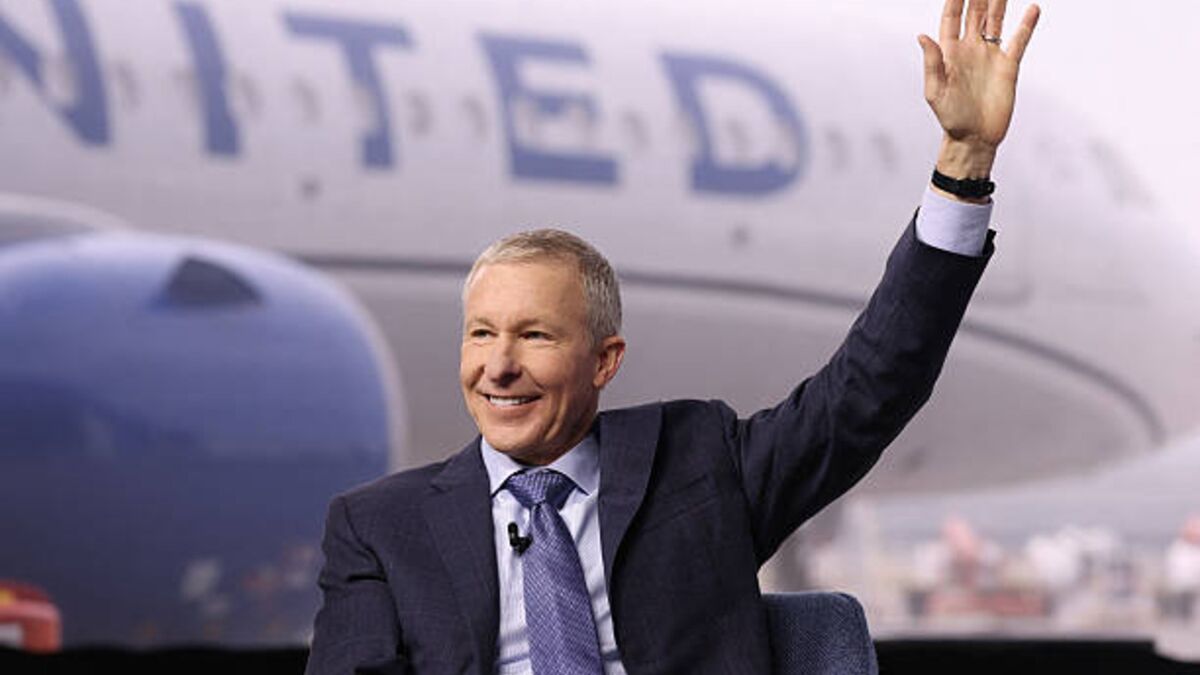

United Airlines CEO Scott Kirby Eyes Global Expansion Amid Industry Consolidation Speculation
Chicago, Illinois – In a statement that has sparked intrigue across the aviation industry, United Airlines CEO Scott Kirby refrained from commenting on whether the airline plans to acquire American Airlines but emphasized his commitment to reshaping United into a dominant global carrier. Speaking from the company’s headquarters in Chicago during an exclusive interview with Bloomberg’s Lisa Abramowicz, Kirby outlined his vision for creating a “great global airline that all U.S. citizens can be proud of,” while addressing the competitive challenges posed by foreign carriers.
Kirby’s remarks come at a pivotal moment for the airline industry, which is still navigating the aftermath of the COVID-19 pandemic, fluctuating fuel prices, and shifting consumer demands. Speculation about mergers and acquisitions has intensified as airlines seek to consolidate resources and expand their market share. While Kirby did not confirm any specific plans to acquire American Airlines, his comments have fueled debates about the future of U.S. aviation and the potential for further industry consolidation.
The Global Competitive Landscape
One of Kirby’s primary concerns is the dominance of foreign airlines in the international market. He argued that U.S. carriers face an uneven playing field, particularly in regions like Asia and the Middle East, where state-backed airlines benefit from significant government subsidies and favorable regulatory environments. “We’re up against airlines that have the full backing of their governments,” Kirby said. “Our focus is on leveling the playing field and ensuring that United Airlines can compete on a global scale.”
The CEO’s sentiments echo long-standing grievances within the U.S. aviation industry. For years, airlines like Emirates, Qatar Airways, and Singapore Airlines have leveraged their government support to offer premium services and expand their global footprints. This has put pressure on U.S. carriers to enhance their offerings and invest heavily in modernization to remain competitive. Kirby’s strategy appears to center on transforming United into a world-class airline capable of rivaling these international giants.
Investing in Innovation and Infrastructure
Under Kirby’s leadership, United Airlines has embarked on an ambitious journey of innovation and expansion. The airline has invested billions of dollars in upgrading its fleet, introducing next-generation aircraft like the Boeing 787 Dreamliner and Airbus A321neo. These planes are designed to improve fuel efficiency, reduce emissions, and enhance passenger comfort—a critical factor in attracting and retaining customers in an increasingly competitive market.
In addition to fleet modernization, United has prioritized enhancing its route network. The airline recently announced new direct flights to destinations in Asia, Europe, and South America, aiming to strengthen its position as a global connector. Kirby’s emphasis on global expansion underscores his belief that the future of aviation lies in international markets, as domestic travel plateaus in the post-pandemic era.
United has also been a pioneer in sustainable aviation initiatives, committing to achieving net-zero carbon emissions by 2050. The airline has invested in sustainable aviation fuel (SAF) and partnered with companies to develop innovative solutions for reducing its environmental footprint. Kirby’s focus on sustainability aligns with growing consumer demand for eco-friendly travel options and positions United as a leader in the industry’s green transition.
The Role of Mergers and Acquisitions
While Kirby remained tight-lipped about United’s potential acquisition of American Airlines, industry analysts speculate that consolidation could be on the horizon. The U.S. aviation market has seen significant mergers in the past, including the creation of United Continental Holdings in 2010 and the merger of American Airlines and US Airways in 2013. These deals have reshaped the competitive landscape, creating larger, more formidable players capable of competing on a global scale.
The prospect of further consolidation has raised questions about the impact on consumers, competition, and the industry as a whole. Critics argue that mergers can lead to reduced competition, higher ticket prices, and diminished service quality. Proponents, however, contend that consolidation enables airlines to achieve economies of scale, invest in innovation, and better compete with international rivals.
Kirby’s decision not to comment on a potential acquisition of American Airlines suggests that United’s current focus is on organic growth and strategic investments rather than large-scale mergers. However, his remarks have undoubtedly reignited discussions about the future of U.S. aviation and the potential for further consolidation.
The Broader Implications for U.S. Aviation
Kirby’s comments come at a time of significant transformation for the U.S. aviation industry. Airlines are grappling with labor shortages, rising operational costs, and the need to adapt to evolving consumer preferences. The pandemic accelerated trends such as digitalization, contactless travel, and personalized services, forcing airlines to rethink their strategies and invest in new technologies.
United’s focus on global expansion and innovation reflects broader industry trends, as airlines seek to recover from the pandemic’s impact and position themselves for long-term success. Kirby’s vision for United as a “great global airline” aligns with the company’s efforts to rebuild its brand and reputation, which took a hit during the early days of the pandemic when the airline faced criticism for its handling of refunds and customer service.
Looking Ahead
As United Airlines continues its transformation under Scott Kirby’s leadership, the airline faces both challenges and opportunities. The competitive pressures from foreign carriers, the need for sustainable innovation, and the potential for industry consolidation all present complex issues that will shape the future of U.S. aviation. Kirby’s emphasis on creating a world-class airline suggests that United is committed to rising to these challenges and securing its place as a global leader in the industry.
While speculation about United’s acquisition of American Airlines persists, Kirby’s refusal to comment leaves the question unanswered. What is clear, however, is that United Airlines is focused on building a stronger, more competitive airline capable of standing tall on the global stage. As the aviation industry continues to evolve, the world will be watching to see how United’s ambitious plans unfold.
In a rapidly changing industry, Scott Kirby’s leadership will undoubtedly play a pivotal role in shaping the future of United Airlines—and perhaps the broader aviation landscape.
