


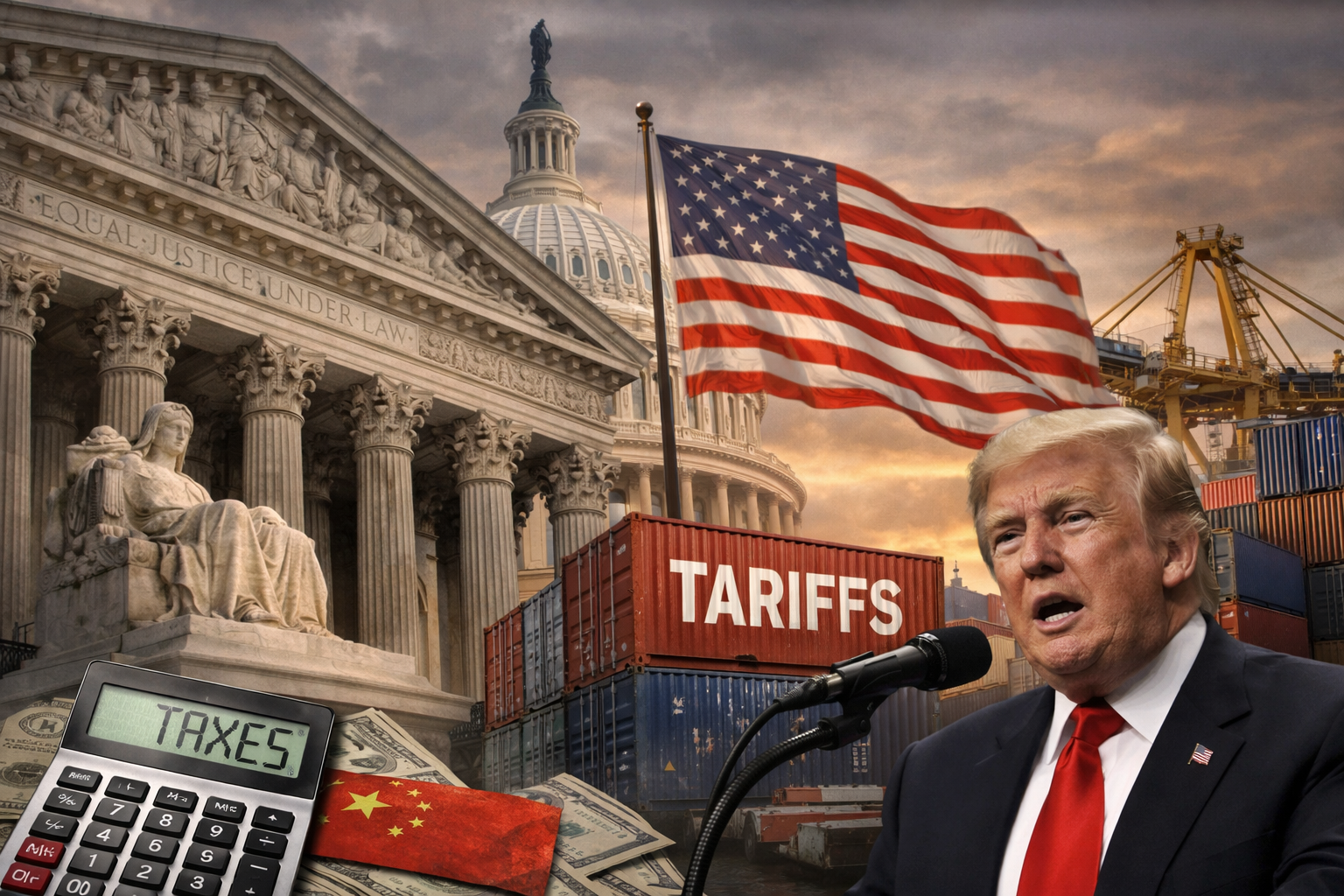

America’s Constitutional Temperature Rises as Tariffs, Courts, and Storms Converge
February 22, 2026
The United States moved through February 21 under the weight of a rapidly intensifying confrontation between executive authority and constitutional limits, a confrontation that unfolded not in abstract legal theory but in real time through decisions, reactions, and policy shifts with immediate economic consequences. The day’s events, dominated by the aftermath of a Supreme Court ruling on presidential tariff powers and the White House’s swift response, offered a revealing portrait of a nation navigating a volatile intersection of law, economics, and institutional power.
At the center of the national conversation stood the Supreme Court’s decision striking down the sweeping tariff regime imposed under emergency powers earlier in the administration. The ruling, reported across major outlets including Reuters and the Associated Press, reaffirmed long-standing constitutional doctrine that taxation authority rests with Congress and signaled renewed judicial skepticism toward expansive claims of executive emergency authority in economic policy. For legal scholars and policymakers alike, the significance of the decision extended beyond tariffs themselves, touching on the broader question of how far the presidency can go in using emergency statutes to reshape domestic economic policy without legislative consent.
President Donald Trump responded with characteristic speed and defiance. Within hours of the ruling, he rejected its conclusions publicly, declaring that the Court’s decision was “incorrect” and insisting that it would not halt his broader trade strategy. Speaking to reporters and later on social media, Trump emphasized that the administration possessed “very powerful alternatives,” signaling a determination to maintain tariff pressure through other statutory pathways. By the end of the day, the White House announced a revised tariff framework invoking Section 122 of the Trade Act of 1974, allowing the president to impose temporary import duties without immediate congressional approval. The new structure included baseline tariffs of approximately 10 percent, with provisions allowing increases up to 15 percent across a wide range of imports.
The speed of the pivot underscored the administration’s view that tariff policy remains a central tool of economic and geopolitical leverage. But it also deepened the constitutional tension that the Court’s ruling had brought into focus. Section 122 authority has rarely been used and never at the scale now proposed, and legal observers quickly noted that the new tariff regime could face additional judicial scrutiny. Reuters reporting emphasized that the provision allows such tariffs to remain in place for up to 150 days without congressional approval, a window that introduces both immediate economic impact and the prospect of further legal and political battles. For markets and trading partners, the message was clear: U.S. trade policy is entering a period of rapid adjustment and potential instability.
Economic analysts moved quickly to assess the consequences. The immediate question concerned not only the impact of the newly announced 10 to 15 percent tariffs on global supply chains and consumer prices, but also the status of revenues collected under the now-invalidated tariff regime. Estimates circulating among policy analysts suggested that tens of billions of dollars in tariff revenues could be subject to refund claims, raising complex administrative and fiscal questions. Reporting from the Associated Press highlighted the likelihood of a prolonged legal process as businesses seek reimbursement and federal agencies determine the mechanics of compliance. Reuters noted that more than a thousand lawsuits related to tariff collections are already in motion, indicating that the financial and legal aftermath of the Court’s decision will likely unfold over months rather than days.
Economists and policy commentators framed the moment as a test of both institutional resilience and economic credibility. Justin Wolfers of the University of Michigan, writing publicly on the issue, characterized tariffs bluntly as a tax borne largely by domestic consumers and businesses, a point that has long animated debate over protectionist trade policy. His comments reflected a broader consensus among many economists that rapid shifts in tariff policy can create uncertainty that weighs on investment and planning even when overall economic indicators remain stable.
The institutional dimension of the day’s developments proved equally striking. According to reporting from Reuters and other outlets, the president reacted sharply to the Court’s ruling, expressing frustration and signaling an intention to continue pursuing tariff authority through alternative legal frameworks. Such exchanges, while not unprecedented, highlighted the increasingly visible tension between branches of government as each seeks to assert its constitutional role. Legal scholars interviewed across multiple publications observed that the episode reflects a broader pattern in which executive initiatives test statutory and constitutional boundaries, courts respond with clarifying rulings, and administrations explore new pathways within or around those constraints.
This dynamic has become a defining feature of contemporary governance. Over the past decade, both Democratic and Republican administrations have relied heavily on executive actions and emergency authorities to advance policy agendas in the face of congressional gridlock. Courts, in turn, have become more willing to scrutinize those actions, particularly when they involve sweeping economic or regulatory consequences. February 21 offered a vivid example of this cycle in motion, with the tariff dispute serving as a focal point for debates about the proper balance of power in a constitutional system designed to diffuse authority.
While Washington grappled with these high-stakes questions, much of the country’s attention also turned toward a developing winter storm threatening the Northeast. Meteorological forecasts warned of heavy snowfall, strong winds, and potential coastal flooding across several major metropolitan areas, prompting state and local officials to issue advisories and begin emergency preparations. Governors and mayors across affected states coordinated with federal agencies to position resources and communicate safety measures, underscoring the constant interplay between national policy debates and the practical responsibilities of governance.
Severe weather events often reveal the operational capacity of government in ways that abstract policy disputes cannot. As transportation systems prepared for disruption and utility providers readied contingency plans, local and state authorities worked to ensure that emergency services and communication networks remained functional. Such efforts, while routine in many respects, highlight the importance of intergovernmental coordination and infrastructure resilience in maintaining public confidence during periods of both political and environmental stress.
The convergence of constitutional conflict, economic uncertainty, and domestic preparedness challenges contributed to a national mood characterized by vigilance and cautious anticipation. For many observers, the day’s events underscored how quickly institutional disputes can translate into tangible economic and social consequences. Tariff policies influence consumer prices and business decisions; court rulings shape the boundaries of executive action; and weather emergencies test the capacity of governments at every level to respond effectively to immediate threats.
Looking ahead, several questions will shape the national conversation in the days and weeks to come. Legal challenges to the newly announced tariff framework appear likely, raising the possibility of further judicial involvement in defining the limits of presidential trade authority. Congress may face renewed pressure to clarify statutory provisions governing tariffs and emergency economic powers, particularly if refund disputes and market volatility persist. At the same time, the practical effects of the winter storm will provide a near-term test of preparedness and coordination across multiple levels of government.
February 21 thus stands as more than a single day’s news cycle. It represents a moment in which constitutional interpretation, economic policy, and administrative governance intersected in ways that illuminate the evolving character of American democracy. The United States continues to operate within a system of checks and balances designed to accommodate disagreement and adaptation. Yet the speed and intensity of recent developments suggest that the boundaries of authority, and the methods by which policy is pursued, remain in active negotiation.
As the country moves forward, the interplay among executive ambition, judicial oversight, legislative authority, and public response will continue to shape the trajectory of national policy. In that sense, the events of February 21 offer not only a record of a single day’s tensions but also a window into the broader forces redefining governance in the United States.
