


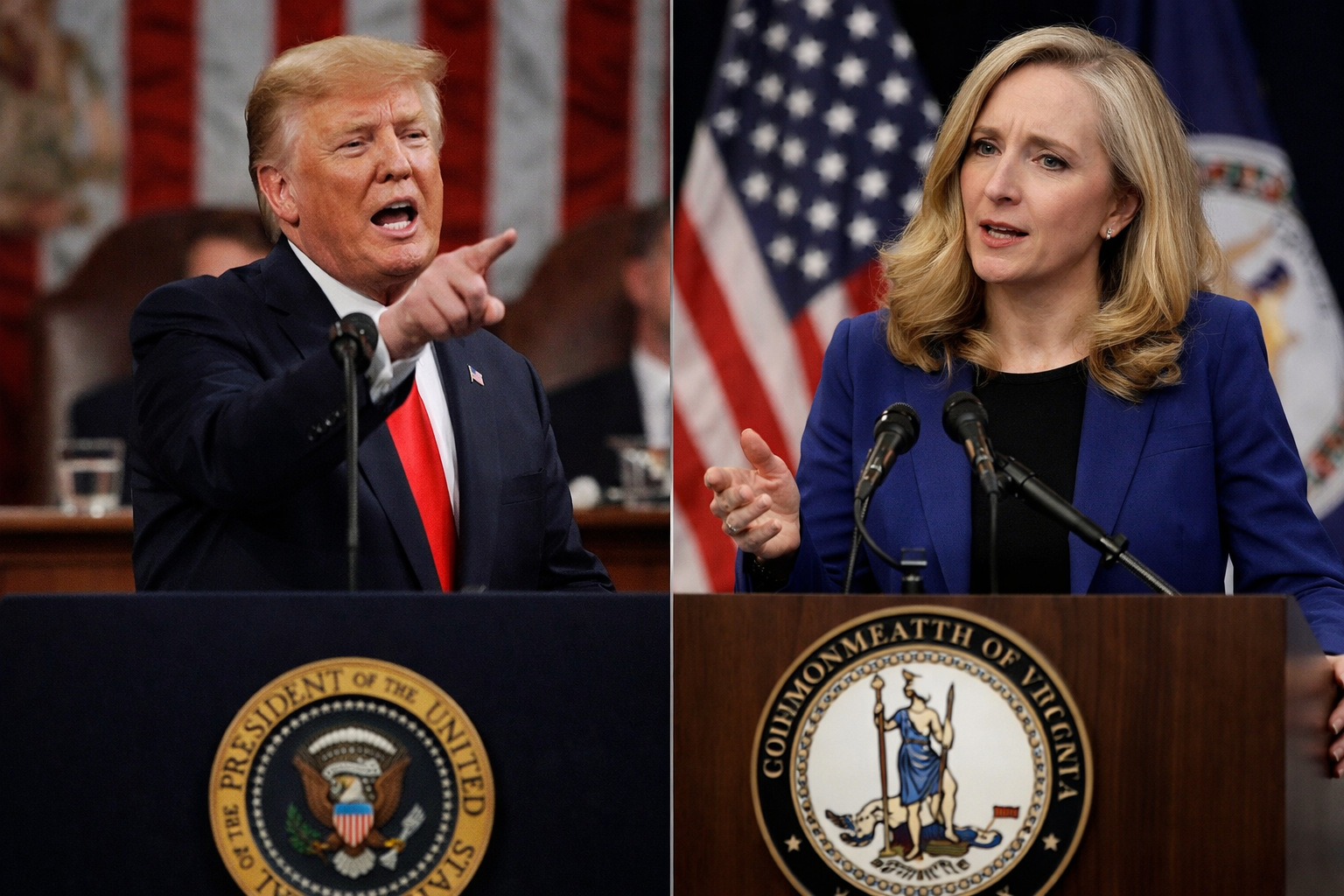

Trump and Virginia Governor Clash in State of the Union Faceoff Over Economy, Tariffs and Democracy
WASHINGTON — President Donald Trump delivered a sweeping and combative State of the Union address Tuesday night, presenting wh In her response to President Trump’s State of the Union address, Virginia Governor Abigail Spanberger articulated the Democratic perspective by questioning the administration’s assertions regarding economic prosperity and national cohesion. She emphasized the need for accountability in addressing rising costs and the implications of current tariffs on American families. Governor Spanberger’s rebuttal underscored her commitment to a balanced governmental approach that prioritizes unity and equitable growth for all citizens. As the nation reflects on these contrasting viewpoints, the dialogue surrounding the future of American policy remains crucial. at he described as a thriving economy and strong American resurgence, while Virginia Governor Abigail Spanberger offered a direct Democratic rebuttal challenging his claims on costs, tariffs, constitutional balance and national unity.
The address and response created a point-by-point political contrast between the administration’s vision and Democratic criticism of its policies and tone.
Trump opened by declaring that the United States is entering what he called a “golden age,” describing the country as stronger, safer and more prosperous than in previous years. He framed his presidency as restoring American confidence and global respect, pointing to what he characterized as renewed economic momentum and national pride.
Spanberger countered almost immediately in her response, arguing that while the president speaks of a golden age, many Americans are still struggling with the cost of living. She said families across the country continue to face high prices for housing, healthcare and everyday essentials, questioning whether the administration’s policies are truly improving life for working households.
Trump then turned to the economy, asserting that it is booming under his leadership. He cited lower gas prices, falling interest rates and strong stock market performance as proof that his economic agenda is working. He told lawmakers and viewers that America’s financial outlook is improving and that his administration has restored confidence in markets and industry.
Spanberger pushed back by saying economic statistics alone do not reflect everyday reality for many families. She argued that despite claims of improvement, Americans are still dealing with high costs and financial pressure. She framed the core question as whether people can actually afford to live comfortably, insisting that many cannot.
On retirement savings, Trump proposed a new initiative to support workers without employer-sponsored retirement plans. He floated the idea of government-matched contributions of up to $1,000 to help individuals build savings, presenting the plan as part of a broader effort to strengthen financial security for the middle class.
Spanberger responded by emphasizing that Americans need more immediate relief from rising expenses rather than long-term proposals that lack detailed funding plans. She said policies must address current affordability challenges rather than rely on broad promises.
Trump then shifted to tariffs, one of the most contentious elements of his speech. Following a recent Supreme Court ruling that blocked certain tariffs imposed under emergency powers, he defended his trade strategy and insisted tariffs remain essential to protecting American industries. He argued that tariffs generate revenue and provide leverage over foreign governments and companies.
Spanberger answered with a direct critique of the tariff policy’s impact on American households. She said tariffs function as hidden taxes that raise the cost of goods and cited estimates suggesting they have added significant expenses for families. She also argued that small businesses and farmers have suffered from retaliatory trade measures and market disruptions.
Trump went further, reviving his long-standing argument that tariffs could eventually replace income taxes as a primary source of federal revenue. He framed tariffs as a tool that shifts the burden from American taxpayers to foreign producers and trading partners.
Spanberger rejected that claim, saying tariffs ultimately fall on American consumers through higher prices. She warned that portraying tariffs as a replacement for income taxes ignores how the global supply chain works and risks misleading the public about who actually pays.
The president also used the speech to criticize the Supreme Court’s recent tariff ruling, describing it as misguided while insisting he retains alternative legal authority to pursue trade measures. He maintained that his administration would continue using tariffs to defend U.S. economic interests.
Spanberger responded by focusing on constitutional balance, saying the moment calls for respect for the separation of powers and for Congress to assert its authority over major economic decisions. She warned that bypassing institutional checks could weaken democratic norms and accountability.
Trump moved next to election integrity, repeating claims that past elections were marred by irregularities and calling for stricter voting laws, including expanded voter identification requirements. He framed these proposals as necessary to restore confidence in the electoral system.
Spanberger countered that American elections remain secure and that repeated claims of widespread fraud risk undermining public trust in democracy. She argued that leaders should focus on strengthening participation and unity rather than casting doubt on the system without evidence.
On foreign policy, Trump delivered a firm warning that the United States would never allow Iran to obtain a nuclear weapon, signaling a continued hard-line stance on national security issues. He presented his administration as committed to projecting strength abroad.
Spanberger did not directly dispute the importance of national security but argued that domestic unity and responsible governance are essential to maintaining global credibility. She said political division and internal conflict weaken America’s standing internationally.
Trump also returned repeatedly to partisan criticism, blaming Democrats for policy failures and accusing them of obstructing progress. His speech featured sharp rhetoric that energized supporters while drawing visible reactions from lawmakers in the chamber.
Spanberger responded by calling for a less divisive approach, saying Americans want leaders who bring people together rather than deepen political divisions. She accused the administration of fostering conflict and prioritizing political battles over practical solutions.
Throughout the evening, Trump framed his administration as delivering results and standing firm against opposition from courts, Congress and political rivals. He presented his policies as bold measures necessary to reshape the economy and restore national strength.
Spanberger’s response presented a contrasting narrative focused on affordability, constitutional balance and accountability. She urged viewers to measure leadership by its impact on everyday life, arguing that many Americans are still waiting to feel the benefits promised by the administration.
The State of the Union and the Democratic rebuttal together illustrated the sharp divide shaping American politics. Each side offered a distinct vision of the country’s direction, with Trump emphasizing economic resurgence and executive action, and Democrats emphasizing cost pressures, institutional checks and a call for unity.
As the nation moves deeper into the political year, the competing narratives laid out in the address and response are likely to shape debate over the economy, trade policy and the balance of power in Washington.
