


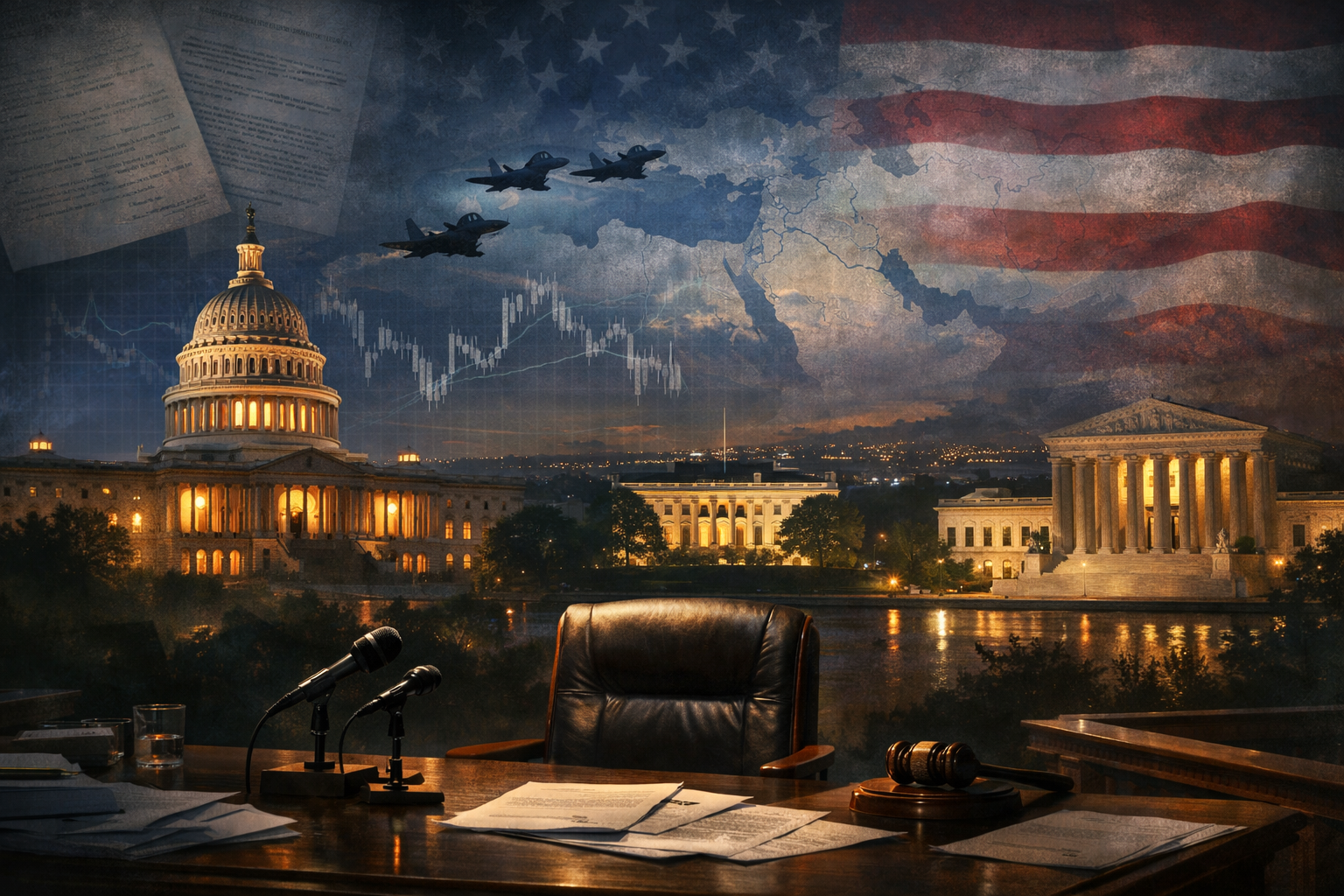

America in the Last 24 Hours: War Signals Abroad, Power Struggles at Home and a Nation in Strategic Transition
America moved through the past 24 hours under the weight of overlapping political, legal, economic and geopolitical developments that together illustrate a nation managing both domestic institutional recalibration and mounting global pressure. From congressional scrutiny of prominent political figures to evolving tensions in U.S. foreign policy, federal labor disputes, immigration debates and economic indicators, the latest national news cycle reflects a country navigating complex transitions across multiple fronts of governance.
At the center of Washington’s attention was renewed congressional focus on accountability among public figures tied to longstanding investigations surrounding financier Jeffrey Epstein. The appearance of a high-profile political figure before lawmakers reignited debate over transparency and oversight, reinforcing Congress’s continued effort to demonstrate institutional scrutiny across political and social elites. Lawmakers from both parties used the moment to emphasize the importance of cooperation with federal inquiries and to reaffirm congressional authority in matters touching public trust.
Political analysts note that such testimony underscores the enduring reach of congressional oversight even years after the core events under investigation. Communications strategist Dana Whitmore observed in national interviews that the hearings reflect “an ongoing institutional commitment to demonstrating that status and influence do not place individuals beyond the reach of inquiry.” While no new legal determinations emerged from the session, the political resonance of the testimony reverberated across cable networks and digital media throughout the day, shaping public discourse about accountability and governance.
Simultaneously, U.S. foreign policy developments — particularly those connected to Iran — continued to command attention among policymakers and global observers. Diplomatic engagement between American and Iranian officials remains active but unresolved, with recent talks concluding without a final agreement. Defense analysts say Washington has maintained a posture combining diplomatic outreach with visible military readiness across the Middle East. Naval deployments and strategic positioning of air assets signal continued deterrence as negotiations proceed.
Former Pentagon policy adviser Michael Trent described the current approach as “a classic dual-track strategy — diplomacy reinforced by credible military capability.” Markets and allied governments are watching closely. Economists warn that sustained geopolitical tension could influence energy prices, investor confidence and broader global economic stability in the coming weeks. For the White House and defense leadership, the challenge lies in balancing pressure with restraint while maintaining alliance cohesion.
Domestic governance also saw significant legal and policy movement. A federal appeals court decision allowing sweeping changes to federal labor relations to proceed marked one of the most consequential domestic rulings of the week. The decision clears the way for implementation of policies that reduce or restructure collective bargaining rights for large segments of the federal workforce while ongoing legal challenges continue through the courts.
Labor unions reacted swiftly, signaling plans for further appeals and warning that the changes could affect morale and retention across government agencies. Supporters of the policy argue that streamlined labor rules will improve administrative flexibility and efficiency. Labor policy analyst Marcus Feldman described the ruling as “one of the most significant structural shifts in federal workforce governance in decades,” noting that its ultimate impact will depend on agency implementation and future judicial review. Legal scholars expect the dispute could eventually reach the Supreme Court, potentially setting precedent on the scope of executive authority over federal employment structures.
Immigration policy developments added another layer to the national conversation. Reports that federal officials are considering targeted refugee processing adjustments drew attention from both advocacy organizations and policymakers. The proposal under discussion would create an expedited pathway for certain applicants citing security concerns in their home countries. Supporters argue that refugee policy must remain responsive to evolving global conditions and credible humanitarian claims. Critics counter that prioritizing specific groups could complicate broader immigration policy and raise questions about consistency in humanitarian admissions.
Immigration scholars say any significant shift in refugee processing priorities could reshape debates over fairness, resource allocation and diplomatic messaging. The issue arrives at a time when refugee admissions remain constrained by administrative backlogs and heightened vetting procedures affecting applicants from multiple regions. As policymakers weigh humanitarian commitments against domestic political considerations, immigration remains one of the most closely watched policy arenas.
The Justice Department also intensified its legal engagement with states over election administration. New federal lawsuits seeking compliance with requests for voter registration data signal an assertive approach to enforcing transparency provisions under federal election law. Federal officials argue that accurate voter rolls are essential to election integrity and public confidence. Several state governments have pushed back, asserting that federal demands risk infringing on state authority and voter privacy protections.
Election law experts suggest these cases could shape the evolving relationship between federal oversight and state election management. Professor Elena Ramirez noted in public radio interviews that the litigation “raises fundamental questions about transparency, privacy and jurisdiction that may ultimately require Supreme Court clarification.” With election cycles approaching in multiple states, the outcome of these legal battles is expected to carry significant administrative and political implications.
Economic indicators released within the same 24-hour window suggested relative stability tempered by caution. Weekly unemployment claims showed modest fluctuation within expected seasonal patterns, while financial markets remained largely steady despite geopolitical concerns. Analysts describe the labor market as resilient but sensitive to external shocks, particularly those linked to energy prices and global supply chains.
Market strategist Olivia Chen told financial networks that investors are navigating a complex environment marked by both opportunity and uncertainty. “The underlying economy continues to show durability,” she said, “but geopolitical risk and policy transitions remain key variables.” Economists say upcoming inflation and employment reports will provide further clarity on whether current stability can be sustained through the next quarter.
Beyond politics and economics, moments of national reflection also shaped the news cycle. Public gatherings honoring prominent civil rights leadership drew attention to the country’s ongoing dialogue about social justice and historical legacy. Preparations for the United States’ 250th anniversary of independence continued, with cultural institutions announcing projects designed to capture the nation’s identity at a pivotal moment. Historians say such initiatives reflect both pride in national history and recognition of the challenges shaping contemporary America.
Security and enforcement developments rounded out the day’s major headlines. Federal authorities announced expanded rewards targeting transnational organized crime networks, reinforcing ongoing efforts to disrupt trafficking operations. Meanwhile, a defense-related incident involving advanced anti-drone technology near the southern border prompted internal review and renewed focus on coordination between military and civilian agencies operating in shared airspace. Defense analysts say the event highlights the growing complexity of modern security systems and the need for updated protocols.
Taken together, the past 24 hours present a portrait of a nation balancing accountability, strategic risk and institutional change. Congressional scrutiny of prominent figures underscores the persistence of oversight in American political life. Foreign policy tensions remind policymakers of the fragile equilibrium between deterrence and diplomacy. Legal battles over labor authority, immigration priorities and election transparency illustrate the ongoing negotiation of power between federal institutions and state governments.
Economic indicators point to resilience but also to caution as global uncertainty continues to influence domestic outlook. Cultural and commemorative moments offer reminders of national continuity even as structural changes reshape governance and public expectations.
As Washington moves into the next news cycle, unresolved questions remain. Diplomatic negotiations abroad continue without final resolution. Court challenges to major domestic policies are likely to advance through the judicial system. Economic data will further inform policy decisions in the weeks ahead. The convergence of these developments suggests a United States entering a period defined less by singular crisis than by sustained strategic adjustment.
For policymakers, institutional leaders and the public alike, the central task remains managing complexity without losing coherence. The past day’s events reveal a country actively recalibrating its domestic institutions while confronting external pressures that demand both caution and resolve. Whether these overlapping challenges yield renewed stability or deeper polarization will depend on decisions still unfolding in Washington and beyond.
For now, the United States continues to move forward through a dense and consequential moment — one defined by scrutiny, strategy and the enduring effort to balance power with accountability in an increasingly uncertain world.
