



America in the Last 24 Hours: War Abroad, Scrutiny at Home, and Rising Political Tensions Across the United State
The past twenty-four hours in the United States have unfolded against a backdrop of intensifying geopolitical conflict, renewed political scrutiny in Washington, and a domestic political climate increasingly shaped by both foreign policy decisions and debates about transparency in government.
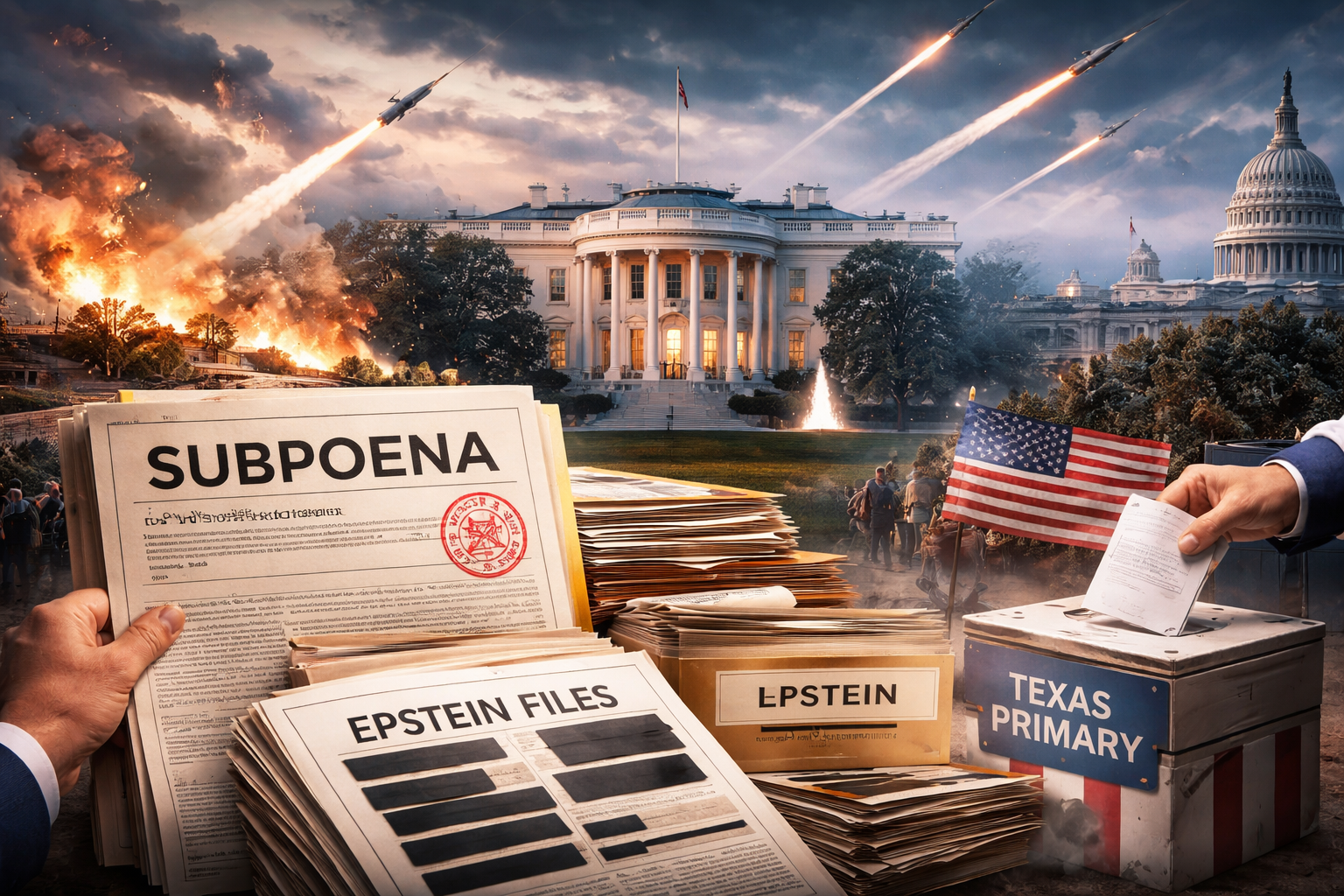
From Congress issuing subpoenas over the handling of documents linked to the Jeffrey Epstein investigation, to escalating U.S. military operations against Iran and growing tensions surrounding election procedures in key states, the events of the past day reveal a country navigating complex pressures both abroad and at home.
Together, these developments provide a snapshot of a nation facing simultaneous tests of governance, military strategy, and democratic accountability.
Congressional Scrutiny Over Epstein Files
One of the most politically sensitive developments in Washington came as lawmakers moved to compel testimony from the Justice Department over concerns surrounding the release of documents tied to the Jeffrey Epstein investigation.
The House Oversight Committee voted in a bipartisan decision to subpoena Attorney General Pam Bondi regarding the status of thousands of documents connected to the Epstein case that have not yet been fully made public.
The move followed reports indicating that tens of thousands of files linked to the investigation appear to be missing or temporarily unavailable from the set of materials that the Justice Department had released to the public.
Under federal transparency requirements, the Justice Department had been expected to release the Epstein files by December 19, 2025. Redactions were permitted only for the purpose of protecting the identities and safety of victims.
However, lawmakers reviewing the documents say the files released so far appear incomplete and contain significant redactions.
Justice Department officials have responded by stating that the documents were taken offline temporarily for additional review and technical processing and are expected to be restored.
Still, the situation has raised questions among lawmakers about whether the release complied fully with legal requirements and whether additional materials remain withheld.
The subpoena means that Bondi will now be required to testify under oath before Congress about the timeline for the release of the documents and the reasons for the gaps identified in the files.
For many lawmakers, the issue extends beyond the Epstein investigation itself. It touches on broader concerns about transparency and public trust in federal institutions, particularly when investigations involve individuals with connections to powerful political or financial circles.
The hearing, when it occurs, is likely to become one of the most closely watched congressional sessions of the year.
Escalation of the U.S.–Iran Conflict
While political tensions unfolded in Washington, the most consequential developments for U.S. foreign policy continued to center on the rapidly escalating military conflict between the United States and Iran.
In recent days, U.S. forces have carried out a series of strikes targeting Iranian military infrastructure and strategic facilities.
The Trump administration has defended the military action as a preemptive measure intended to prevent Iran from advancing toward nuclear weapons capability.
Speaking to reporters, President Donald Trump argued that the strikes were necessary to prevent what he described as an imminent threat.
According to the president, Iran could have obtained a nuclear weapon within a matter of weeks if the United States had not intervened.
However, assessments from American intelligence agencies have reportedly challenged that timeline, suggesting that Iran was not on the verge of acquiring a nuclear weapon in the immediate future.
The conflicting claims have fueled debate in Washington about the justification for the military campaign and whether the United States has clearly defined objectives for the conflict.
Despite these questions, Congress has so far chosen not to restrict the administration’s authority to continue the military operations.
In a closely watched vote, the U.S. Senate rejected a war powers resolution that would have required explicit congressional authorization for ongoing military action against Iran.
Supporters of the resolution argued that the Constitution gives Congress the authority to declare war and that lawmakers should play a direct role in determining whether the United States engages in prolonged military conflict.
Opponents countered that limiting the president’s authority in the middle of an active military campaign could send the wrong message to U.S. troops and adversaries abroad.
Senator Susan Collins of Maine said the moment required strong and unified support for American service members operating in the region.
For now, the Senate vote effectively allows the president to continue the military campaign without new authorization from Congress.
Concerns About Military Resources
Alongside the debate over strategy and authorization, defense analysts and lawmakers have also raised questions about the rate at which the United States is consuming advanced weapons systems during the conflict.
Military reporting suggests that U.S. forces have used a significant portion of certain high-end munitions and missile interceptors during recent operations.
Some analysts warn that if the conflict continues at its current pace, the United States could face pressure to accelerate defense production in order to replenish stockpiles.
Pentagon officials have insisted that the U.S. military maintains sufficient reserves to sustain current operations and defend American interests globally.
Nevertheless, the discussion reflects broader concerns about the logistical and industrial challenges that modern warfare places on national defense systems.
Unlike earlier conflicts, contemporary military campaigns often rely heavily on highly specialized and expensive precision weapons that require complex manufacturing processes.
If the war expands or continues for an extended period, the United States may face difficult decisions about defense spending and production capacity.
Americans Stranded Abroad
Another issue gaining attention in Washington involves Americans who remain stranded in parts of the Middle East following the escalation of hostilities.
The rapid onset of the conflict left many travelers and expatriates in the region seeking assistance from the U.S. government in returning home.
Critics have questioned why evacuation plans were not put in place earlier.
Administration officials have said the situation developed rapidly and that coordination with regional partners is ongoing to ensure the safety of American citizens.
While some evacuation efforts have begun, many Americans remain in countries where commercial travel options have been disrupted by the conflict.
The issue has added another dimension to the broader debate over the administration’s preparation for the military campaign.
Political Effects of the Conflict
Beyond the battlefield, the war with Iran is already influencing domestic politics in the United States.
Foreign conflicts have historically reshaped political narratives and electoral dynamics, sometimes strengthening leaders during the early stages of military action while generating opposition if wars become prolonged or costly.
Early polling suggests that public opinion regarding the strikes remains divided.
Surveys conducted in recent days indicate that a minority of Americans support the military campaign against Iran, reflecting a degree of skepticism among voters who remain wary of entering another long foreign conflict.
Some political figures within both major parties have begun to debate the potential political consequences of the war.
Within conservative circles, some voices have warned that prolonged military involvement could alienate voters who prefer a more restrained foreign policy.
Others argue that demonstrating strength abroad remains a central element of American leadership and national security.
As the conflict unfolds, its trajectory could become a defining issue in the upcoming election cycle.
Election Tensions in Texas
At the same time, developments in state politics have highlighted continuing debates over election procedures and voting access.
Primary elections held in Texas this week produced strong turnout among Democratic voters in several areas.
However, the voting process itself became the subject of controversy after changes were made to polling procedures in certain counties.
In Dallas and Williamson counties, officials discontinued a system that previously allowed voters to cast ballots at any polling location within their county.
The change meant that voters were required to cast ballots at specific assigned locations.
As a result, many voters reported confusion about where they were permitted to vote, leading to long lines and logistical problems at some polling places.
In response to the confusion, local judges ordered some polling locations to remain open beyond the scheduled closing time in order to allow additional voters to cast ballots.
However, the Texas Supreme Court later limited those extensions, ruling that ballots cast after the original closing time would need to be separated from the rest while legal questions about their validity are considered.
Voting rights advocates argue that the situation demonstrates the challenges voters can face when election procedures change unexpectedly.
Election officials say the system remains legal and that counties have the authority to determine how polling locations operate.
The episode reflects a broader national debate about election administration and access to the ballot, a topic that continues to shape political discourse across the United States.
A Country Facing Multiple Pressures
Taken together, the developments of the past twenty-four hours illustrate the complex environment the United States currently faces.
International conflict, domestic political disputes, and questions about transparency in government are unfolding simultaneously.
Each issue carries its own implications, but together they reveal a broader pattern of tension within the American political system.
The war with Iran represents one of the most significant foreign policy challenges facing the country in years.
At the same time, congressional oversight battles and debates over election procedures highlight ongoing struggles over institutional accountability and democratic processes.
In many ways, these parallel developments underscore the interconnected nature of modern governance.
Foreign policy decisions influence domestic politics, while internal political disputes shape how the United States presents itself on the global stage.
As events continue to unfold, the coming days are likely to bring further developments that will test the resilience of American political institutions and the country’s ability to navigate a rapidly changing international landscape.
For now, the past twenty-four hours have offered a clear reminder that the United States is operating in a period defined by both global uncertainty and intense political debate at home.
