


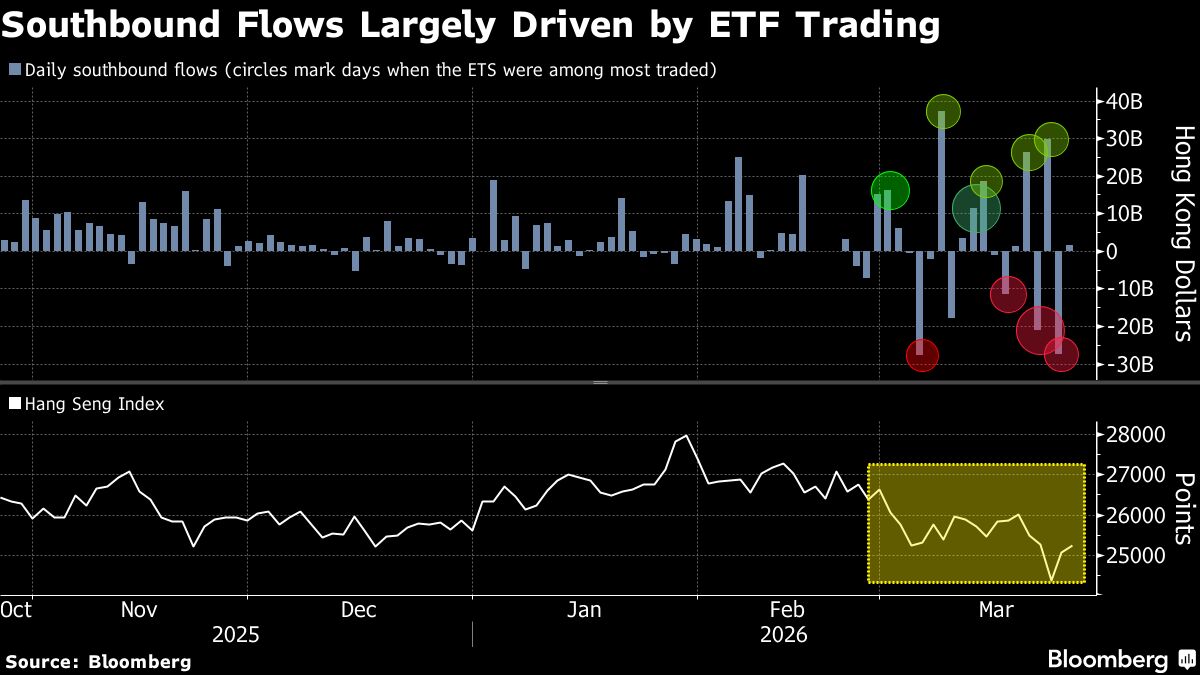

Chinese Investors’ Volatile Flows into Hong Kong Stocks Reflect Market Uncertainty
Hong Kong’s stock market, long regarded as a gateway between China and global capital, is facing a new wave of turbulence as mainland Chinese investors exhibit erratic patterns in fund flows. Recent weeks have seen sharp fluctuations in capital pouring into Hong Kong-listed equities, signaling a lack of confidence among investors to establish long-term positions. This volatile trend highlights broader uncertainties in China’s economy, geopolitical tensions, and the evolving dynamics of global financial markets.
The Hong Kong Stock Exchange, historically a favored destination for mainland investors seeking exposure to international markets, has witnessed a rollercoaster ride in 2023. Data from financial analysts reveals that net inflows from mainland investors, facilitated through the Stock Connect program, have swung dramatically between positive and negative territory. In some weeks, billions of yuan have flowed into Hong Kong equities, only to be reversed in subsequent weeks as investors retreated. This erratic behavior contrasts sharply with the steady, long-term investment strategies that characterized previous years.
A Window into Broader Economic Concerns
The volatility in fund flows is emblematic of deeper economic and geopolitical anxieties plaguing China’s investors. Domestically, the mainland economy continues to grapple with a sluggish post-pandemic recovery, deflationary pressures, and a prolonged property crisis. Globally, rising interest rates in the West and escalating tensions between China and the United States have further muddied the waters for investors seeking stable returns.
“The hesitancy among mainland investors reflects a broader sentiment of caution,” said Li Wei, a senior financial analyst at Beijing-based consultancy Horizon Insights. “Hong Kong stocks are seen as a proxy for international exposure, but the current environment is fraught with risks, and investors are reluctant to commit.”
The Stock Connect program, launched in 2014, was designed to bridge mainland China and Hong Kong’s financial markets, allowing investors to trade shares across borders. It has been instrumental in driving liquidity into Hong Kong’s markets, particularly during periods of bullish sentiment. However, recent months have seen a retreat from this trend, with net inflows into Hong Kong stocks dropping significantly compared to previous years.
Geopolitical Tensions and Regulatory Risks
Geopolitical factors have played a significant role in shaping investor behavior. The ongoing trade and technology disputes between China and the U.S., coupled with tightening sanctions on Chinese companies, have created a challenging environment for cross-border investments. Additionally, concerns over Beijing’s regulatory crackdowns on industries ranging from technology to education have further dampened investor confidence.
“Investors are wary of the unpredictability of regulatory actions,” noted Chen Yiming, a Hong Kong-based market strategist. “The fear is that Beijing could introduce new policies overnight that could disrupt entire sectors.”
Hong Kong’s unique position as a semi-autonomous region adds another layer of complexity. While it operates under a separate legal and financial system from mainland China, its proximity and economic ties mean it is inextricably linked to Beijing’s policies. Recent moves by Chinese authorities to tighten oversight of Hong Kong’s financial sector have heightened concerns about the city’s autonomy and its appeal as an international financial hub.
Sector-Specific Challenges
Certain sectors in Hong Kong’s market have been particularly sensitive to these dynamics. Technology stocks, which once attracted significant interest from mainland investors, have seen subdued activity amid global semiconductor shortages and U.S. restrictions on chip exports to China. Meanwhile, property developers and financial institutions have struggled under the weight of China’s real estate crisis and rising debt levels.
The volatility in fund flows has also been exacerbated by the divergent performance of Hong Kong’s Hang Seng Index and mainland China’s CSI 300 Index. While the Hang Seng has shown signs of recovery in recent months, it remains far below its pre-pandemic highs. In contrast, the CSI 300 has languished, reflecting sluggish domestic demand and investor pessimism.
Global Implications
The fluctuating fund flows into Hong Kong stocks are not just a local issue; they have broader implications for global markets. As one of the world’s largest financial centers, Hong Kong serves as a critical node for capital movement between East and West. Instability in its markets can ripple outwards, affecting investor sentiment worldwide.
“Hong Kong’s role as a financial bridge means its health is closely watched by global investors,” said Sarah Thompson, a London-based emerging markets economist. “The current volatility suggests that confidence in China’s economic outlook remains fragile, which could have knock-on effects for other emerging markets.”
Looking Ahead
The future trajectory of mainland investors’ activity in Hong Kong’s stock market remains uncertain. While some analysts believe that a stabilization in China’s economy and easing geopolitical tensions could restore confidence, others warn that the current trends may persist in the absence of clear catalysts.
“Investors are looking for signs of stability—both domestically and internationally,” said Li Wei. “Until then, the erratic fund flows are likely to continue.”
As Hong Kong navigates these challenges, its ability to adapt and innovate will be key to maintaining its status as a global financial hub. For now, the city’s markets remain a barometer of broader economic and geopolitical trends, reflecting the hopes and fears of investors worldwide.
In a world of increasing uncertainty, Hong Kong’s stock market serves as a reminder that stability is often elusive, but resilience is essential.
