


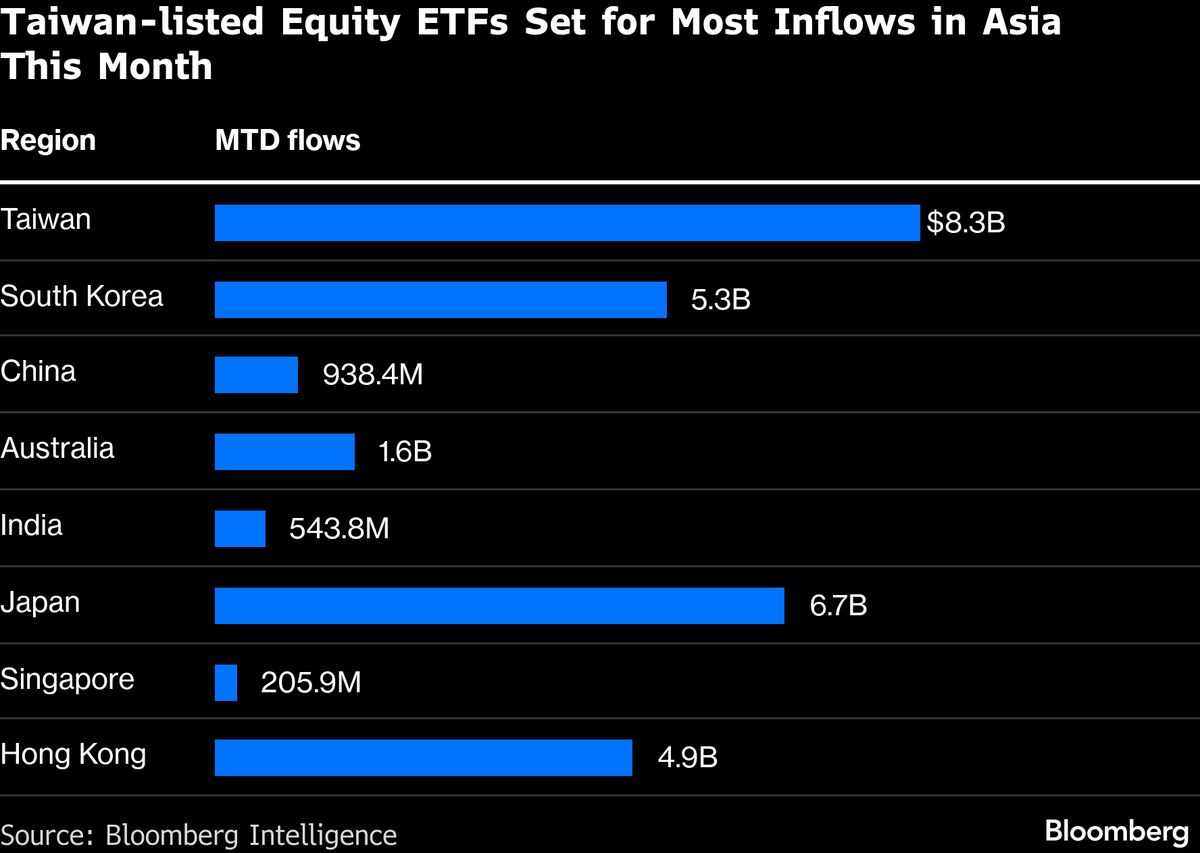

Taiwan’s Largest ETF Sees Record Inflows as Investors Flock to Tech Haven Amid Global Turmoil
Taipei, Taiwan — In a surprising turn of events, Taiwan’s largest equity exchange-traded fund (ETF) is poised to smash monthly inflow records, as domestic investors rally behind the island’s booming technology sector despite mounting geopolitical tensions and global market volatility. The Taiwan Capitalization Weighted Stock Index ETF, commonly known as the “Yuan Taiwan 50 ETF,” has seen unprecedented demand this month, marking a stark contrast to the broader unease gripping global financial markets.
The fund, which tracks the performance of Taiwan’s 50 largest listed companies, has become a beacon of resilience in a world rattled by escalating conflict in the Middle East, inflationary pressures, and fears of economic stagnation. Investors are increasingly viewing Taiwan’s tech-heavy market as a safe haven, betting on the island’s dominance in semiconductor manufacturing and its pivotal role in the global supply chain.
A Global Context of Uncertainty
The surge in inflows comes against a backdrop of heightened geopolitical tensions and market instability. The recent escalation of hostilities between Iran and Israel has sent shockwaves through global markets, prompting investors to reassess risk appetites and seek refuge in perceived safe assets. Meanwhile, central banks worldwide continue to grapple with inflationary pressures, with the U.S. Federal Reserve and the European Central Bank maintaining a cautious stance on interest rates.
Amid this turbulence, Taiwan’s economy has emerged as a rare bright spot. The island’s GDP growth has outpaced many advanced economies, driven largely by its thriving tech industry. Taiwan Semiconductor Manufacturing Company (TSMC), the world’s largest contract chipmaker and a major component of the Yuan Taiwan 50 ETF, has been at the forefront of this success. TSMC’s cutting-edge semiconductor technology powers everything from smartphones to electric vehicles, cementing Taiwan’s position as a critical player in the global tech ecosystem.
Why Investors Are Flocking to Taiwan’s ETF
The Yuan Taiwan 50 ETF has become a magnet for investors seeking exposure to Taiwan’s robust tech sector without the complexity of individual stock picking. The fund’s top holdings include TSMC, MediaTek, and Hon Hai Precision Industry (Foxconn), all of which are global leaders in their respective fields. This concentration in high-growth, high-impact companies has drawn both retail and institutional investors, fueling the ETF’s meteoric rise.
“Taiwan’s tech sector is uniquely positioned to weather global uncertainties,” said Chen Li-wei, an analyst at Cathay Securities in Taipei. “The island’s semiconductor industry is indispensable to the global economy, and investors recognize that. This ETF offers a convenient and diversified way to tap into that potential.”
The ETF’s performance also reflects a broader trend of domestic investors turning inward. While foreign investors have been net sellers of Taiwanese equities in recent months, locals have stepped in to fill the void, driven by confidence in their own markets and a desire to hedge against external risks. This divergence highlights a growing sense of self-reliance among Taiwanese investors, who are increasingly looking beyond global headwinds to focus on homegrown opportunities.
A Record-Breaking Month for Inflows
Preliminary data shows that the Yuan Taiwan 50 ETF has attracted over $1.5 billion in inflows this month, putting it on track to surpass its previous record set in 2021. This influx of capital has pushed the fund’s assets under management (AUM) to more than $10 billion, making it one of the largest and most liquid ETFs in Asia.
The timing of this surge is particularly noteworthy. Historically, periods of global instability have prompted investors to retreat to traditional safe havens such as gold, U.S. Treasuries, or Japanese yen. The fact that Taiwan’s ETF is now being viewed in a similar light underscores the island’s growing economic clout and the perceived durability of its tech sector.
Challenges and Risks Ahead
However, the ETF’s success is not without risks. Taiwan’s economy remains heavily dependent on exports, making it vulnerable to fluctuations in global demand. Moreover, the island’s geopolitical situation is fraught with uncertainty, as tensions between Taipei and Beijing continue to simmer. China claims Taiwan as part of its territory and has not ruled out the use of force to achieve reunification. Any escalation in cross-strait tensions could have immediate and severe repercussions for Taiwan’s markets.
Additionally, the global semiconductor industry faces its own set of challenges. A potential slowdown in demand for consumer electronics, coupled with increasing competition from other chip-producing nations, could weigh on Taiwan’s tech giants. Investors must also contend with the cyclical nature of the semiconductor industry, which has historically been prone to periods of boom and bust.
The Bigger Picture
The record inflows into Taiwan’s largest ETF underscore a broader narrative of resilience and opportunity in the face of global adversity. As investors navigate an increasingly complex and volatile landscape, Taiwan’s tech-heavy market offers a compelling proposition: exposure to a sector that is both indispensable and innovative.
Yet, the ETF’s success also serves as a reminder of the delicate balance that defines Taiwan’s position in the world. Its economic strength is underpinned by irreplaceable technological expertise, but its geopolitical vulnerabilities loom large. For now, investors seem willing to bet on the former, even as they keep a wary eye on the latter.
As the month draws to a close, all eyes will be on whether the Yuan Taiwan 50 ETF can sustain its momentum—and what its performance signals for Taiwan’s broader economic trajectory. In a world fraught with uncertainty, one thing is clear: Taiwan’s tech sector remains a force to be reckoned with, and its ETF is a testament to that enduring strength.
The global financial landscape may be shifting, but in Taiwan, confidence in the future appears unwavering—for now.
