



America in the Last 24 Hours: War Escalation, NATO Rift, TSA Pay Crisis, and Nationwide Storm Chaos
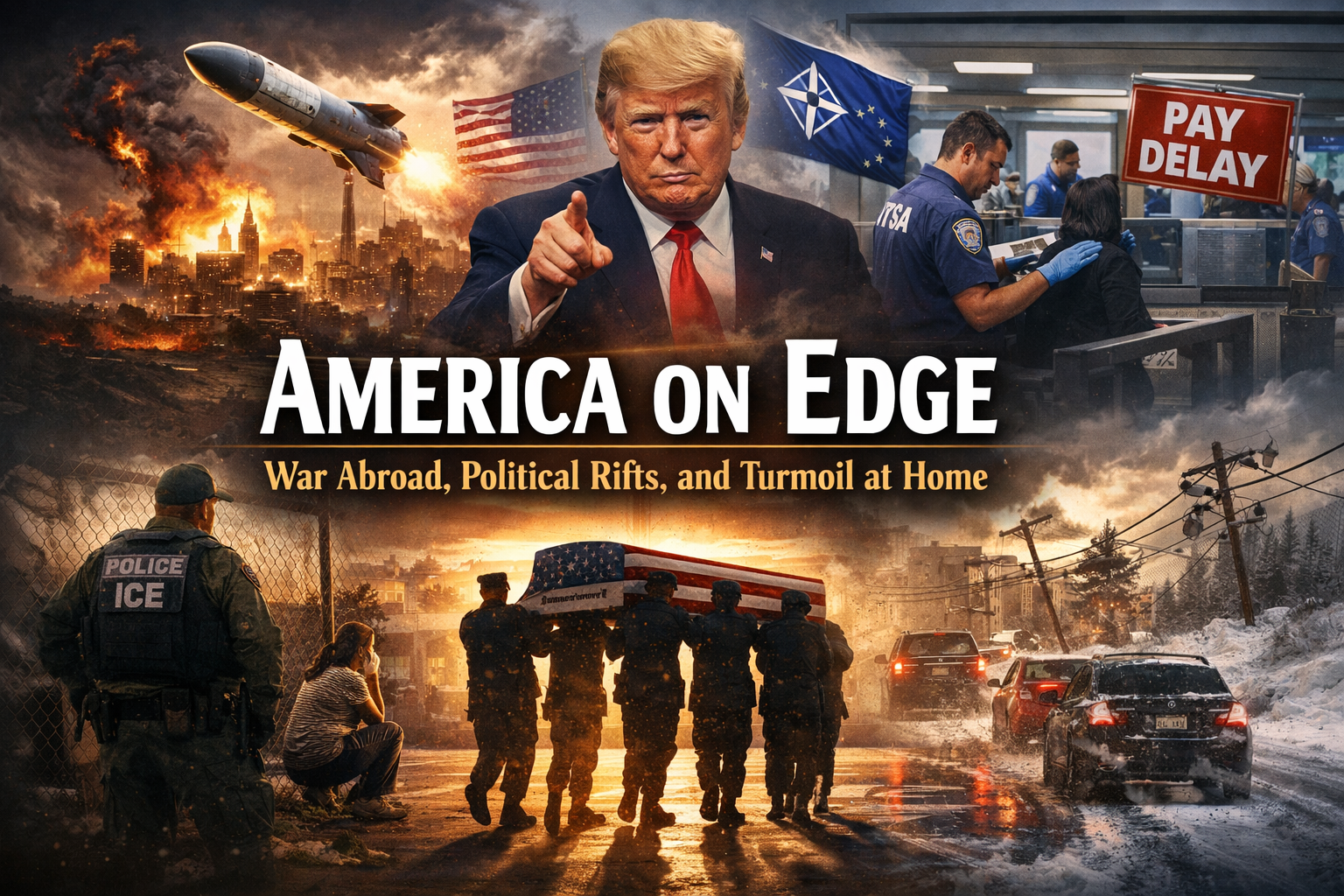
Over the last 24 hours, the United States has found itself at the center of a rapidly evolving global and domestic landscape, where war abroad, political strain at home, and environmental disruptions are converging into a single, defining moment.
At the heart of it all is the intensifying U.S.–Israel–Iran conflict, now entering its third week. What began as a strategic military engagement has steadily expanded into a broader regional confrontation, with missile and drone exchanges continuing to destabilize parts of the Middle East. The human cost is rising, and so too are the geopolitical stakes. Reports indicate that American personnel have been caught in the crossfire, with casualties underscoring the increasingly direct risks to U.S. interests and lives.
Yet, beyond the battlefield, the conflict is beginning to reshape America’s relationships with its closest allies. In a striking development, former President Donald Trump publicly criticized NATO and European Union nations for refusing or hesitating to support U.S. requests tied to securing key global shipping routes, particularly around the Strait of Hormuz. His remarks point to a growing fracture in what has long been considered a unified Western alliance. The reluctance of European partners to fully align with U.S. strategic demands reflects deeper disagreements about the scope, risks, and long-term implications of the conflict.
This emerging tension signals a broader shift. The United States, long accustomed to leading a cohesive alliance system, now appears to be navigating a more cautious and, at times, resistant international community. The implications are significant. A weakened NATO consensus could reshape global power dynamics, embolden adversaries, and complicate future multinational operations.
While these global tensions unfold, pressures are mounting within the United States itself. At airports across the country, Transportation Security Administration (TSA) workers continue to operate under the shadow of financial uncertainty tied to ongoing funding disruptions within the Department of Homeland Security. The possibility of delayed or withheld pay has raised concerns not only about worker morale but also about operational continuity. In past shutdown scenarios, similar conditions led to absenteeism and longer security lines, raising real questions about the resilience of critical infrastructure during times of political gridlock.
This domestic strain is unfolding alongside a series of troubling developments within the immigration system. Reports of deaths involving asylum seekers in or shortly after Immigration and Customs Enforcement custody have reignited debates about detention conditions, oversight, and the broader humanitarian implications of enforcement policies. At the same time, legal and political tensions continue to rise as activists, migrants, and authorities navigate an increasingly charged environment.
Compounding these challenges is a powerful and disruptive weather system that has swept across large portions of the country. From blizzards in the Midwest to severe storms and high winds in other regions, the system has caused widespread travel disruptions, power outages affecting hundreds of thousands, and renewed concerns about infrastructure resilience in the face of extreme weather events. For many Americans, the immediate reality of delayed flights, hazardous roads, and power loss has brought the broader national moment into sharp, tangible focus.
Economically, the ripple effects of global instability are becoming harder to ignore. Energy markets remain sensitive to developments in the Middle East, with concerns over oil supply routes contributing to fluctuations in fuel prices. Meanwhile, broader economic uncertainty is being fueled by a combination of geopolitical tension, domestic policy debates, and strategic moves such as expanded drilling projects and renewed engagement with energy-producing nations like Venezuela.
And yet, amid all of this, there remains a thread of normalcy—if only briefly. The launch of the NCAA March Madness tournament offers a familiar cultural moment, drawing millions of Americans into arenas and living rooms across the country. It serves as both a distraction and a reminder of the nation’s capacity to balance crisis with continuity.
Taken together, the past 24 hours paint a picture of a nation operating under multiple layers of pressure. Internationally, the United States is navigating a complex and increasingly contested leadership role. Domestically, it is confronting the realities of governance challenges, institutional strain, and social tension. Environmentally, it is once again reminded of the unpredictable force of nature.
The intersection of these forces is what defines this moment. Decisions made in Washington, on the battlefield, and within federal agencies are no longer isolated—they are interconnected, each carrying consequences that extend far beyond their immediate context.
As America moves forward, the question is no longer whether these pressures will shape the nation’s trajectory, but how—and how quickly those effects will be felt, both at home and around the world.
