


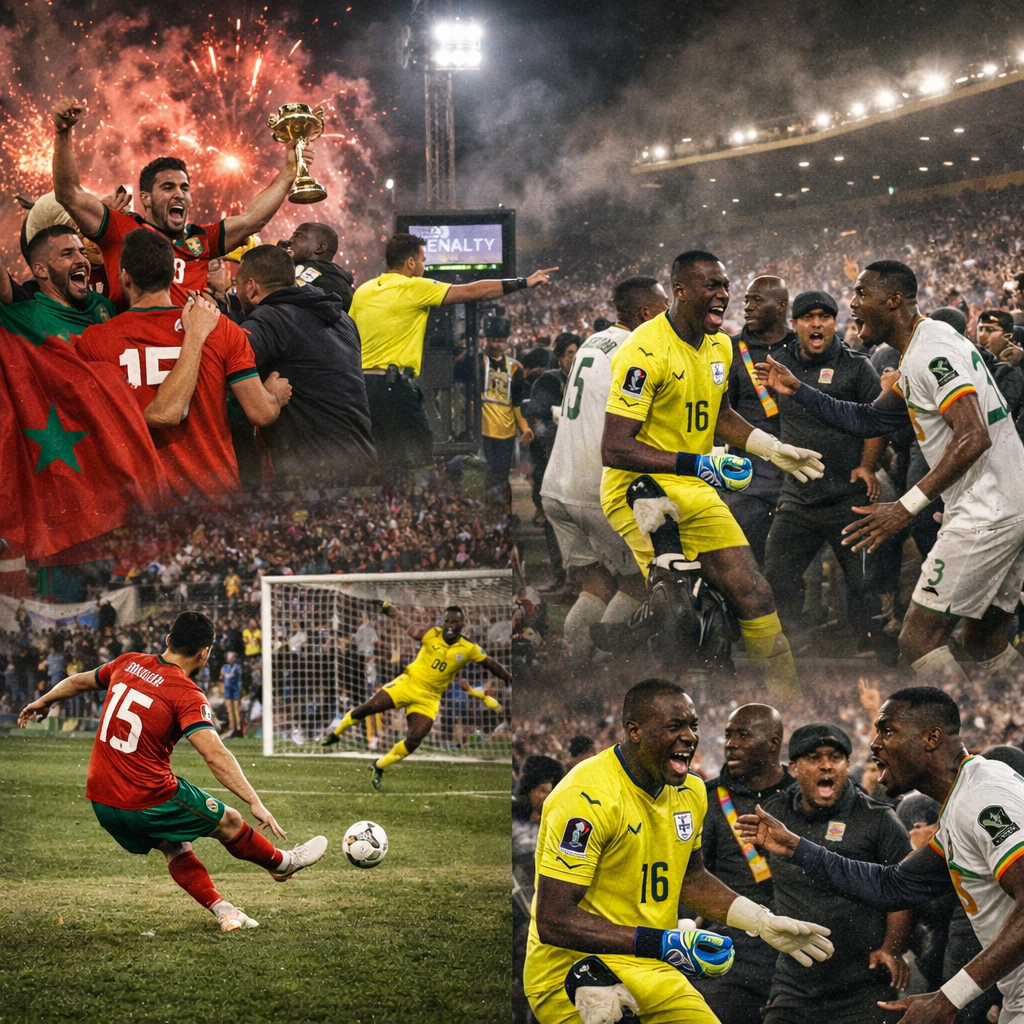

What should have been remembered as a dramatic African football final has now become one of the most controversial rulings in the history of the game on the continent.
In a decision that has sent shockwaves across global football, the Confederation of African Football (CAF) has overturned Senegal’s hard-fought 1–0 victory over Morocco in the 2026 Africa Cup of Nations final and instead awarded the title to Morocco by default. The ruling, delivered by CAF’s appeals board, reclassifies the match as a 3–0 forfeit win for the host nation, citing Senegal’s temporary walk-off during the closing stages of the game.
This is not merely a reversal of a result. It is a rewriting of history.
—
The Night That Changed Everything
On January 18, 2026, in Rabat, Senegal and Morocco faced off in what was expected to be a fitting climax to a fiercely contested AFCON tournament. The match delivered intensity, drama, and ultimately chaos.
As the clock ticked into stoppage time, Senegal believed they had seized the decisive moment. A goal that appeared to put them ahead was ruled out for a foul, a decision that immediately raised eyebrows. Replays suggested minimal contact, but the referee stood firm.
Moments later, the tension escalated.
After a VAR review, Morocco was awarded a penalty deep into stoppage time. For Senegal, it was a turning point that crossed from controversy into perceived injustice. Led by their coach, the Senegalese players walked off the pitch in protest, leaving the game suspended for approximately fifteen minutes.
Inside the stadium, emotions boiled over. Fans surged, security scrambled, and the atmosphere teetered on the edge of complete breakdown.
When order was restored and play resumed, Morocco had the chance to decide the match from the spot. Brahim Díaz stepped up and attempted a Panenka — a bold, almost theatrical chip. But the moment backfired. Senegal’s goalkeeper Édouard Mendy read it perfectly and made the save.
The psychological swing was immediate.
Senegal regrouped, pushed forward, and eventually found the breakthrough in extra time, scoring what was widely accepted as the winning goal. On the pitch, they were champions. In the stands, they were celebrated as such. Across Africa, the narrative seemed settled.
Until now.
—
The Legal Earthquake
CAF’s initial disciplinary response acknowledged the chaos. Fines were issued. Sanctions were imposed. But crucially, the result stood. Senegal remained champions.
That decision has now been overturned.
Invoking Article 82 of its competition regulations, CAF’s appeals board determined that Senegal’s walk-off — even though temporary — constituted a breach serious enough to be classified as a forfeiture. The regulation is explicit: any team that leaves the field without authorization before the end of a match can be deemed to have lost.
From a strictly legal standpoint, the rule is clear.
From a footballing standpoint, the implications are explosive.
Because Senegal did return. They did finish the match. They did win it on the field.
Yet, in the eyes of the appeals panel, the act of protest itself — the refusal to continue play at that critical moment — was sufficient to nullify everything that followed.
—
A Decision That Divides a Continent
The backlash has been immediate and intense.
Critics argue that CAF has applied the rule in a manner that ignores context. A 15-minute protest, they say, should not outweigh 120 minutes of football. The match resumed under the referee’s authority. No abandonment was declared. The game reached its natural conclusion.
To strip a team of a title under those circumstances feels, to many, disproportionate.
Others, however, see it differently.
They argue that discipline and order are the foundation of the sport. If teams are allowed to walk off in protest without consequence, it opens the door to chaos in future matches. From this perspective, CAF’s decision is not just about this final, but about setting a precedent.
And that is precisely what makes this moment so consequential.
—
Beyond the Trophy
This controversy is not just about who lifts a trophy. It is about governance, authority, and the fragile relationship between players, officials, and the systems meant to ensure fairness.
VAR, once introduced to eliminate clear errors, now sits at the center of yet another storm. The penalty decision that triggered Senegal’s protest is being scrutinized as heavily as the ruling that followed.
Trust is the currency of sport. And right now, that trust is under strain.
For Morocco, the title will be official, but inevitably contested in the court of public opinion. For Senegal, the sense of injustice will linger, fueling what is almost certain to be the next phase of this saga.
—
The Battle Moves to Switzerland
Senegal is expected to take the case to the Court of Arbitration for Sport (CAS) in Lausanne. If they do, this dispute will move from the pitch and the stands into the realm of international sports law.
And there, the questions will become even sharper:
Does a temporary protest equal a forfeiture?
Should intent matter in the application of rules?
Can a completed match be retroactively invalidated on procedural grounds?
The answers will not only determine the fate of AFCON 2026, but could shape how football handles controversy for years to come.
—
A Final That Will Never Be Settled
Long after the legal arguments are exhausted, this final will remain unresolved in spirit.
In Rabat, one team celebrated on the night.
In the record books, another now holds the title.
And between those two realities lies a fracture — one that speaks to the evolving, and often uneasy, intersection of sport, technology, and regulation.
African football has produced many unforgettable moments.
But few have left behind a question as enduring as this:
What truly defines a champion — the result on the pitch, or the ruling off it?
