



IMF Downgrades Global Growth Forecast Amid Middle East Conflict and Energy Market Volatility
Washington, D.C. — The International Monetary Fund (IMF) has slashed its global economic growth projections for 2023, citing the escalating conflict in the Middle East as a significant disruptor of energy markets and a potential catalyst for broader instability. The revised outlook, released on Tuesday, underscores the fragile state of the global economy as it grapples with the dual shocks of geopolitical tensions and volatile oil prices.
In its latest World Economic Outlook report, the IMF revised its global growth forecast to 2.9%, down 0.2 percentage points from its previous estimate in October 2022. While the adjustment may appear marginal, the organization warned that the situation could deteriorate further if the conflict prolongs or intensifies, particularly if key energy infrastructure in the region sustains severe damage. Such a scenario, the IMF cautioned, could trigger a sharp downturn in global growth, exacerbating inflationary pressures and stifling recovery efforts worldwide.
A Crisis with Global Ramifications
The Middle East conflict, which erupted in October 2023, has already sent shockwaves through global energy markets. As a region that accounts for nearly one-third of the world’s oil supply, any disruption to its production and distribution networks has immediate and far-reaching consequences. Oil prices surged by over 15% in the weeks following the outbreak of hostilities, amplifying inflationary pressures in economies already struggling with rising costs of living.
The IMF report highlights the potential for a “major oil shock” should the conflict escalate further. Such a scenario would not only strain energy-importing nations but also destabilize financial markets, as investors pivot away from riskier assets in favor of safe havens. Emerging markets, in particular, are vulnerable, as they face higher borrowing costs and reduced access to capital amid tightening global financial conditions.
Europe’s Dual Challenges
The IMF’s warnings come at a precarious time for Europe, which continues to navigate the economic fallout from Russia’s invasion of Ukraine. The war has already disrupted energy supplies, driven up inflation, and forced European nations to accelerate their transition to alternative energy sources. Now, with the Middle East conflict compounding these challenges, European policymakers face an increasingly complex balancing act.
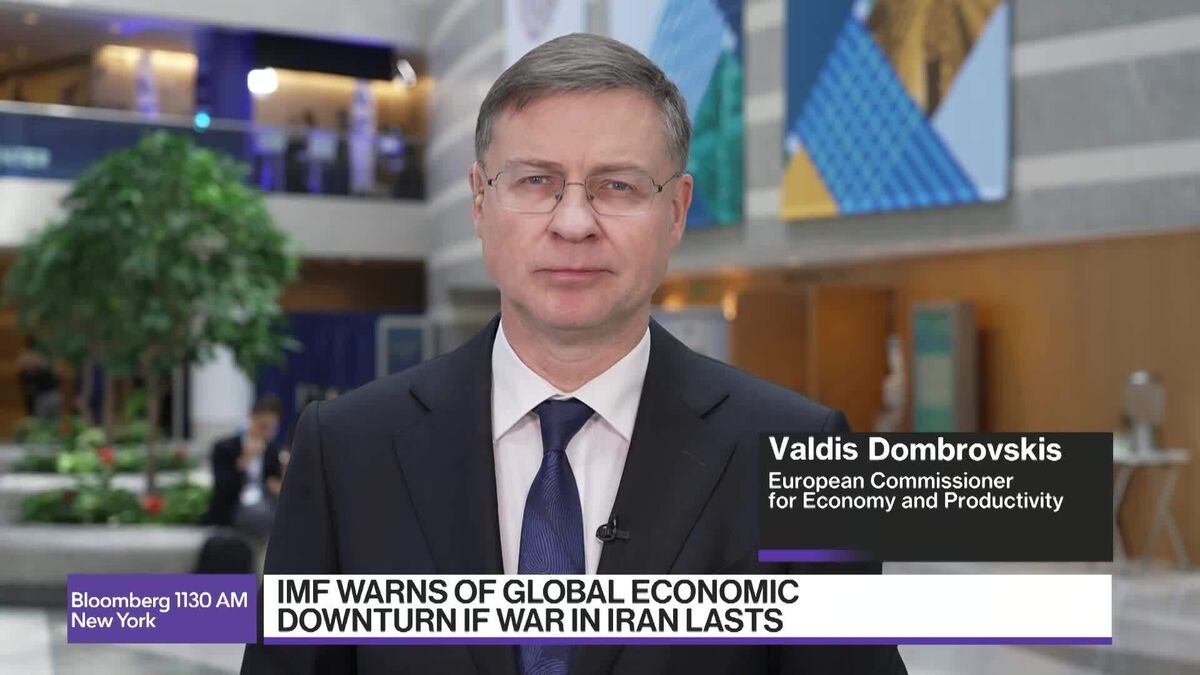
In an interview with Bloomberg’s Balance of Power, European Commissioner for Economy and Productivity Valdis Dombrovskis acknowledged the heightened risks facing the European Union (EU). He noted that while the bloc has made strides in reducing its reliance on Russian energy, the Middle East crisis underscores the need for greater energy diversification and investment in renewables.
“The war in Ukraine served as a wake-up call for Europe to rethink its energy strategy,” Dombrovskis said. “Now, with the Middle East situation, we are reminded once again of the urgency to accelerate our green transition and build resilience against external shocks.”
Despite these efforts, the EU’s economic outlook remains uncertain. The IMF has projected a modest growth rate of 0.7% for the eurozone in 2023, a figure that reflects the region’s ongoing struggles with high inflation, sluggish demand, and the lingering effects of geopolitical instability.
A Fragile Recovery Amid Persistent Risks
The IMF’s downgraded growth forecast is a stark reminder of the interconnectedness of the global economy and the cascading effects of geopolitical crises. The organization emphasized that while the global economy has shown resilience in the face of multiple shocks—including the COVID-19 pandemic, the Ukraine war, and tightening monetary policies—the current environment remains fraught with risks.
Among these risks is the potential for further escalation in the Middle East, which could disrupt oil exports from key producers such as Saudi Arabia, Iran, and Iraq. Any damage to critical infrastructure, such as pipelines or shipping routes, would have immediate implications for global energy supply chains. Additionally, prolonged hostilities could exacerbate regional instability, sparking refugee crises and further straining global humanitarian resources.
Another concern is the potential for secondary effects on global trade and investment. The IMF noted that businesses and consumers are already grappling with elevated uncertainty, which could dampen spending and investment decisions. Moreover, central banks face a delicate task in managing inflation without stifling growth, particularly in economies where inflationary pressures remain stubbornly high.
Calls for Coordinated Action
Against this backdrop, the IMF has reiterated the importance of coordinated policy responses to mitigate the impact of geopolitical shocks. The organization has urged governments to prioritize targeted fiscal measures to support vulnerable populations, while central banks maintain vigilance in their fight against inflation.
For policymakers in energy-dependent economies, the IMF recommends accelerating investments in renewable energy and enhancing energy efficiency to reduce exposure to volatile oil markets. The organization also stressed the need for international cooperation to resolve conflicts and restore stability in crisis-affected regions.
“The global economy is at a critical juncture,” the IMF stated in its report. “While resilience has been tested repeatedly in recent years, the current environment demands proactive and coordinated action to safeguard growth and stability.”
A Delicate Balancing Act
As the global economy navigates this turbulent period, the IMF’s revised forecast serves as a sobering reminder of the delicate balance between growth and stability. While the immediate risks are clear, the long-term outlook remains uncertain, hinging on the trajectory of geopolitical developments and the effectiveness of policy responses.
For now, the world watches with bated breath as the Middle East conflict unfolds, hoping for a resolution that averts further economic disruption. Yet, as history has shown, the path to recovery is rarely linear, and the global economy’s resilience will once again be put to the test.
In the words of IMF Managing Director Kristalina Georgieva, “In an interconnected world, no economy is an island. The challenges we face demand collective action and unwavering resolve to secure a stable and prosperous future for all.”
As policymakers and global leaders grapple with these complex issues, the stakes have never been higher. The world’s economic trajectory now rests on their ability to navigate uncertainty with foresight and determination.
