


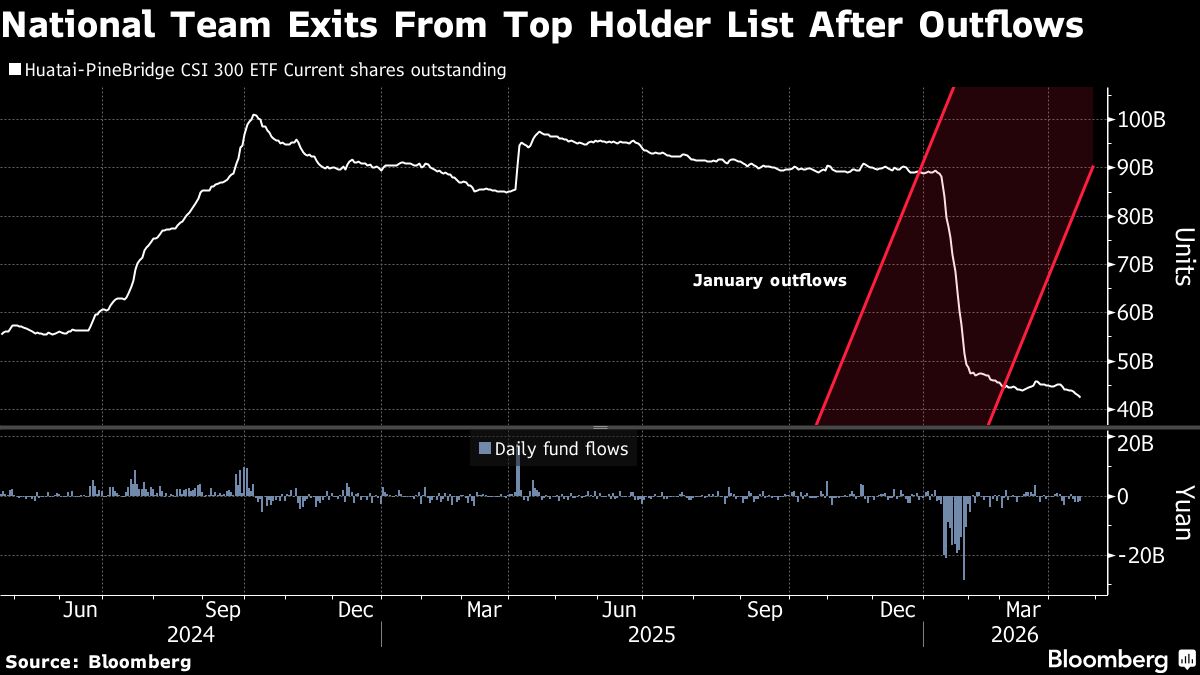

China’s “National Team” Scales Back Stock Market Interventions Amid Concerns Over Overheated Rally
Beijing, China—In a move that underscores the Chinese government’s delicate balancing act in managing its financial markets, the so-called “national team” has significantly reduced its presence in the country’s largest exchange-traded funds (ETFs), signaling a shift away from its previously dominant role in propping up equities. This strategic pullback comes as policymakers attempt to temper an overheated stock market rally that earlier this year raised concerns about speculative fervor and unsustainable growth.
The “national team,” a term coined to describe state-backed entities tasked with stabilizing China’s volatile stock markets, has been a central player in the country’s financial ecosystem since the 2015 market crash. Comprising major institutions such as China Securities Finance Corp., Central Huijin Investment, and state-owned asset managers, the group has historically intervened during periods of extreme turbulence, injecting liquidity and restoring investor confidence. However, its recent retreat from key ETFs suggests a concerted effort to allow market forces to play a greater role, even as Beijing remains vigilant about potential risks.
Market Context: A Frenetic Start to the Year
The decision to dial back intervention follows a dramatic surge in Chinese equities during the first quarter of 2023. Buoyed by optimism about the country’s post-pandemic economic recovery and anticipation of supportive government policies, the benchmark Shanghai Composite Index rallied by more than 13% in the first three months of the year, while the CSI 300 Index, which tracks the performance of the largest companies listed in Shanghai and Shenzhen, gained over 10%.
However, this rapid ascent sparked concerns among regulators that the market was becoming overheated, with retail investors piling into stocks fueled by speculative bets rather than fundamental valuations. Analysts warned that such exuberance could lead to asset bubbles and instability, particularly given China’s already fragile economic landscape, which includes lingering challenges in the property sector, sluggish consumer demand, and geopolitical tensions.
Against this backdrop, the “national team” began scaling back its positions in major ETFs such as the Huatai-Pinebridge CSI 300 ETF and the ChinaAMC CSI 300 ETF, according to recent filings and data from financial institutions. While these entities had been substantial buyers during periods of market stress, their reduced activity suggests a deliberate strategy to let markets self-correct and reduce the perception of state-backed manipulation.
A Shift Toward Market-Driven Dynamics
The pullback by the “national team” aligns with broader efforts by Chinese authorities to promote a more market-oriented financial system. Over the past decade, Beijing has gradually sought to reduce direct intervention in its economy and markets, emphasizing the need for greater transparency, efficiency, and investor discipline. This philosophy has been reinforced by President Xi Jinping’s vision of a “new era” of economic governance, which prioritizes sustainable growth and risk management over short-term gains.
However, the path toward market-driven dynamics is fraught with challenges. China’s stock markets are notoriously volatile, often swayed by sentiment rather than fundamentals, and retail investors—who account for a significant portion of trading activity—are prone to herd behavior. In this context, the “national team” has been a crucial stabilizing force, stepping in to prevent panic selling or speculative bubbles from spiraling out of control.
The recent reduction in its presence raises questions about whether China’s markets are ready to function without such heavy-handed oversight. While some analysts view the move as a positive step toward normalizing market operations, others caution that it could leave equities vulnerable to sudden downturns, particularly as global economic uncertainty persists.
Broader Implications for China’s Economy
The retreat of the “national team” also reflects broader concerns about China’s economic trajectory. After a strong start to the year, growth has shown signs of moderating, with key indicators such as industrial output, retail sales, and fixed-asset investment pointing to uneven recovery. The property sector, a cornerstone of the economy, remains under pressure, with major developers struggling to service debt and complete projects. Meanwhile, exports have softened amid weaker global demand, and youth unemployment has reached record highs, exacerbating social and economic pressures.
In this context, policymakers face a delicate balancing act: fostering confidence in financial markets while avoiding excessive risk-taking. The decision to reduce state-backed interventions in ETFs suggests a preference for longer-term stability over short-term gains, even if it means allowing markets to experience greater volatility in the interim.
Reactions from Investors and Analysts
Market participants have offered mixed reactions to the “national team’s” reduced presence. Some investors view the move as a positive development, arguing that it signals confidence in the resilience of China’s markets and a commitment to allowing market forces to dictate prices. “This is a step in the right direction,” said Ming Li, a portfolio manager at Shanghai-based asset management firm Harvest Fund. “It shows that regulators are willing to let markets find their own equilibrium, which should lead to healthier valuations over time.”
However, others warn that the withdrawal of state-backed support could expose vulnerabilities, particularly if external shocks or domestic economic headwinds intensify. “The ‘national team’ has been a critical buffer during periods of stress,” noted Daniel So, a strategist at Hong Kong-based brokerage CMB International. “Without it, there’s a risk that investor confidence could erode quickly if market sentiment turns negative.”
Looking Ahead: A Test for China’s Markets
As China’s stock markets navigate this new phase, all eyes will be on how they respond to reduced state intervention. Will they mature into more efficient, self-sustaining ecosystems, or will they buckle under the weight of heightened volatility and speculative pressures? The answer will not only shape the trajectory of China’s financial markets but also provide critical insights into the broader evolution of its economic governance model.
For now, Beijing appears content to let markets chart their own course, albeit with a watchful eye. The “national team” may have stepped back, but its presence remains a safety net, ready to intervene if stability is threatened. As China continues its journey toward market reform, its policymakers will undoubtedly face difficult trade-offs—balancing the need for growth with the imperative of prudence in an increasingly complex global landscape.
The retreat of the “national team” marks a pivotal moment in China’s financial history, one that underscores the challenges and opportunities of transitioning to a more market-driven economy. Only time will tell whether this shift proves to be a masterstroke or a miscalculation.
