


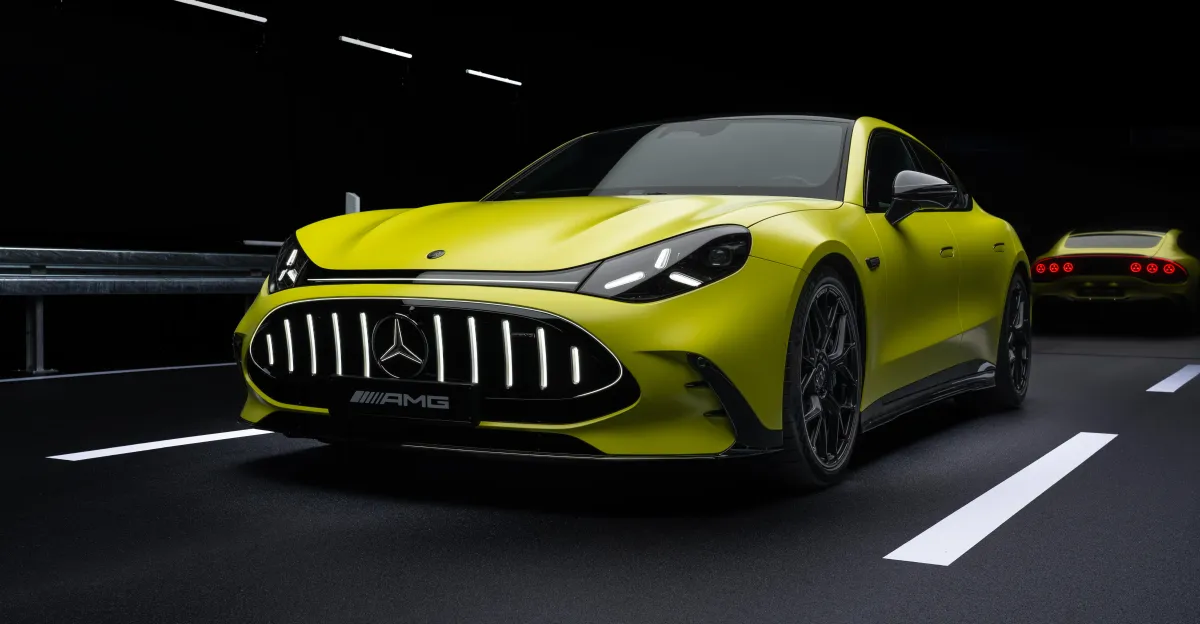

Mercedes-AMG Unleashes Electrified Hyper-Sedan with Breakthrough Engineering
Stuttgart, Germany – May 2026
Mercedes-Benz has officially unveiled its most audacious electric vehicle yet—the 2027 AMG GT 4-Door Coupe—an engineering tour de force packing Formula 1-derived technology, hypercar-rivaling power, and charging speeds that redefine performance EV benchmarks. With this launch, the German automaker signals its intent to dominate the high-performance electric segment, leveraging cutting-edge innovations first proven in its record-shattering Vision AMG XX concept.
From Concept to Reality: The Nardò Legacy
The production model inherits DNA from Mercedes’ experimental XX concept, which made headlines in 2025 by completing a staggering 40,075 kilometers (24,901 miles) in under eight days at Italy’s Nardò test track—equivalent to circumnavigating the globe—without overheating or significant performance drop-offs. The feat demonstrated the endurance potential of Mercedes’ next-gen axial-flux motors and advanced battery cooling, both of which are now central to the GT 4-Door Coupe’s design.
Next-Gen Powertrain: Lighter, Stronger, Faster
At the heart of the AMG GT’s propulsion system are three axial-flux motors developed by YASA, the British electric motor specialist acquired by Mercedes in 2021. Unlike conventional radial-flux motors, these compact, disc-shaped units deliver 1,153 horsepower and a seismic 1,475 lb-ft of torque while weighing one-third less than traditional designs. This marks the first deployment of axial-flux technology in a production car, offering a power density that rivals multi-million-dollar hypercars.
The battery system is equally revolutionary. Employing ultra-slim cylindrical cells (just 1 inch in diameter), Mercedes engineers prioritized thermal management through a Formula 1-inspired direct liquid cooling system. A proprietary non-conductive oil flows around each cell, providing 20 kW of cooling capacity—four times that of the brand’s EQS luxury sedan. The result? Unprecedented resistance to performance fade, even under repeated track use.
Charging Like a Smartphone
Built on an 800-volt architecture, the GT 4-Door Coupe supports 600 kW ultra-fast charging, replenishing its battery from 10-80% in just 11 minutes. Its adaptive voltage system seamlessly switches between 800V and 400V for compatibility with global DC networks, including NACS (Tesla standard) and CCS2. With an energy density of 298 Wh/kg—thanks to a nickel-cobalt-manganese-aluminum cathode and silicon-infused anode—the car balances range and rapid energy delivery.
A Digital Chassis with a “Race Engineer Core”
Mercedes has redefined vehicle control with the AMG Race Engineer Core, a centralized supercomputer running on the company’s proprietary MB.OS. Replacing dozens of dispersed control units, this system harmonizes powertrain response, suspension tuning, battery cooling, and energy recuperation in real time.
Inside, drivers are greeted by a triple-screen cockpit—a 10.2-inch instrument cluster, a 14-inch central touchscreen, and a matching passenger display—all unified under a single glass pane. Real-time telemetry on aerodynamics, battery heat, and energy flow caters to performance purists.
The Sound of (Artificial) Power
Acknowledging that electrification lacks auditory drama, Mercedes programmed 1,600 sound files simulating the growl of the AMG GT R’s V8, complete with faux exhaust burbles and simulated gearshifts. Custom tones also accompany door unlocks, ignition, and charging—a nod to tradition in a silent era.
Availability and the Road Ahead
The AMG GT 55 variant arrives in late 2026, followed by the more potent GT 63 in early 2027. While pricing remains undisclosed, the car’s positioning suggests a premium over the outgoing combustion model (which started near $100,000).
As Mercedes accelerates into electrification, the GT 4-Door Coupe represents both a technical milestone and a cultural gambit—proving that blistering speed and sustainability need not be mutually exclusive. Whether purists embrace its silent-but-deadly demeanor, however, remains the final frontier.
