



UK Bond Investors Brace for Political Turmoil as Local Elections Loom
The UK’s bond market, long a barometer of economic confidence, is facing a seismic shift as investors pivot their attention from monetary policy to the political arena. With local elections scheduled for next week, concerns are mounting that a poor showing for the ruling Conservative Party could destabilise the government and spark renewed volatility in gilts. This potential upheaval comes at a delicate time for the UK economy, which is still grappling with the aftermath of Brexit, inflationary pressures, and a fragile fiscal outlook. As markets brace for uncertainty, the political landscape is increasingly seen as the primary driver of investor sentiment—a stark departure from the traditional focus on central bank decisions.
The upcoming local elections on May 2nd represent a critical test for Prime Minister Rishi Sunak and his Conservative government, which has been trailing the opposition Labour Party in opinion polls for months. These elections, which will determine control of councils across England and mayoralties in key regions, are widely viewed as a litmus test for voter sentiment ahead of a general election expected later this year. A significant loss of Conservative seats could embolden calls for leadership changes within the party, further destabilising an already fractured government.
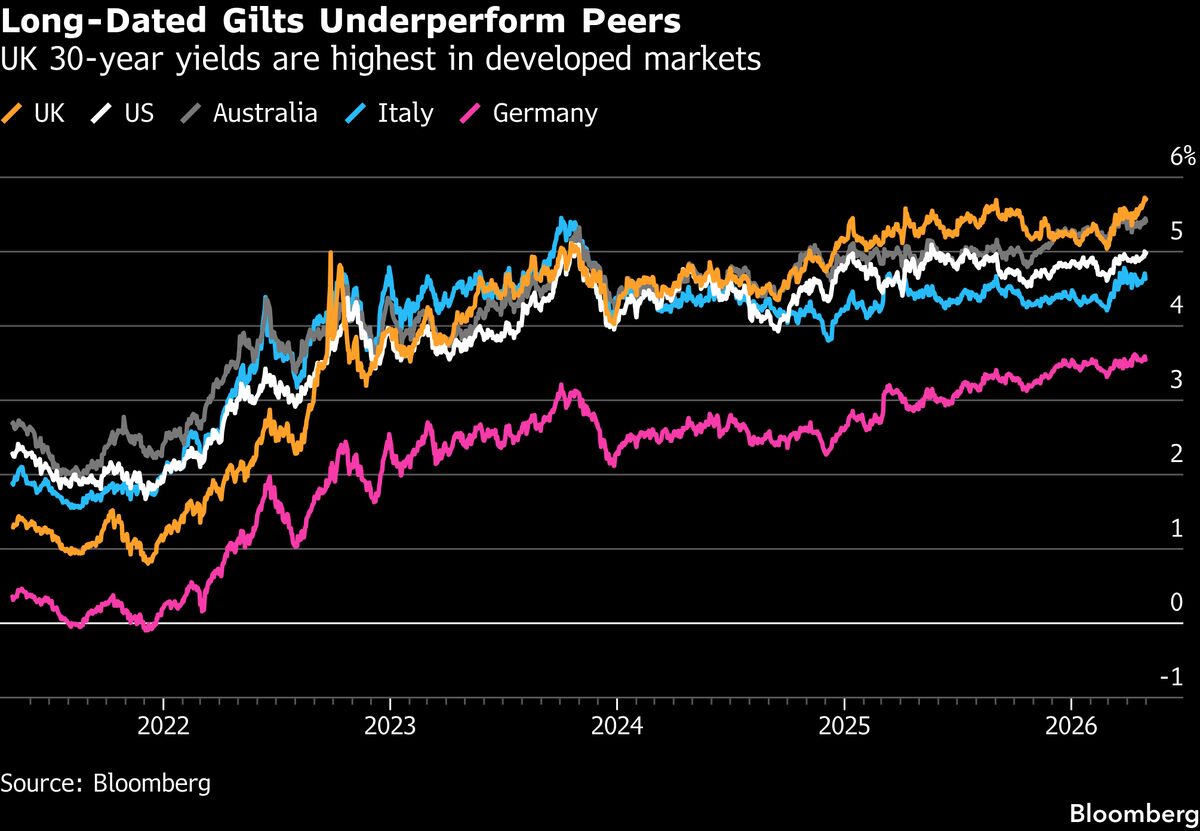
For bond investors, the spectre of political instability is deeply concerning. The UK gilt market has been relatively stable in recent months after the turbulence of Liz Truss’s brief premiership in 2022, during which her controversial fiscal policies prompted a historic selloff. However, the current environment remains fraught with risks. Inflation, though easing, remains stubbornly above the Bank of England’s 2% target, while public debt is hovering near historic highs. Any perception of a weakening government could reignite fears of fiscal indiscipline, putting upward pressure on bond yields.
The shift in focus from monetary policy to politics underscores the unique challenges facing the UK. While central banks globally have been the dominant force shaping bond markets in recent years, the UK’s post-Brexit trajectory has introduced a new layer of complexity. Investors are increasingly attuned to the possibility that political missteps could undermine economic stability, particularly in a country where fiscal and monetary policy are closely intertwined.
A Fragile Economic Backdrop
The UK economy is in a precarious position, with growth lagging behind many of its peers. GDP contracted by 0.3% in the final quarter of 2023, pushing the economy into a technical recession. While modest growth is expected this year, the recovery remains fragile, constrained by high borrowing costs and weak consumer confidence. The Bank of England has signalled that it may cut interest rates later this year, but policymakers remain cautious, wary of reigniting inflationary pressures.
Against this backdrop, the government’s fiscal position is under intense scrutiny. Public debt has surged to levels not seen since the 1960s, and the government’s ability to manage its finances effectively has become a key concern for investors. The Truss episode, during which unfunded tax cuts sent gilt yields soaring, serves as a cautionary tale. While Sunak and Chancellor Jeremy Hunt have sought to restore fiscal credibility, doubts persist about the government’s ability to maintain discipline in the face of mounting economic and political challenges.
The Political Stakes
The local elections are being closely watched as a gauge of the Conservatives’ prospects in the next general election. Polls suggest that Labour is on course for a significant victory, with projections indicating that the Tories could lose hundreds of council seats. Such a result would likely intensify pressure on Sunak from within his party, where divisions over policy and leadership have simmered for months.
A poor showing could also embolden the opposition, with Labour leader Keir Starmer positioning himself as the leader-in-waiting. Starmer has sought to project an image of fiscal responsibility, pledging to adhere to strict borrowing rules if elected. However, some investors remain wary of Labour’s policies, particularly its plans for increased public spending on infrastructure and social programs.
Market Implications
For bond markets, the immediate concern is that political instability could undermine confidence in the UK’s fiscal trajectory. This could lead to higher gilt yields, increasing borrowing costs for the government and exacerbating the country’s debt challenges. The pound could also come under pressure, particularly if uncertainty prompts a flight of foreign capital.
The Bank of England’s role adds another layer of complexity. While the central bank has sought to insulate monetary policy from political developments, it cannot operate in a vacuum. A prolonged period of political uncertainty could complicate the bank’s efforts to navigate a soft landing for the economy, potentially delaying rate cuts and prolonging pain for borrowers.
A Broader Global Context
The UK’s predicament is unfolding against a backdrop of global economic uncertainty. Central banks worldwide are grappling with the challenge of taming inflation without stifling growth, while geopolitical tensions and trade disruptions add to the headwinds. In this context, the UK’s political risks stand out as a unique vulnerability, highlighting the broader challenges facing post-Brexit Britain.
Looking Ahead
As the local elections approach, investors are hedging their bets, wary of the potential for unexpected outcomes. Some analysts argue that a Labour victory could ultimately bring stability, providing a clearer policy direction and reducing the risk of abrupt fiscal changes. Others caution that any change in government brings its own uncertainties, particularly for a country still finding its footing in a post-Brexit world.
For now, the UK bond market remains in wait-and-see mode, reflecting a broader sense of caution about what lies ahead. The coming weeks will be crucial in shaping the political and economic trajectory of the nation, with far-reaching implications for investors and policymakers alike. As one analyst aptly put it, “In the UK, politics has become the new monetary policy.”
In a world where economic stability hinges on political clarity, the stakes have never been higher. Whether the UK can navigate this turbulent period will depend on its ability to balance competing pressures—and restore investor confidence in the process. For now, the only certainty is uncertainty, as markets brace for a pivotal moment in the UK’s political and economic journey.
