


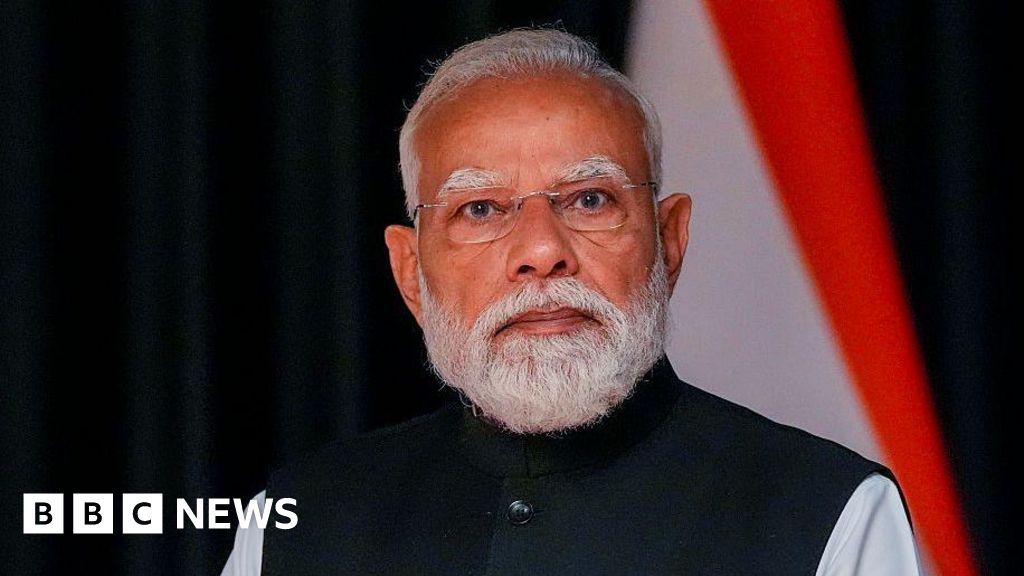

Indian Prime Minister Modi Faces Criticism for Avoiding Questions During Norway Visit
By [Your Name]
Oslo, Norway—In a moment that has sparked international debate, Indian Prime Minister Narendra Modi walked away from a joint press briefing in Oslo this week without answering questions, leaving journalists and observers questioning his transparency. The incident unfolded after a carefully orchestrated appearance alongside Norwegian Prime Minister Jonas Gahr Store, during which Modi addressed pre-prepared topics but avoided direct engagement with the press. As the Indian leader exited the stage, Norwegian journalist Helle Lyng called out, asking why he refused to take questions. Her query echoed in the hall, met with silence.
The episode, seemingly minor, has reignited longstanding concerns about Modi’s approach to media relations and accountability, raising broader questions about the state of democratic norms in one of the world’s largest democracies. Against a backdrop of global unrest and shifting power dynamics, Modi’s visit to Norway—and his avoidance of impromptu scrutiny—has drawn attention far beyond the borders of Europe and South Asia.
The Incident in Context
Prime Minister Modi’s two-day official visit to Norway was part of a broader diplomatic effort to strengthen bilateral ties between India and the Nordic nation. Discussions with Norwegian leaders centered on trade, climate change, and regional security, with both sides emphasizing cooperation in renewable energy and sustainable development. However, the optics of Modi’s refusal to engage with journalists quickly overshadowed the substantive outcomes of the trip.
The incident is emblematic of Modi’s longstanding practice of avoiding unscripted interactions with the press. During his tenure as Prime Minister, Modi has largely relied on controlled media environments, such as pre-recorded interviews and orchestrated speeches, rather than spontaneous press conferences. Critics argue that this approach undermines democratic principles, particularly in a country like India, where freedom of the press has increasingly come under strain in recent years.
Global Implications
The fallout from Modi’s Oslo appearance extends beyond mere protocol. In an era defined by geopolitical uncertainty and authoritarian resurgence, the behavior of democratic leaders on the global stage carries significant weight. India, as the world’s largest democracy and a rising economic and military power, is seen as a counterbalance to China’s influence in the Indo-Pacific region. However, Modi’s avoidance of press scrutiny fuels concerns that democratic values are eroding under his leadership.
This is not an isolated incident. Modi’s administration has faced criticism for its handling of dissent within India, including the targeting of journalists, activists, and opposition figures. Global human rights organizations have raised alarms about shrinking press freedoms and the use of state power to silence critics. As India positions itself as a key player in international forums, including the G20 and the United Nations, Modi’s actions in Oslo serve as a reminder of the challenges facing democratic governance in the 21st century.
A Pattern of Behavior
Modi’s reluctance to take questions is consistent with his broader approach to media engagement. Since assuming office in 2014, he has held only a handful of press conferences, preferring instead to communicate through social media and scripted appearances. This strategy has allowed him to maintain tight control over his public image but has drawn criticism from press freedom advocates and opposition leaders alike.
In India, where the media landscape is increasingly polarized, Modi’s approach has emboldened those who seek to suppress dissent. Journalists critical of the government have faced harassment, legal action, and even physical violence. Against this backdrop, Modi’s actions in Oslo are seen as a troubling extension of his domestic policies, reinforcing concerns about the erosion of democratic norms in one of the world’s most populous nations.
Why It Matters
The global implications of Modi’s actions cannot be overstated. As authoritarian regimes rise and democratic institutions falter, the behavior of elected leaders on the international stage serves as a barometer of democratic health. Modi’s refusal to engage with journalists in Oslo sends a signal that transparency and accountability are not priorities for his administration, undermining India’s credibility as a democratic leader.
Moreover, the incident highlights the growing tension between India’s aspirations for global leadership and its domestic challenges. As Modi seeks to position India as a key player in international affairs, his administration’s handling of press freedoms and dissent will continue to draw scrutiny. The Oslo incident is a reminder that actions speak louder than words—and that true leadership requires a commitment to democratic principles, even in the face of uncomfortable questions.
A Broader Trend
Modi’s actions are part of a broader trend among global leaders who seek to avoid direct engagement with the press. From Russia’s Vladimir Putin to Turkey’s Recep Tayyip Erdoğan, authoritarian leaders have increasingly relied on controlled media environments to shape their public narratives. However, Modi’s case is particularly concerning because it involves the leader of a nation that prides itself on its democratic heritage.
In a world where trust in institutions is increasingly fragile, the actions of leaders like Modi have far-reaching consequences. By avoiding accountability, they contribute to a culture of opacity and impunity, eroding public trust in the very institutions that underpin democracy.
Conclusion
Narendra Modi’s refusal to take questions in Oslo was more than a momentary lapse in protocol—it was a microcosm of the challenges facing democracy in an era of authoritarian resurgence. As India seeks to assert itself on the global stage, its leader’s actions will continue to be scrutinized for what they reveal about the state of democratic governance.
In the end, the ability to answer tough questions is not just a matter of protocol—it is a test of leadership. For Modi and India, the Oslo incident serves as a stark reminder that transparency and accountability are not optional extras but essential components of democracy. As the world watches, the question remains: Will India rise to the challenge, or will it succumb to the pressures of authoritarianism? The answer will shape not only India’s future but the future of democracy itself.
