


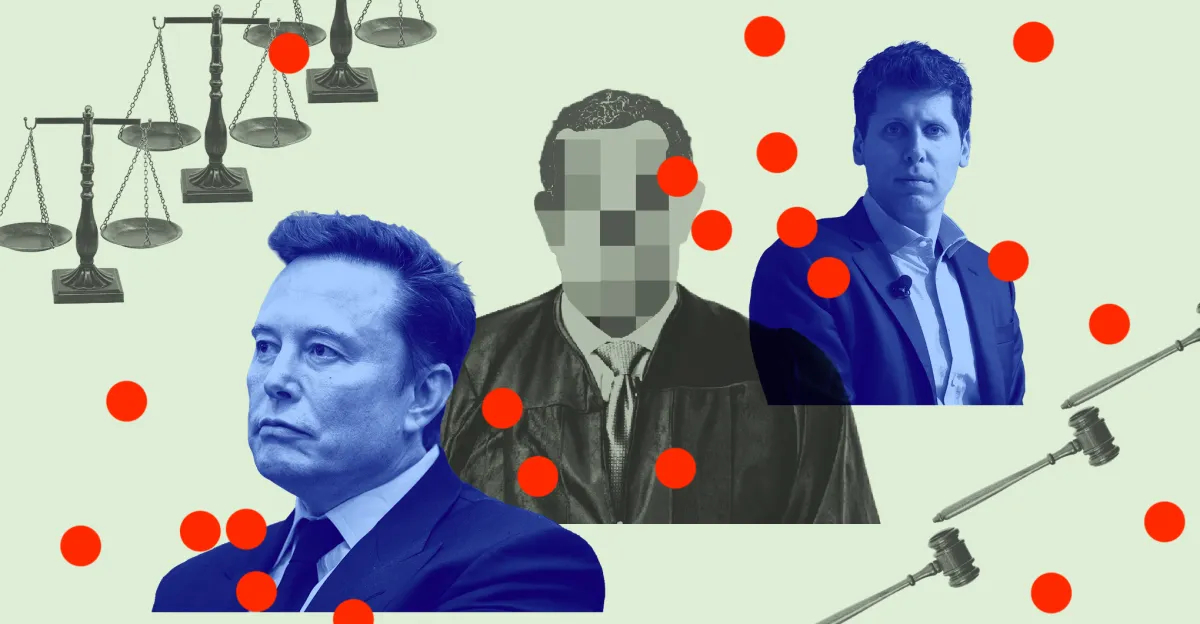

Elon Musk’s Legal Team Faces Scrutiny After Courtroom Revelation in OpenAI Dispute
In a dramatic twist during a high-stakes legal battle, Elon Musk’s legal representatives may have inadvertently opened a Pandora’s box of complications, potentially exposing the Tesla and SpaceX CEO to further scrutiny. The incident unfolded in a California courtroom this week, where Jared Birchall, Musk’s longtime confidant and financial advisor, testified in a case involving OpenAI. What began as a routine examination took an unexpected turn when Birchall’s testimony revealed controversial details about Musk’s bid for OpenAI’s assets, raising questions about the transparency and strategy of Musk’s legal team.
The case centers on OpenAI, the artificial intelligence research organization co-founded by Musk in 2015, which has since become a major player in the AI industry. Musk, who left OpenAI’s board in 2018, has been critical of the organization’s shift from a nonprofit to a for-profit model. The courtroom drama stems from Musk’s earlier bid—through his AI venture, xAI—to acquire OpenAI’s nonprofit arm for a staggering $97.4 billion in February 2025, a move that has since become a focal point of legal contention.
Birchall’s testimony was largely procedural until the latter stages, when a note passed to Musk’s lead attorney, Marc Toberoff, prompted a surprising line of questioning. Birchall was asked whether he was familiar with xAI’s bid for OpenAI’s assets. His response was both revealing and potentially damaging. “Sam Altman was on both sides of the table,” Birchall stated, referring to OpenAI’s CEO and his alleged dual role in negotiations. According to Birchall, Altman was negotiating on behalf of both OpenAI’s nonprofit and for-profit entities, raising concerns about conflicts of interest and the undervaluation of the nonprofit’s assets.
This revelation led to a flurry of objections from OpenAI’s legal team, led by Bradley Wilson of Wachtell Lipton. Wilson argued that Birchall’s testimony lacked foundation and sought to have it struck from the record. The jury was dismissed as the lawyers sparred over the admissibility of the testimony, with Judge Yvonne Gonzalez Rogers intervening to question Birchall directly.
The judge’s questioning exposed gaps in Birchall’s recollection and legal comprehension. Birchall admitted he had no firsthand knowledge of discussions between Musk and other key figures, such as Shivon Zilis, about the bid. He also confirmed that he did not recall who had decided on the $97.4 billion figure, claiming it came from Musk’s legal team rather than Musk himself. Judge Gonzalez Rogers expressed skepticism, noting Birchall’s inability to provide coherent accounts of his involvement in raising such a colossal sum. “You must have been very convincing,” she remarked. “You’re not very convincing today.”
The courtroom exchange deepened when Toberoff took responsibility for the note that triggered the questioning, claiming it was “appropriate” to introduce the topic. However, Judge Gonzalez Rogers raised eyebrows by suggesting that Toberoff may have intended to “open the door” to further scrutiny. Legal experts speculate that this could pave the way for OpenAI’s lawyers to pursue additional discovery into Musk’s bid, potentially uncovering more details about its origins and motivations.
The timing of these revelations is particularly sensitive given OpenAI’s ongoing restructuring efforts to prepare its for-profit arm for a public offering. Musk’s bid, which came during this period, has been portrayed by his team as an attempt to ensure fair valuation of OpenAI’s nonprofit assets. However, critics argue that it could also be seen as an effort to exert control over a competitor in the rapidly evolving AI sector.
This latest development adds to the growing list of legal and regulatory challenges facing Musk, who has been embroiled in high-profile disputes with regulators, investors, and business rivals in recent years. The OpenAI case also highlights the complexities of AI governance and the ethical dilemmas surrounding the commercialization of AI technologies.
As the trial continues, all eyes will be on Judge Gonzalez Rogers’ ruling on the admissibility of Birchall’s testimony, which is expected to be delivered imminently. Her decision could have far-reaching implications for both Musk and OpenAI, shaping the narrative around one of the most contentious chapters in the AI industry’s history.
For now, the courtroom drama serves as a reminder of the high stakes involved in the intersection of technology, law, and ambition. Whether Musk’s legal team’s strategy will ultimately prove to be a misstep or a calculated maneuver remains to be seen, but one thing is certain: the outcome of this case will resonate far beyond the walls of the courtroom.
