


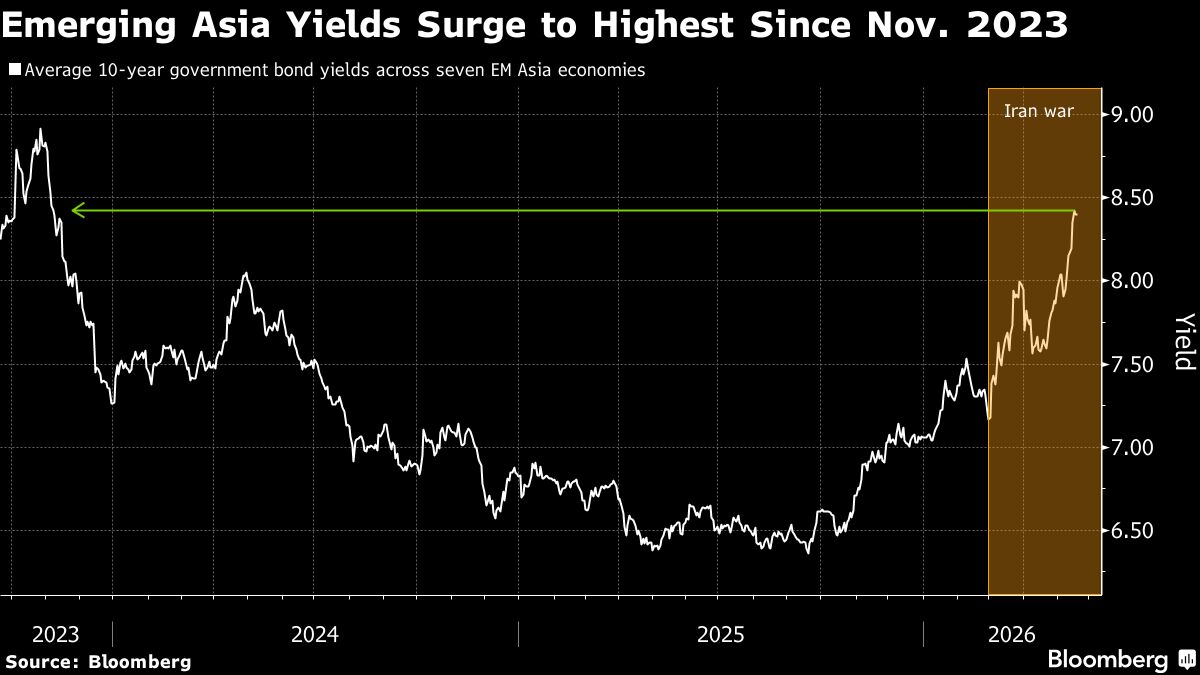

Emerging Asian Markets Face Mounting Pressure Amid Rising Iran Tensions
As geopolitical tensions in the Middle East escalate, emerging markets across Asia are feeling the ripple effects, with currencies and bond yields plunging to concerning levels. The intensifying conflict involving Iran has sent shockwaves through global financial systems, prompting investors to flee riskier assets in favor of safer havens. Countries such as India, Indonesia, and Malaysia, already grappling with economic vulnerabilities, are now facing heightened volatility and capital outflows as the crisis unfolds.
Geopolitical Uncertainty Spurs Market Turmoil
The recent spike in tensions between Iran and its regional adversaries, coupled with broader instability in the Middle East, has amplified fears of a protracted conflict. For emerging Asian economies, which are heavily reliant on stable global trade and investment flows, the situation poses significant challenges. The uncertainty has spurred a rush toward safe-haven assets like the U.S. dollar, gold, and government bonds in developed economies, leaving emerging markets exposed to sharp currency depreciations and rising borrowing costs.
Currencies such as the Indian rupee, Indonesian rupiah, and Malaysian ringgit have all weakened considerably in recent weeks. The Indian rupee, for instance, has hovered near record lows against the dollar, raising concerns about import costs and inflation in one of Asia’s largest economies. Similarly, bond yields in these countries have surged as investors demand higher returns to compensate for increased risk.
Economic Vulnerabilities Amplify Impact
Asia’s emerging markets are no strangers to external shocks, but the current crisis comes at a particularly delicate time. Many economies in the region are still recovering from the lingering effects of the COVID-19 pandemic, which disrupted supply chains, dampened consumer demand, and strained public finances. Rising interest rates in advanced economies, led by the U.S. Federal Reserve, had already put pressure on these markets, forcing central banks to tighten monetary policy to prevent capital flight.
The Iran conflict adds another layer of complexity to an already fragile economic environment. Higher oil prices, driven by fears of supply disruptions, are particularly concerning for net energy importers like India and Thailand. Escalating fuel costs could exacerbate inflationary pressures and widen trade deficits, further straining these economies.
Investor Sentiment Turns Cautious
The prevailing mood among investors is one of caution. According to analysts, the flight to safety has accelerated in recent days, with many pulling funds out of emerging markets to minimize exposure to geopolitical risks. This shift has been particularly pronounced in equity markets, where stocks in countries like Indonesia and the Philippines have seen significant declines.
“Emerging markets are always sensitive to global uncertainty, but the current situation is particularly troubling,” said Priya Menon, a senior economist at a global financial consultancy. “With the conflict in Iran showing no signs of abating, investors are recalibrating their portfolios to reflect heightened risks.”
Central banks across Asia are scrambling to stabilize their economies. In India, the Reserve Bank of India (RBI) has intervened in currency markets to stem the rupee’s decline, while Indonesia’s central bank has raised interest rates to attract foreign capital. However, such measures may provide only temporary relief, as the root causes of the crisis—geopolitical instability and global economic uncertainty—remain unresolved.
Broader Implications for Global Economy
The turmoil in Asian emerging markets is not an isolated phenomenon. It reflects broader vulnerabilities in the global economy, which has been grappling with multiple, overlapping crises in recent years. From the COVID-19 pandemic to climate change-induced disruptions, these challenges have tested the resilience of even the most robust economies.
Emerging markets, however, are uniquely susceptible to external shocks due to their reliance on foreign investment and trade. The current crisis underscores the interconnectedness of global financial systems and the potential for regional conflicts to have far-reaching consequences.
Economists warn that prolonged instability in the Middle East could lead to a wider economic slowdown, particularly if oil prices remain elevated. Higher energy costs would not only impact emerging markets but also weigh on growth in advanced economies, where inflationary pressures are already a concern.
Looking Ahead: A Delicate Balancing Act
As the situation evolves, policymakers in emerging markets face a delicate balancing act. On one hand, they must address immediate economic challenges, such as currency volatility and inflationary pressures. On the other hand, they must navigate the broader geopolitical landscape, which remains highly unpredictable.
International organizations, including the International Monetary Fund (IMF) and the World Bank, have called for coordinated action to mitigate the economic fallout from the crisis. However, with geopolitical tensions showing no signs of easing, such efforts may fall short.
For investors, the path ahead is fraught with uncertainty. While emerging markets offer attractive growth prospects over the long term, the current environment demands a cautious approach. Diversification and risk management will be key to navigating the challenges ahead.
Conclusion
The escalating tensions in Iran have cast a long shadow over emerging Asian markets, exacerbating existing vulnerabilities and testing the resilience of these economies. As currencies weaken and bond yields rise, policymakers and investors alike are being forced to confront the realities of a rapidly changing geopolitical landscape. While the full impact of the crisis remains uncertain, one thing is clear: emerging markets will need to brace for continued volatility in the weeks and months ahead. In a world increasingly shaped by uncertainty, adaptability and preparedness will be essential to weathering the storm.
