


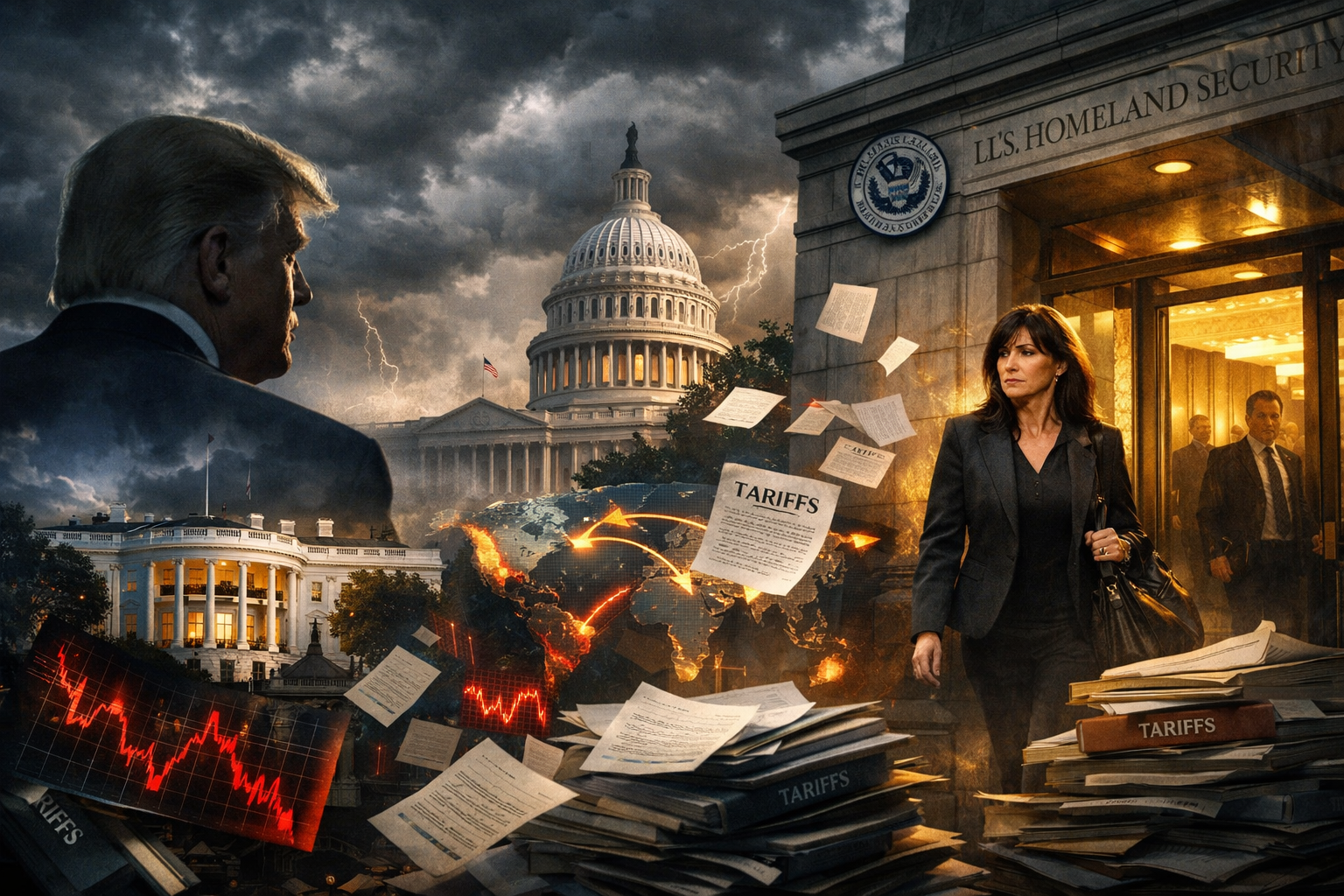

America in the Last 24 Hours: Cabinet Upheaval, Tariff Shockwaves, and a Nation Navigating Global Conflict
The United states has experienced a turbulent 24 hours marked by major developments in government leadership, economic policy, and foreign affairs. Decisions emerging from the White House, federal courts, and Congress have triggered political debate across the country while international tensions continue to reshape American strategic priorities.
Taken together, these events illustrate a moment of intense political, economic, and geopolitical pressure for the United States, as policymakers confront both domestic legal battles and global security challenges.
White House Upheaval: Homeland Security Leadership Removed
One of the most consequential developments came from the executive branch, where President Donald J. Trump abruptly removed Kristi Noem as Secretary of the Department of Homeland Security, one of the most powerful security posts in the federal government.
The Department of Homeland Security (DHS) oversees immigration enforcement, counterterrorism, cybersecurity, disaster response, and transportation security. Noem’s removal marks the first cabinet-level firing of Trump’s second presidential term, highlighting rising tensions inside the administration.
The president has nominated Senator Markwayne Mullin of Oklahoma to replace her. Mullin, a staunch supporter of the administration’s immigration policies and a former member of the House of Representatives, will assume the role pending Senate confirmation.
Noem’s tenure had become controversial after several incidents drew bipartisan scrutiny. Among them were fatal law-enforcement encounters involving federal officers and criticism surrounding a $220 million advertising campaign tied to immigration messaging.
Political analysts note that the removal also reflects broader internal tensions over immigration enforcement strategy.
According to Michael Bender of The New York Times, leadership shifts at DHS often signal deeper policy disagreements inside the White House, particularly when immigration and national security debates intensify in Congress.
In an unusual move, Noem was reassigned to a newly created diplomatic role as Special Envoy for the “Shield of the Americas,” a regional security initiative expected to be unveiled later this week.
The reshuffle underscores how central immigration and border policy remain to national political debates.
Courts Force Massive Tariff Refunds
While Washington processed the cabinet shake-up, a major legal and economic story unfolded in the federal courts.
A judge at the U.S. Court of International Trade, Judge Richard Eaton, is now overseeing a process that could require the federal government to refund as much as $130 billion to $175 billion in tariffs previously collected under Trump administration trade policies.
The refunds stem from a Supreme Court decision that found the administration had exceeded its authority when imposing sweeping tariffs under emergency economic powers legislation.
The ruling built on earlier litigation known as V.O.S. Selections v. Trump, in which a panel of trade court judges concluded that the use of the International Emergency Economic Powers Act (IEEPA) to justify tariffs went beyond the law’s intended scope.
Economists at the Penn Wharton Budget Model, a research center at the University of Pennsylvania, estimate that the federal government could face one of the largest refund obligations in modern trade history if courts require repayment to importers.
The case was initially brought by Atmus Filtration Inc., a Tennessee-based company that argued it had paid millions of dollars in tariffs that were later declared unlawful.
Legal scholars say the ruling could have far-reaching implications for the balance of power between the presidency and Congress in trade policy.
Timothy Meyer, a professor of international law at Duke University, has argued that courts are increasingly scrutinizing the use of emergency authorities in economic policy because such powers were never intended to replace legislative trade decisions.
At the same time, more than twenty U.S. states have filed additional lawsuits challenging new tariffs introduced by the administration, arguing that they increase consumer prices and bypass congressional oversight.
The legal battles highlight how trade policy remains a central economic issue affecting both businesses and consumers.
Congress Confronts War Powers Debate
Another major issue dominating Washington is the escalating conflict involving the United States, Israel, and Iran.
Members of Congress returned to Washington this week amid intensifying debates over whether the president should face new restrictions on military authority.
Efforts to pass legislation limiting presidential war powers in relation to the Iran conflict have so far failed in the Senate.
Supporters of the administration argue that restricting military authority could weaken American deterrence at a moment of geopolitical danger. Critics counter that Congress must retain its constitutional role in deciding when the United States enters armed conflict.
According to Barbara Slavin, a Middle East specialist at the Stimson Center, the current tensions reflect a longstanding strategic dilemma in American foreign policy: balancing deterrence against escalation.
“Every military exchange increases the risk of regional spillover,” she has argued in previous analyses of U.S.–Iran relations.
Military strategists also note that the conflict is becoming a testing ground for emerging technologies, including artificial intelligence systems used in battlefield targeting and defense coordination.
The Pentagon has not disclosed the full extent of U.S. operational involvement, but officials say American forces remain on high alert across the region.
Economic and Political Implications
The combination of cabinet upheaval, trade litigation, and geopolitical tension has created an unusually volatile policy environment in Washington.
Economists warn that tariff refund obligations could complicate federal budgeting while ongoing legal disputes create uncertainty for businesses engaged in international trade.
Meanwhile, immigration enforcement remains one of the most polarizing issues in American politics, with DHS leadership changes likely to intensify congressional oversight and partisan debate.
Political scientists at institutions such as Brookings and Harvard’s Kennedy School of Government have frequently noted that moments when economic disputes, national security crises, and domestic political battles intersect tend to produce periods of heightened institutional stress.
This moment appears to fit that pattern.
A Nation Balancing Crisis and Continuity
Despite the political turbulence dominating headlines, everyday life across the United States continues largely unchanged.
Markets are responding cautiously to legal developments in trade policy. Businesses are watching court proceedings closely to determine whether refunds will materialize and how quickly.
Meanwhile lawmakers continue negotiating federal funding measures, including the budget for the Department of Homeland Security.
Taken together, the developments of the past 24 hours reflect a country confronting multiple simultaneous challenges:
• leadership changes within national security institutions
• sweeping court rulings affecting trade policy
• escalating geopolitical tensions in the Middle East
• growing legal and constitutional debates over presidential power
For observers of American governance, the moment offers a vivid reminder that the nation’s political system is constantly balancing competing pressures from the courts, Congress, the executive branch, and global events.
