


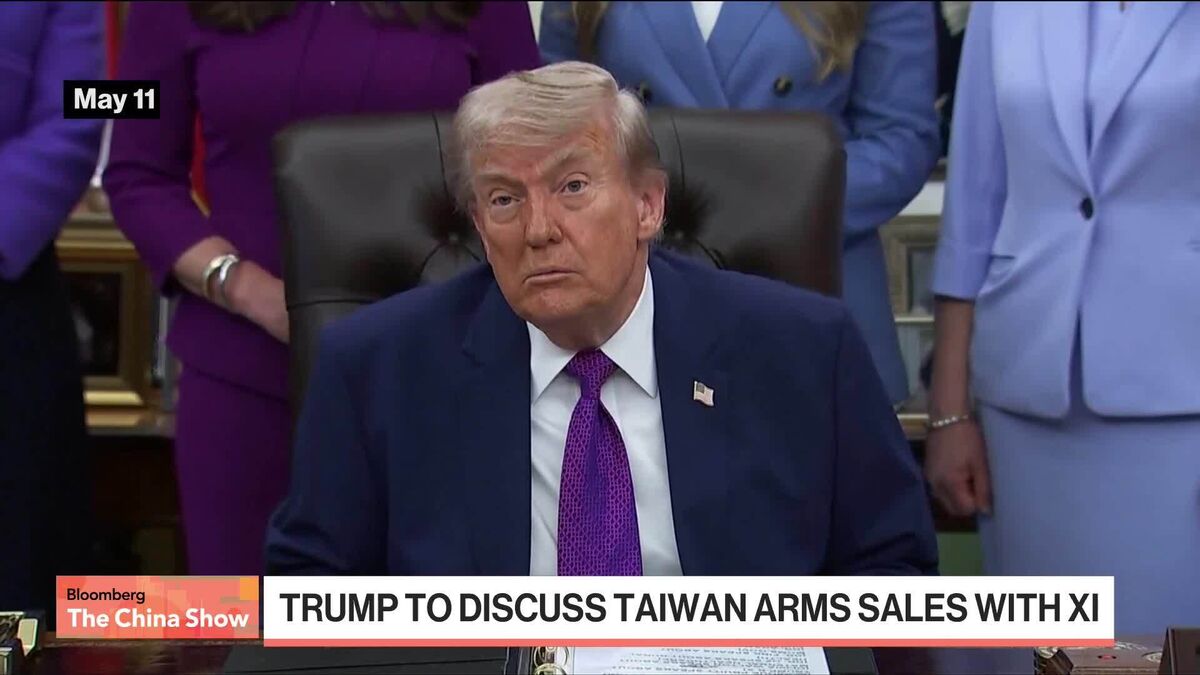

Trump’s Taiwan Arms Sales Comment Sparks Tensions Ahead of Xi Meeting
Washington, D.C. – In a move that risks escalating diplomatic tensions ahead of a pivotal meeting with Chinese leader Xi Jinping, U.S. President Donald Trump announced on Tuesday that he plans to discuss U.S. arms sales to Taiwan during their upcoming talks. The statement, which came just days before the two leaders are set to convene, has drawn sharp criticism from Beijing and raised concerns over the future of U.S.-China relations, as well as Washington’s longstanding policy regarding the self-governing island.
The announcement marks a significant departure from the delicate diplomatic balancing act the United States has maintained for decades regarding Taiwan. Washington officially recognizes Beijing as the sole legitimate government of China under the One-China Policy, which has been a cornerstone of Sino-American relations since the 1970s. However, the U.S. has continued to provide Taiwan with defensive weapons under the Taiwan Relations Act, a practice that has long been a source of friction with Beijing.
A Delicate Diplomatic Landscape
Taiwan, officially known as the Republic of China, has been a flashpoint in U.S.-China relations for decades. The island has governed itself independently since 1949, when Nationalist forces fled mainland China after losing the civil war to the Communist Party. Beijing views Taiwan as a breakaway province and has vowed to reunify it with the mainland, by force if necessary. The U.S., while adhering to the One-China Policy, has consistently supported Taiwan’s self-defense capabilities, a stance that has angered Chinese leaders.
Trump’s decision to bring arms sales into his discussions with Xi represents a bold and potentially disruptive move. Traditionally, U.S. presidents have avoided publicly linking Taiwan with bilateral talks, opting instead to handle such matters discreetly to avoid provoking Beijing. By placing the issue on the agenda, Trump risks undermining decades of diplomatic nuance and further straining an already fragile relationship.
“It’s a highly sensitive topic,” said Bonnie Glaser, director of the China Power Project at the Center for Strategic and International Studies. “The Chinese have always been very clear that they see Taiwan as a core interest, and any perceived encroachment on that issue could have significant repercussions.”
Beijing’s Sharp Response
China’s Foreign Ministry was quick to condemn Trump’s remarks, reiterating its unwavering stance on Taiwan. In a statement released Wednesday, spokesperson Hua Chunying urged the U.S. to “strictly abide by the One-China Principle” and warned that any interference in Taiwan’s affairs would be met with “resolute opposition.”
“The Chinese government is determined to safeguard national sovereignty and territorial integrity,” Hua said. “We urge the U.S. to handle Taiwan-related issues with caution and refrain from sending the wrong signals to separatist forces.”
Analysts fear that Trump’s approach could embolden Taiwanese leaders to push for greater independence, a move that Beijing has consistently warned could trigger military action. Taiwan’s government, meanwhile, has cautiously welcomed the prospect of continued U.S. support.
“Taiwan is committed to maintaining peace and stability in the region,” said Taiwanese Foreign Minister Joseph Wu in a statement. “We appreciate the U.S.’s commitment to our defense and hope that any discussions will contribute to our security.”
The Broader Geopolitical Context
The timing of Trump’s announcement is particularly significant, coming amid a backdrop of heightened tensions between the U.S. and China on multiple fronts. The two nations are locked in a protracted trade war that has disrupted global markets and threatened economic stability. Additionally, disputes over technology, cybersecurity, and territorial claims in the South China Sea have further complicated the relationship.
Taiwan has emerged as a focal point in this broader geopolitical struggle, with both Washington and Beijing viewing the island as a strategic linchpin in the region. For the U.S., Taiwan represents a critical ally in countering China’s growing influence in Asia. For China, Taiwan is a non-negotiable element of its national sovereignty.
“The Taiwan issue is inseparable from the larger U.S.-China rivalry,” said Richard Bush, a senior fellow at the Brookings Institution. “It’s not just about arms sales; it’s about the broader dynamics of power and influence in the Asia-Pacific region.”
Trump’s Unorthodox Approach
Trump’s willingness to openly discuss arms sales with Xi reflects his unorthodox approach to diplomacy, which has often prioritized direct negotiation over traditional protocol. While some argue that this approach could yield breakthroughs, others worry that it risks destabilizing carefully calibrated relationships.
“Trump’s style is certainly unconventional,” said Susan Thornton, former Acting Assistant Secretary of State for East Asian and Pacific Affairs. “But when it comes to Taiwan, the stakes are incredibly high. Any misstep could have far-reaching consequences.”
The upcoming meeting between Trump and Xi is being closely watched by policymakers and analysts around the world. While both leaders have expressed optimism about reaching a trade deal, the inclusion of Taiwan in their discussions could overshadow other agenda items and complicate negotiations.
A Delicate Balancing Act
For the U.S., navigating the Taiwan issue requires a delicate balancing act. On one hand, Washington has a moral and strategic obligation to support Taiwan’s democratic government and ensure its security. On the other hand, it must avoid actions that could provoke a military confrontation with China, which would have devastating consequences for the region and beyond.
“The U.S. has to tread carefully,” said Michael Auslin, a fellow at the American Enterprise Institute. “Taiwan is a crucial ally, but the U.S. also needs to manage its relationship with China in a way that doesn’t escalate tensions unnecessarily.”
As Trump prepares to meet with Xi, the world will be watching to see how the two leaders navigate this complex and contentious issue. The outcome of their discussions could have profound implications for U.S.-China relations, regional stability, and the future of Taiwan.
In a world increasingly shaped by geopolitical rivalries, the Taiwan issue serves as a stark reminder of the fine line between diplomacy and confrontation. Whether Trump’s approach will yield progress or provoke further conflict remains to be seen.
