


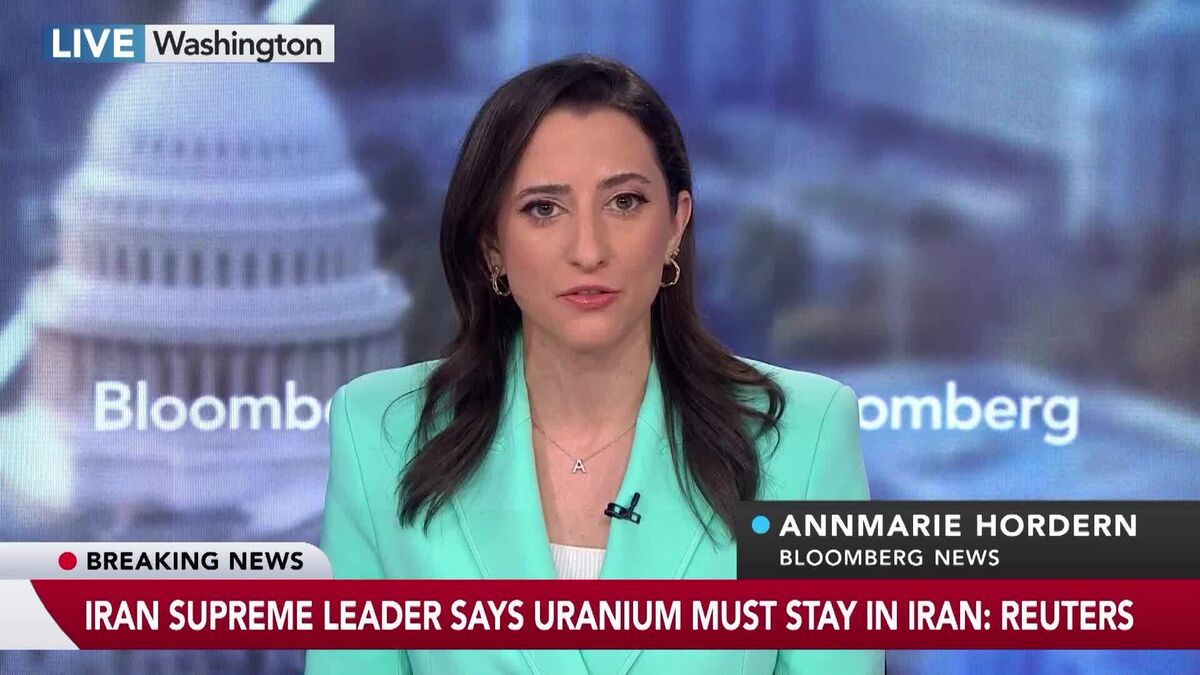

Iran’s Supreme Leader Asserts Enriched Uranium Must Remain Domestic, Escalating Tensions with the U.S.
In a move that threatens to escalate tensions between Tehran and Washington, Iran’s Supreme Leader Ayatollah Ali Khamenei declared on Wednesday that all enriched uranium produced in the country must remain within its borders, effectively ruling out any possibility of exporting it as part of a potential nuclear deal. The announcement, reported by Reuters, has sent shockwaves through global markets, with oil prices surging amid fears of a renewed standoff between the two nations. This development comes just a day after U.S. President Donald Trump stated that Washington was in the “final stages” of diplomatic negotiations with Iran, suggesting a potential resolution to years of strained relations. However, Khamenei’s latest remarks appear to complicate efforts to reach a lasting agreement, raising questions about the future of Iran’s nuclear program and its implications for global security.
The Context of Iran’s Nuclear Program
Iran’s nuclear program has been a source of international concern for decades, with Western powers accusing Tehran of seeking to develop nuclear weapons under the guise of a civilian energy program. These suspicions culminated in 2015 with the signing of the Joint Comprehensive Plan of Action (JCPOA), commonly known as the Iran Nuclear Deal. The agreement, brokered by the United States, the United Kingdom, France, Germany, Russia, and China, imposed strict limits on Iran’s uranium enrichment activities in exchange for the lifting of crippling economic sanctions. However, the pact began to unravel in 2018 when President Trump unilaterally withdrew the U.S. from the deal, citing its failure to address Iran’s ballistic missile program and regional influence.
Since then, Iran has gradually scaled back its compliance with the JCPOA, increasing its uranium enrichment levels and stockpiles beyond the limits set by the agreement. Tehran has insisted that its actions are reversible and that it remains committed to diplomacy, but the international community has grown increasingly alarmed by its provocative steps. Against this backdrop, Khamenei’s latest statement underscores Iran’s determination to assert its sovereignty over its nuclear program, even at the risk of further isolating itself from the global community.
Khamenei’s Statement and Its Implications
Speaking to Iranian officials on Wednesday, Ayatollah Khamenei emphasized that Iran’s enriched uranium must not be exported under any circumstances, effectively rejecting one of the key components of the JCPOA. “Our enriched uranium must remain in the country,” he said, according to Reuters. “Exporting it would be a betrayal of the nation’s interests.” While Khamenei did not explicitly reference the ongoing diplomatic talks with the U.S., his remarks were widely interpreted as a direct response to President Trump’s statement the previous day.
The timing of Khamenei’s declaration has raised eyebrows, coming just as the Biden administration has signaled its willingness to re-engage with Tehran on the nuclear issue. President Biden, who served as vice president when the JCPOA was negotiated, has expressed a desire to revive the deal, albeit with modifications to address its perceived shortcomings. However, Khamenei’s insistence on retaining enriched uranium suggests that Iran may be unwilling to compromise on what it views as a critical aspect of its national security strategy.
Global Markets React to Rising Tensions
The prospect of renewed friction between Iran and the U.S. has sent ripples through global markets, particularly in the energy sector. Oil prices surged following Khamenei’s announcement, with Brent crude climbing more than 2% to surpass $85 per barrel. Analysts attributed the spike to fears that a breakdown in diplomacy could disrupt global oil supplies, given Iran’s status as a major producer.
“Any escalation in U.S.-Iran tensions has the potential to drive oil prices higher,” said Annmarie Hordern, a senior energy analyst at Bloomberg. “The market is particularly sensitive to developments in Iran because of its strategic location in the Persian Gulf, a key transit route for global oil shipments.”
The situation is further complicated by the fact that Iran and the U.S. have yet to establish a clear framework for negotiations. While both sides have expressed a willingness to engage in dialogue, there remains a significant gap in their respective positions, particularly regarding sanctions relief and the scope of Iran’s nuclear activities.
The Road Ahead: Diplomacy or Confrontation?
The latest developments underscore the challenges facing U.S.-Iran diplomacy, which has been marked by mutual distrust and conflicting priorities. For Iran, the nuclear program represents a cornerstone of its national identity and a source of leverage in negotiations with Western powers. For the U.S., the program is a potential threat to regional stability and global security, particularly given Iran’s alleged support for militant groups in the Middle East.
Despite these obstacles, diplomatic engagement remains the most viable path forward, according to experts. “The alternative to diplomacy is a dangerous escalation that could spiral out of control,” said Trita Parsi, a Middle East expert and author of Losing an Enemy: Obama, Iran, and the Triumph of Diplomacy. “Both sides have much to gain from a negotiated settlement, but they will need to demonstrate flexibility and goodwill to make it happen.”
As the world watches anxiously, the next steps taken by Tehran and Washington will be crucial in determining whether the two nations can overcome their differences or whether they are headed for another prolonged standoff. For now, the ball appears to be in Iran’s court, with Khamenei’s remarks signaling a hardening of its position. Yet, amidst the uncertainty, one thing remains clear: the stakes could not be higher for the future of Iran’s nuclear program—and for global peace and security.
Conclusion
The latest chapter in the U.S.-Iran saga highlights the delicate balance between diplomacy and confrontation. While Ayatollah Khamenei’s insistence on retaining enriched uranium suggests a firm stance, it also underscores the complexities of negotiating a lasting resolution to the nuclear impasse. As both sides weigh their options, the world waits to see whether pragmatism or principle will prevail in shaping the path ahead.
