


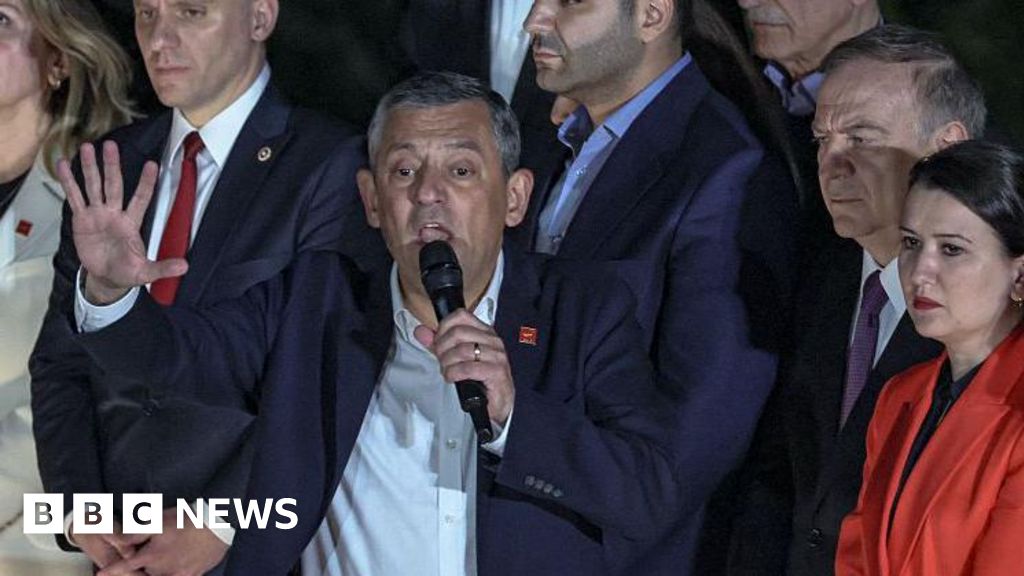

Turkish Court Overturns Opposition Leader’s Victory, Deepening Political Crisis
A Blow to Democracy: Court Nullifies Özgür Özel’s Leadership Win
In a move that has sent shockwaves through Turkey’s political landscape, an appeals court has overturned the election victory of Özgür Özel as leader of the Republican People’s Party (CHP), dealing a severe blow to the country’s beleaguered opposition. The ruling, widely seen as another step in President Recep Tayyip Erdoğan’s consolidation of power, raises urgent questions about the future of democracy in a nation already grappling with economic turmoil and shrinking civil liberties.
The decision not only undermines the legitimacy of Turkey’s largest opposition party but also reinforces fears of judicial interference in politics—a trend that has grown alarmingly frequent under Erdoğan’s long rule. With local elections looming in 2024, the court’s intervention threatens to further destabilize an already polarized society, casting a shadow over Turkey’s democratic institutions at a time when the country can ill afford more division.
The Ruling and Its Immediate Fallout
The Ankara appeals court declared Özel’s September 2023 leadership victory “void” on procedural grounds, citing alleged irregularities in the internal election process. The CHP, Turkey’s oldest political party and the primary opposition force, has denounced the decision as politically motivated, accusing the judiciary of acting under government pressure.
Özel, a former pharmacist turned seasoned politician, had campaigned on a platform of revitalizing the CHP and mounting a stronger challenge to Erdoğan’s Justice and Development Party (AKP). His removal leaves the party in disarray, with no clear successor in place—raising concerns about the opposition’s ability to present a united front ahead of crucial municipal elections next year.
The ruling comes just months after Erdoğan secured another presidential term in a contentious election marred by accusations of media suppression and voter intimidation. Critics argue that the latest court decision fits a broader pattern of stifling dissent, following years of crackdowns on journalists, activists, and opposition figures.
A Global Context: Turkey’s Democratic Backslide
Turkey’s democratic decline is not an isolated incident but part of a troubling global trend where leaders manipulate legal systems to entrench their power. From Hungary’s Viktor Orbán to India’s Narendra Modi, populist strongmen have increasingly weaponized courts, electoral laws, and state institutions to sideline rivals and silence critics.
For NATO and the European Union, Turkey’s backsliding presents a strategic dilemma. Ankara remains a critical ally in managing migration, countering Russian influence, and maintaining regional stability. Yet its authoritarian drift complicates diplomatic relations, particularly as Western leaders face growing pressure to uphold democratic values abroad.
The economic implications are equally dire. Turkey’s inflation has soared past 60%, the lira has collapsed, and foreign investors are fleeing amid political uncertainty. A weakened opposition means fewer checks on Erdoğan’s unorthodox economic policies, deepening the crisis for ordinary Turks already struggling with soaring living costs.
Why This Matters Beyond Turkey’s Borders
The erosion of Turkey’s democracy has far-reaching consequences. As a bridge between Europe and the Middle East, Turkey plays a pivotal role in regional security, from the war in Ukraine to the conflict in Syria. A government unchecked by opposition risks becoming more unpredictable in its foreign policy, potentially destabilizing an already volatile neighborhood.
Moreover, the silencing of dissent in Turkey sets a dangerous precedent for other nations where democracy hangs in the balance. If courts can overturn opposition victories with impunity, it sends a chilling message to pro-democracy movements worldwide—that legal systems can be bent to serve those in power rather than the rule of law.
What Comes Next?
The CHP now faces a critical choice: challenge the ruling through protests and legal appeals or accept the decision and regroup. Mass demonstrations could reignite the protest movement that once shook Erdoğan’s grip during the 2013 Gezi Park uprising, but they also risk violent crackdowns. Alternatively, a fractured opposition might pave the way for even greater AKP dominance in next year’s local elections.
International reactions will also be telling. Will Western leaders condemn the court’s decision, or will strategic interests once again outweigh concerns over democratic norms? The answer could determine whether Turkey continues its slide into authoritarianism or finds a path back to pluralism.
A Democracy Under Siege
Turkey stands at a crossroads. The court’s decision to annul Özel’s leadership victory is more than a political setback—it is another nail in the coffin of Turkish democracy. With each passing year, the space for dissent shrinks, the judiciary grows more compliant, and the prospects for a fair electoral contest dim.
For Turks who still believe in democratic governance, the battle is far from over. But as the government tightens its grip, the world must decide whether to stand by as a key ally drifts further into autocracy—or to demand accountability before it’s too late. The stakes extend far beyond Ankara; they are a test of whether democracy can survive in an era of rising authoritarianism.
