


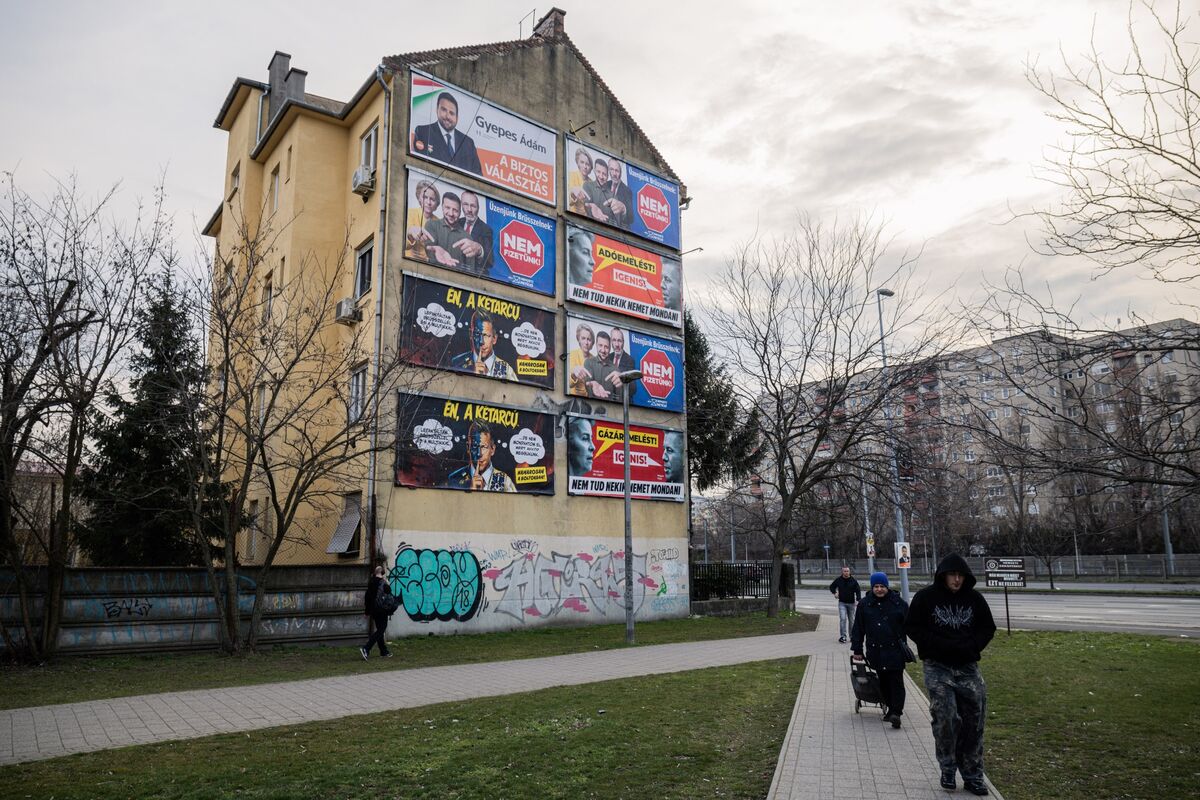

Budapest Braces for Election Showdown as Orbán Faces Toughest Test in 16 Years
Budapest, Hungary – Tens of thousands of supporters of Hungarian Prime Minister Viktor Orbán and his main rival, Péter Márki-Zay, flooded the streets of Budapest on Sunday, marking a pivotal moment in the country’s political landscape. The rallies, held less than a month before Hungary’s national election on April 3, underscored the high stakes of a contest that could see Orbán’s 16-year grip on power challenged like never before.
Orbán, Europe’s longest-serving leader, has dominated Hungarian politics since his return to power in 2010, reshaping the country’s institutions, media, and judiciary in a manner critics describe as authoritarian. However, a united opposition coalition led by Márki-Zay, a conservative mayor and political outsider, has gained momentum in recent months, promising to restore democracy, tackle corruption, and realign Hungary with the European Union. Polls suggest a tight race, with Orbán’s Fidesz party facing its most significant threat in over a decade.
A Divided Nation
The dueling rallies in Budapest showcased the deep polarization of Hungarian society. Orbán’s supporters, draped in the national colors of red, white, and green, gathered near the iconic Heroes’ Square, waving banners that read “Strong Hungary, Stable Leadership.” Addressing the crowd, Orbán framed the election as a choice between Hungary’s independence and what he called “foreign interference,” a familiar refrain in his populist rhetoric.
“We are fighting not only for Hungary but for the future of Europe,” Orbán declared. “Our opponents are backed by Brussels, multinational corporations, and foreign interests. They want to take away our sovereignty and push their liberal agenda on our people.”
Meanwhile, Márki-Zay’s supporters, bolstered by an alliance of six opposition parties spanning the political spectrum from left to right, convened near the Liberty Bridge. Their message was one of unity and change. “This is not just about replacing Orbán; it’s about rebuilding Hungary,” Márki-Zay told the cheering crowd. “We will restore the rule of law, fight corruption, and ensure that every Hungarian has a fair chance to succeed.”
The contrasting tones of the rallies reflected the broader ideological divide in Hungary. Orbán’s Fidesz party has cultivated a nationalist, anti-immigration platform, emphasizing Christian values and skepticism of the EU. The opposition, by contrast, has sought to appeal to disillusioned voters by focusing on economic inequality, governance reform, and reintegration with European institutions.
The Orbán Era: Consolidation and Controversy
Since returning to power in 2010, Orbán has transformed Hungary into a model of illiberal democracy, a term he himself has embraced. His government has centralized power, curtailed press freedom, and rewritten the constitution to entrench Fidesz’s dominance. Orbán’s critics accuse him of eroding democratic norms, while his supporters credit him with protecting Hungary’s sovereignty and economic stability.
Under Orbán’s leadership, Hungary has become a key player in European politics, often clashing with Brussels over issues ranging from migration to judicial independence. His close ties with Russia and China have also raised concerns among Western allies, particularly amid the ongoing crisis in Ukraine. Despite these controversies, Orbán has maintained a loyal base, particularly in rural areas, where his message of national pride resonates strongly.
However, recent scandals and economic challenges have weakened Orbán’s standing. Allegations of corruption involving close allies, rising inflation, and shortages of essential goods have fueled public discontent. The opposition has capitalized on these issues, positioning itself as a viable alternative to Orbán’s entrenched regime.
The Opposition’s Uphill Battle
Márki-Zay, a self-described “conservative with progressive ideas,” emerged as the opposition’s unity candidate after a primary election last year. His campaign has focused on building a broad coalition, appealing to both left-leaning urban voters and conservative rural constituents disillusioned with Fidesz.
Yet the opposition faces significant hurdles. Fidesz’s control over state media and its ability to shape public narratives through propaganda have given Orbán a distinct advantage. Additionally, Hungary’s electoral system, which heavily favors the incumbent party, makes it difficult for the opposition to translate votes into parliamentary seats.
Despite these challenges, the opposition has mounted an unprecedented grassroots campaign, mobilizing volunteers and leveraging social media to bypass state-controlled outlets. Their efforts have energized a segment of the electorate long apathetic to politics, particularly younger voters and urban professionals.
Global Implications
The outcome of Hungary’s election will have far-reaching implications beyond its borders. Orbán’s tenure has made Hungary a focal point in the global debate over the rise of populism and the erosion of democratic norms. His re-election would embolden other nationalist leaders in Europe and beyond, cementing Hungary’s role as a bastion of illiberal governance.
Conversely, a victory for the opposition would mark a significant shift in Central European politics, potentially reversing Hungary’s democratic backslide and restoring its relationship with the EU. It could also inspire pro-democracy movements in neighboring countries, where leaders like Poland’s Jarosław Kaczyński have emulated Orbán’s populist playbook.
A Nation at a Crossroads
As the April 3 election approaches, Hungary finds itself at a crossroads. The choice between Orbán’s nationalist vision and the opposition’s promise of reform represents not just a political decision but a defining moment for the country’s future.
For Orbán, the election is a test of his enduring appeal and the resilience of his illiberal model. For the opposition, it is an opportunity to prove that change is possible, even in the face of entrenched power.
As the sun set over Budapest on Sunday, the echoes of competing chants lingered in the air—a reminder of the stakes of a contest that will shape Hungary’s destiny and reverberate across Europe. In a race too close to call, one thing is certain: Hungary’s election will be a watershed moment, not just for its people, but for the future of democracy itself.
