


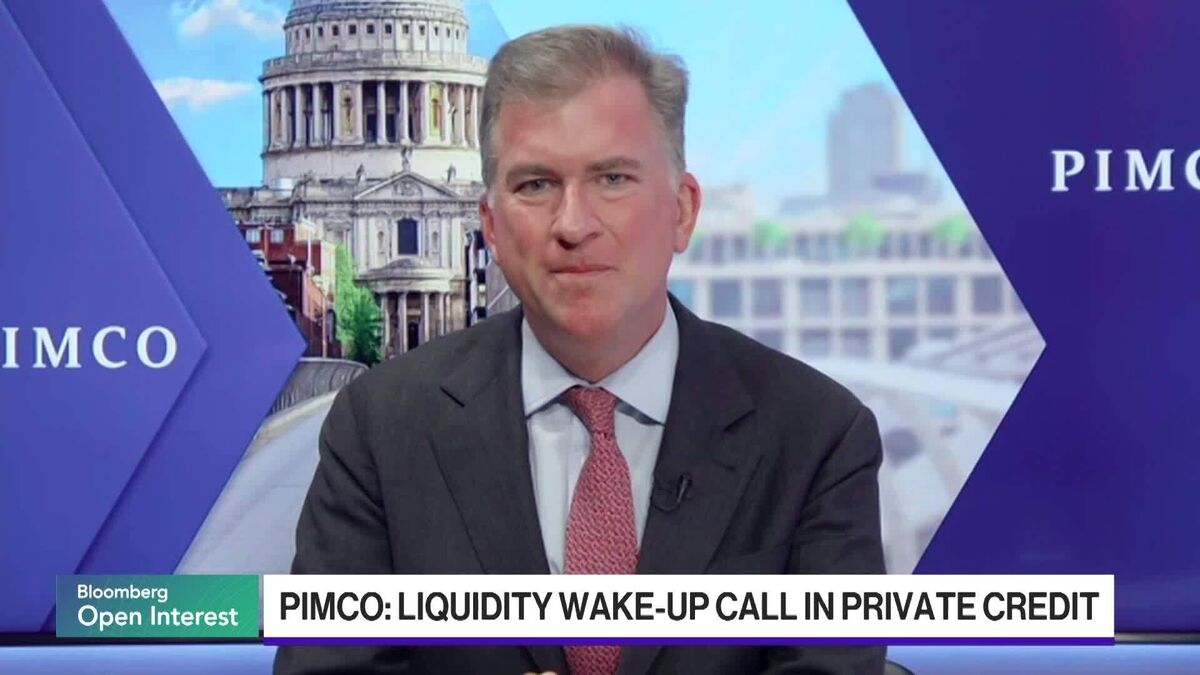

Private Credit Market Shows Signs of Cooling Amid Economic Uncertainty, Says Pimco President
Global Investors Monitor Shifting Dynamics as High Interest Rates Reshape Private Lending
The $1.7 trillion private credit market, once a red-hot haven for yield-seeking investors, is showing early signs of cooling as economic headwinds and tighter monetary policies reshape risk appetites. Christian Stracke, President of investment giant Pimco, acknowledged the slowdown in a recent Bloomberg interview but tempered concerns, stating that while deal flow has softened, the sector is far from crisis territory.
Speaking on Bloomberg Open Interest, Stracke noted that higher borrowing costs and increased lender caution have contributed to a more measured pace in private credit transactions. However, he emphasized that the market remains fundamentally robust, with ample liquidity and disciplined underwriting preventing a broader meltdown. His comments come as institutional investors worldwide reassess exposure to alternative assets amid persistent inflation and geopolitical volatility.
A Maturing Market, Not a Collapse
Private credit—non-bank lending to corporations, often at higher interest rates—has exploded in popularity over the past decade as institutional investors chased higher returns in a low-rate environment. But with central banks maintaining restrictive policies, borrowers face steeper refinancing costs, and lenders are becoming more selective.
“The market is cooling, not freezing,” Stracke said. “We’re seeing more scrutiny on deals, longer due diligence periods, and some repricing of risk, but this is a natural correction rather than a systemic breakdown.”
Data from Preqin supports this view: private credit fundraising dipped by 23% year-over-year in Q1 2024, yet dry powder (uninvested capital) remains near record highs at $400 billion. This suggests that while deployment has slowed, institutional demand persists.
Why the Slowdown? Interest Rates and Default Risks
The Federal Reserve’s aggressive rate hikes since 2022 have reshaped the calculus for private debt. Many loans issued during the ultra-cheap money era now carry floating rates, squeezing corporate borrowers. Meanwhile, lenders are bracing for potential defaults as economic growth slows in key markets like the U.S. and Europe.
Still, Stracke downplayed doomsday scenarios. “Default rates are ticking up but from historically low levels,” he noted. “The best-managed funds are avoiding the riskiest segments and focusing on senior secured loans with strong covenants.”
Industry analysts point to middle-market companies—those with $50 million to $1 billion in revenue—as particularly vulnerable. Many lack the scale to absorb higher interest expenses, yet they rely heavily on private credit due to limited access to traditional bank financing.
Opportunities Amid the Caution
Despite the slowdown, some investors see value emerging. Distressed debt funds are raising capital to target struggling borrowers, while direct lenders are negotiating tighter terms to protect returns. Stracke highlighted Pimco’s selective approach, favoring industries with stable cash flows like healthcare and infrastructure over cyclical sectors like retail or hospitality.
“Private credit isn’t homogenous,” he stressed. “The dispersion between winners and losers will widen, but that creates opportunities for disciplined investors.”
Regulators are also watching closely. The Bank of England and U.S. Treasury have flagged private credit’s opacity as a potential risk, though no major interventions are imminent. For now, the market’s evolution appears driven more by economic forces than policy crackdowns.
The Road Ahead: A More Cautious Era
As the private credit market adjusts to a higher-for-longer rate environment, experts predict a prolonged period of moderation rather than a sharp downturn. The asset class still offers yield advantages over public bonds, and banks continue retreating from leveraged lending, leaving room for private lenders to fill the gap.
Yet with global growth forecasts uncertain, the days of breakneck expansion may be over. “This is a healthy recalibration,” Stracke concluded. “Investors are being compensated for risk appropriately now—that’s sustainable.”
For now, the message is clear: private credit isn’t collapsing, but its golden age of unchecked growth has passed. In its place, a more cautious, selective market is emerging—one where risk management may finally catch up to returns.
