



Inside Amazon’s Secretive Chip Lab: How AWS Is Challenging Nvidia’s AI Dominance
AUSTIN, Texas — In an unassuming office building in Austin’s upscale Domain district, a team of engineers is quietly reshaping the future of artificial intelligence. Behind the glass walls of Amazon Web Services’ (AWS) custom chip lab, a relentless pursuit of innovation is underway—one that could disrupt Nvidia’s stranglehold on the AI hardware market and redefine the economics of large-scale machine learning.
This exclusive behind-the-scenes access comes just weeks after Amazon CEO Andy Jassy announced a landmark $50 billion partnership with OpenAI, positioning AWS as the exclusive cloud provider for the AI lab’s next-generation Frontier agent-building platform. At the heart of this deal lies Amazon’s homegrown Trainium chips—a family of processors rapidly gaining traction as a cost-effective alternative to Nvidia’s GPUs.
The Rise of Trainium: A Threat to Nvidia’s AI Monopoly?
The global AI industry currently faces a critical bottleneck: an acute shortage of high-performance chips capable of handling the astronomical computational demands of modern large language models (LLMs). Nvidia, with its industry-leading H100 and upcoming B100 GPUs, commands an estimated 80% of this market. But Amazon’s Trainium chips—now in their third generation—are emerging as a formidable challenger.
“Our customer base is expanding as fast as we can get capacity out there,” said Kristopher King, director of AWS’s chip lab, during the tour. “Bedrock [AWS’s AI service platform] could be as big as EC2 one day.”
The numbers underscore this ambition:
- 1.4 million Trainium chips are already deployed across AWS data centers.
- Over 1 million Trainium2 chips power Anthropic’s Claude models.
- The newly released Trainium3 promises 50% lower costs for comparable performance versus traditional cloud servers.
What makes Trainium particularly disruptive is its dual capability. Initially designed for AI model training, the chips have been optimized for inference—the process of generating responses from trained models, which constitutes the bulk of real-world AI workloads. With inference now accounting for up to 90% of AI operational costs, according to industry analysts, Amazon’s efficiency gains could prove transformative.
Inside the Lab: Where Silicon Meets Sweat Equity
The AWS chip lab—a bustling space resembling a cross between a university engineering workshop and a server room—is where theoretical designs become tangible products. Unlike sterile clean rooms where chips are manufactured (a task handled by TSMC and Marvell), this facility focuses on the “bring-up” process—the high-stakes moment when prototype chips are activated for the first time.
“It’s like a big overnight party. You stay here, like a lock-in,” King explained, recalling the Trainium3 bring-up. When the prototype’s cooling system failed to align, engineers resorted to grinding down metal components in a nearby conference room to avoid disrupting the pizza-fueled debugging session.
The lab’s work extends beyond chips themselves. AWS designs the entire stack:
- Neuron switches enabling low-latency communication between chips
- Nitro virtualization technology for secure multi-tenant operation
- Liquid-cooled server sleds that house the processors (a marked improvement over air-cooled predecessors)
This vertical integration allows Amazon to control costs end-to-end—a hallmark of the company’s broader business strategy.
The OpenAI Factor: A Deal That Could Reshape Cloud AI
February’s AWS-OpenAI agreement represents a seismic shift in the AI infrastructure landscape. Under the terms:
- AWS becomes the exclusive cloud provider for OpenAI’s Frontier agent platform
- Amazon commits 2 gigawatts of Trainium computing capacity—enough to power ~1.5 million homes
- The deal could position AWS as OpenAI’s primary alternative to Microsoft Azure
However, the partnership exists in a legal gray area. The Financial Times reported Microsoft believes the arrangement may violate its own OpenAI agreement, which grants Redmond access to all of the AI lab’s models. AWS executives declined to comment on potential litigation during the tour.
Beyond Chips: The Ecosystem Play
Amazon’s strategy extends beyond hardware. Key software developments aim to lower barriers to adoption:
- PyTorch support allows most open-source AI models to run on Trainium with “basically a one-line change,” according to engineering director Mark Carroll
- A new partnership with Cerebras Systems integrates specialized inference chips alongside Trainium
- The Trn3 UltraServer architecture combines custom networking and liquid cooling for optimal performance
Perhaps most telling is the client roster. Beyond Anthropic and now OpenAI, Apple publicly praised AWS’s Graviton and Inferentia chips in 2024—a rare endorsement from the typically secretive tech giant.
The Road Ahead: Scaling the Unscalable
With demand for AI compute outpacing supply globally, AWS faces the daunting task of scaling production while maintaining quality. The Austin team is already developing Trainium4, even as they support existing deployments like Project Rainier—a 500,000-chip cluster powering Anthropic’s operations.
The pressure is palpable. CEO Andy Jassy has called Trainium one of AWS’s most exciting technologies, revealing it’s already a multi-billion-dollar business. For engineers like Carroll, the mission is clear: “It’s very important that we get as fast as possible to prove that it’s actually going to work. So far, we’ve been doing really well.”
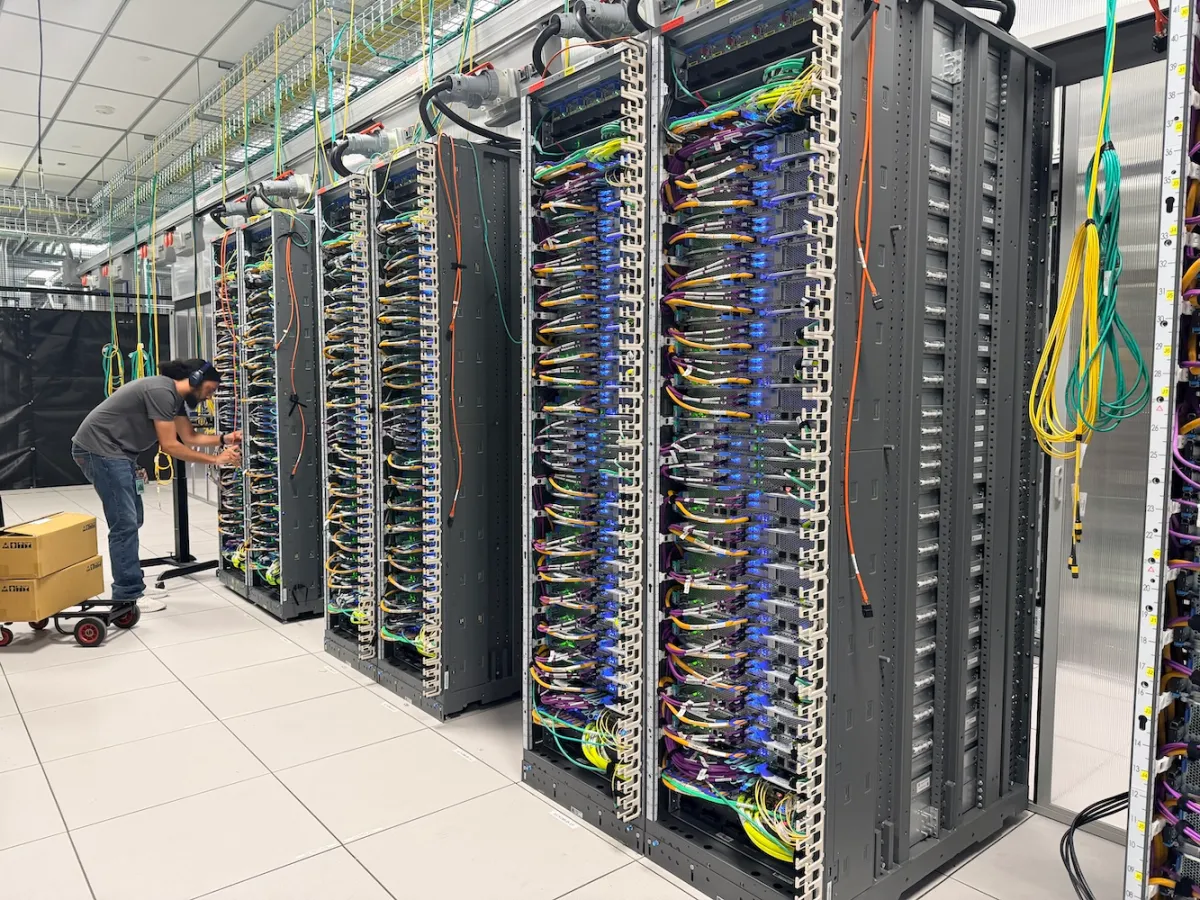
As the tour concluded in the team’s private data center—a deafening, metal-scented facility requiring mandatory ear protection—the scale of Amazon’s ambition came into focus. Row upon row of servers hummed with Trainium3 chips, their liquid cooling systems silently recycling fluids in a nod to sustainability.
In the high-stakes race to power the AI revolution, Amazon has made one thing clear: They’re no longer content to just rent Nvidia’s chips. They’re building an alternative empire—one silicon breakthrough at a time.
The Verdict: While Nvidia remains the undisputed leader in AI acceleration, AWS’s vertically integrated approach—combining custom chips, servers, and software—poses the most credible threat yet to its dominance. The coming years will test whether Amazon can turn technical ingenuity into lasting market share.
