


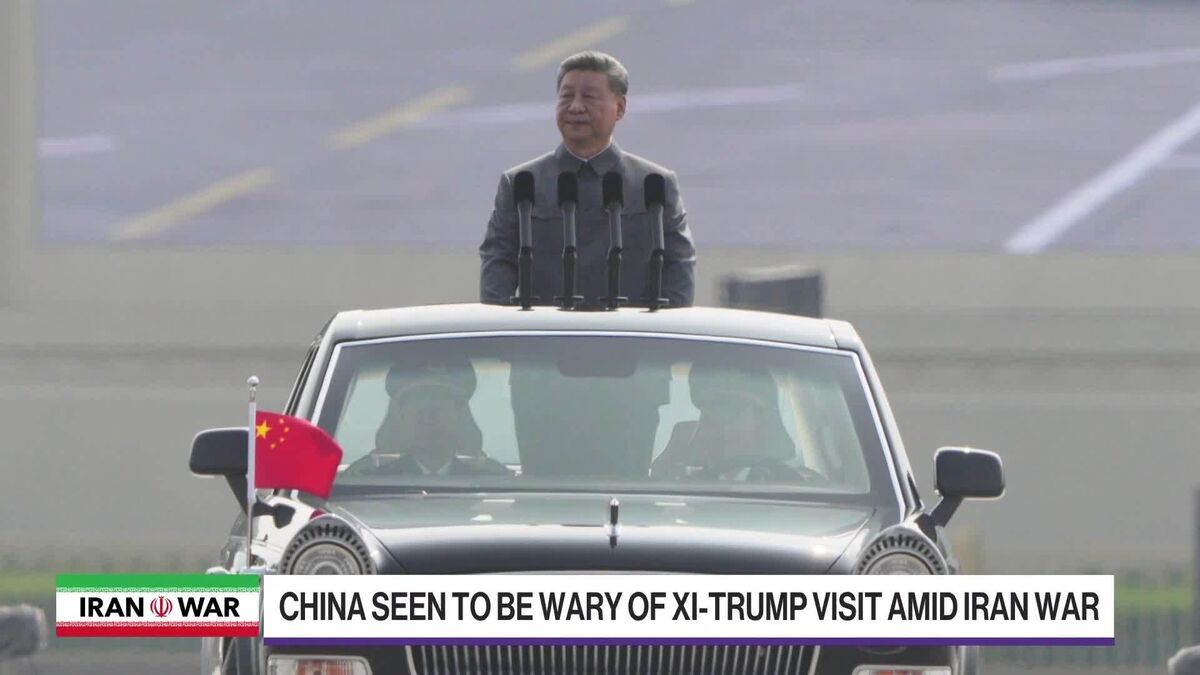

Beijing on Edge: US-China Summit Looms as Iran Conflict Sparks Global Anxiety
As world leaders brace for a pivotal meeting between U.S. President Donald Trump and Chinese President Xi Jinping, Beijing finds itself grappling with escalating tensions over the unresolved Iran conflict. The stakes are high, with the Trump-Xi summit seen as a defining moment in global geopolitics. Against a backdrop of trade wars, strategic rivalries, and regional instability, the two leaders will attempt to leverage their personal rapport to navigate a storm of international crises.
The Trump-Xi meeting, scheduled for later this month, comes at a time of heightened uncertainty in global affairs. The U.S.-China relationship, already strained by a prolonged trade conflict, is further complicated by divergent approaches to Iran. Recent developments in the Middle East, including Iran’s alleged violations of the 2015 nuclear deal and the U.S.’s imposition of crippling sanctions, have thrust the region into chaos. Beijing, a signatory to the nuclear agreement and a key economic partner of Tehran, has repeatedly called for diplomacy over confrontation. However, Washington’s hardline stance has left China walking a diplomatic tightrope, balancing its commitments to Iran with its desire to maintain stable relations with the U.S.
The Iran Factor: A Thorn in US-China Relations
China’s role in the Iran conflict has become a focal point of international attention. As Iran’s largest trading partner and a major buyer of its oil, Beijing has been caught in the crossfire of U.S. sanctions. In May 2019, Washington ended waivers that allowed some countries, including China, to continue importing Iranian oil without penalty. This move has forced Beijing to reassess its economic ties with Tehran while avoiding actions that could provoke further U.S. ire.
Experts warn that China’s predicament reflects a broader dilemma: how to assert its growing global influence without alienating the world’s sole superpower. “China is keen to position itself as a responsible global actor, but its economic interests in Iran are pulling it in a different direction,” says Li Mingjiang, a professor of international relations at Nanyang Technological University in Singapore. “The Trump-Xi summit will be a critical test of whether the two leaders can find common ground on Iran or if this issue will deepen their rivalry.”
The stakes are particularly high for Beijing, which views Iran as a strategic partner in its Belt and Road Initiative (BRI), a trillion-dollar infrastructure project aimed at boosting global connectivity. Iran’s geographic location makes it a linchpin in China’s plans to expand trade routes across Asia, the Middle East, and Europe. However, U.S. sanctions have disrupted this vision, forcing Chinese companies to scale back their investments in Iran.
Navigating Geopolitical Storms: The Trump-Xi Dynamic
Against this fraught backdrop, the Trump-Xi summit offers a rare opportunity for dialogue. The two leaders have developed a surprisingly cordial relationship despite their countries’ growing rivalry. Their personal rapport has been credited with averting further escalation in the U.S.-China trade war, which has seen both sides impose tariffs on billions of dollars’ worth of goods.
Observers note that Trump and Xi share a pragmatic approach to diplomacy, often prioritizing short-term gains over long-term strategies. This could work in their favor as they attempt to tackle complex issues like Iran. However, the summit’s success will hinge on their ability to balance competing interests.
“Trump and Xi both have a transactional mindset, which could help them strike deals on specific issues,” says Bonnie Glaser, director of the China Power Project at the Center for Strategic and International Studies. “But the underlying tensions in the U.S.-China relationship are unlikely to disappear overnight.”
Global Implications: A Test for Multilateralism
The Trump-Xi meeting also underscores the challenges of multilateralism in an increasingly polarized world. The Iran conflict has exposed deep divisions among key global players, with European nations, Russia, and China critical of Washington’s unilateral approach. The U.S. withdrawal from the 2015 nuclear deal, formally known as the Joint Comprehensive Plan of Action (JCPOA), has left the agreement in tatters, with Iran gradually scaling back its compliance.
China has joined European countries in urging the U.S. to return to the negotiating table, but Washington has shown little interest in compromise. Instead, Trump has doubled down on his “maximum pressure” campaign, aiming to force Iran into submission through economic sanctions and military threats. This strategy has heightened tensions in the region, raising fears of a miscalculation that could spiral into full-blown conflict.
For Beijing, the Iran crisis is a stark reminder of the limits of its global influence. While China has emerged as a major player in international affairs, it remains cautious about challenging U.S. dominance directly. “China’s approach to Iran reflects its broader strategy of avoiding direct confrontation with the U.S.,” says Zhu Feng, a professor of international relations at Nanjing University. “Beijing wants to play a constructive role, but it’s not willing to risk its own interests in the process.”
The Road Ahead: What to Expect
As the Trump-Xi summit approaches, analysts are divided on what outcomes to expect. Some believe the meeting could yield progress on trade, with both sides eager to ease economic tensions ahead of the U.S. presidential election. Others warn that the Iran issue could overshadow other agenda items, further straining U.S.-China relations.
One possible scenario is that Trump and Xi agree to a temporary truce on Iran, allowing China to continue limited oil imports in exchange for concessions on trade. However, such an arrangement would be fragile at best, given the deep-rooted differences between the two countries.
Ultimately, the summit may serve as a barometer of the U.S.-China relationship’s trajectory. As the world watches, the question remains: Can Trump and Xi rise above their differences to address urgent global challenges, or will their meeting highlight the growing chasm between East and West?
In a world fraught with uncertainty, the Trump-Xi summit offers both hope and caution—a reminder that even the most powerful leaders must navigate the complexities of a rapidly changing global order.
