


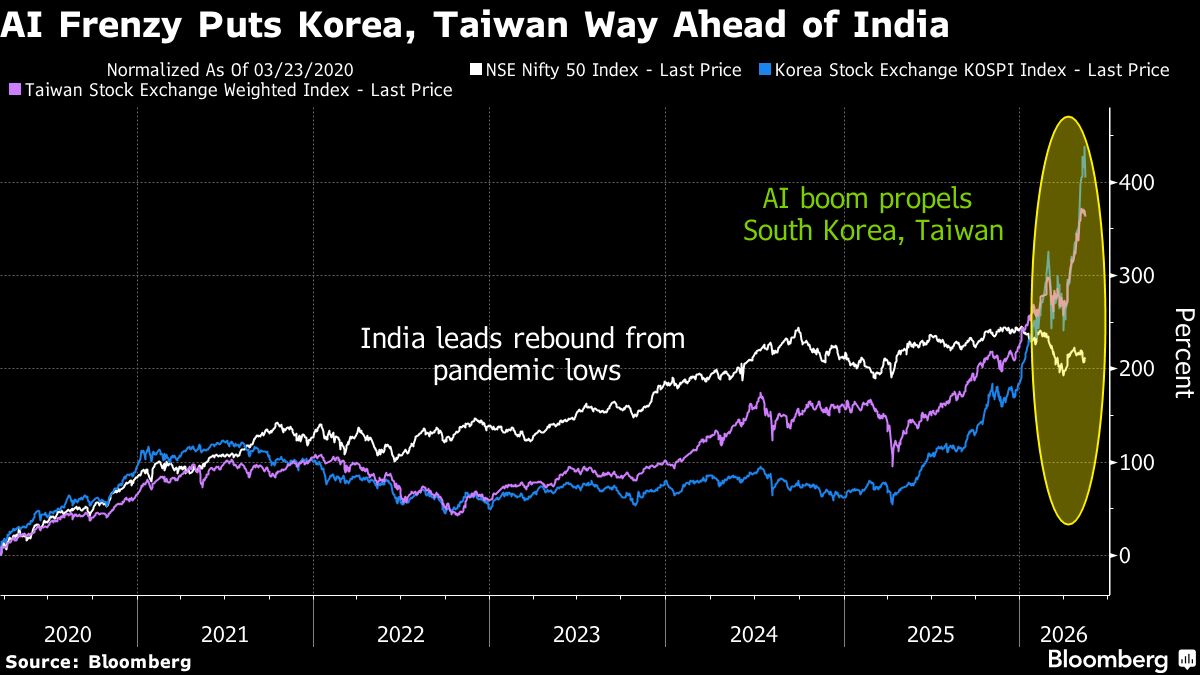

AI Investment Boom Reshapes Global Markets: India Emerges as Unexpected Casualty
By [Your Name], International Business Correspondent
A seismic shift in global investment patterns is underway as capital floods into artificial intelligence technologies, leaving traditional tech hubs scrambling to adapt—and India, surprisingly, on the losing end of this financial realignment.
New data reveals that while AI-focused companies in the U.S., China, and Europe attract record-breaking funding, India’s tech sector is struggling to keep pace. Once celebrated as a rising star in software services and IT outsourcing, the South Asian giant now risks being sidelined in the race to dominate the next frontier of technological innovation.
The AI Gold Rush and Its Winners
The AI revolution has triggered an unprecedented redistribution of global capital. Over the past 18 months, venture funding for AI startups has surged past $330 billion worldwide, with the U.S. accounting for nearly 60% of that sum, according to Crunchbase. China, despite geopolitical tensions, remains a formidable player, securing 22% of global AI investments. Meanwhile, Europe’s robust regulatory framework and deep research talent pool have made it a magnet for ethical AI development.
Silicon Valley giants like OpenAI, Anthropic, and Nvidia continue to dominate headlines with multibillion-dollar funding rounds. China’s Baidu and SenseTime are advancing in generative AI and facial recognition, while European firms like DeepMind (UK) and Mistral AI (France) push breakthroughs in machine learning. Against this backdrop, India’s absence from the AI investment boom is striking.
Why India Is Falling Behind
Experts cite three critical factors behind India’s underperformance:
-
Overreliance on Services, Not Innovation
India built its tech reputation on cost-effective software services and back-office operations, but AI demands cutting-edge R&D and proprietary technology. Unlike China, which aggressively invested in homegrown AI models, India’s tech sector remains largely dependent on adapting Western tools for local markets. -
Brain Drain and Funding Gaps
Top Indian AI researchers frequently migrate to the U.S. or Europe, lured by better funding and infrastructure. Domestic venture capital for deep-tech startups pales in comparison to Silicon Valley or Shenzhen. In 2023, Indian AI firms raised just $4.7 billion—a fraction of the $98 billion secured by U.S. counterparts. -
Regulatory Hesitation
While the EU and U.S. debate AI ethics, India lacks a cohesive national strategy. Ambiguous data privacy laws and slow-moving policy reforms have deterred investors. “You can’t attract AI capital if companies are unsure about data governance,” says Priya Kumar, a Mumbai-based tech analyst.
The Human Cost: Jobs at Risk
The stakes extend beyond investment flows. AI automation threatens India’s $250 billion IT services industry, which employs over 5 million workers. Roles in data entry, customer support, and basic coding are increasingly vulnerable to AI-driven efficiencies. The World Bank warns that without urgent upskilling, India could face a “digital divide” that exacerbates unemployment.
Silver Linings and Emerging Players
Not all hope is lost. Some Indian startups, such as conversational AI firm Uniphore and healthcare diagnostics pioneer SigTuple, are gaining traction. The government’s ₹10,000 crore ($1.2 billion) AI mission, announced in 2024, aims to boost research and infrastructure. Yet critics argue the plan lacks the scale needed to compete globally.
Global Implications
India’s struggle underscores a broader trend: the AI revolution is concentrating wealth and talent in a handful of tech superpowers. For developing economies, failing to secure a foothold in AI could mean perpetual dependency on foreign technology—a scenario with profound geopolitical ramifications.
The Road Ahead
To reclaim relevance, India must bridge the gap between its service-sector strengths and AI innovation. This requires bolder policies, private-public partnerships, and incentives to retain top talent. As Rajeev Chandrasekhar, India’s Minister of State for IT, recently stated, “The choice is simple: lead, follow, or get left behind.”
For now, the world watches to see whether India can pivot from outsourcing powerhouse to AI contender—or remain a cautionary tale in the uneven spread of technological progress.
