


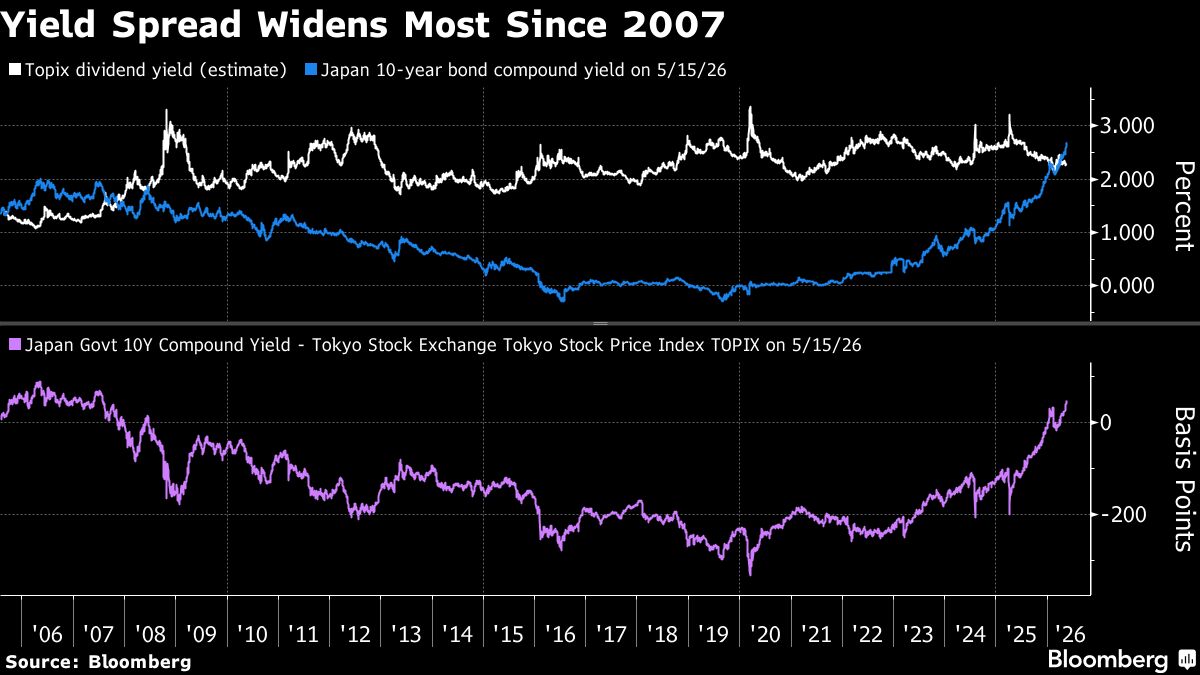

Japan’s Bond Yields Outpace Dividend Returns: A Potential Shift in Investor Strategy
In a noteworthy development for global financial markets, Japan’s 10-year government bond yield has surged past the country’s average dividend yields, signaling a potential shift in investor behavior. This rare occurrence—where sovereign bond returns eclipse equity dividends—could prompt a significant rotation of capital from stocks to bonds, particularly once the current volatility in the bond market stabilizes. The implications of this shift are far-reaching, not only for Japan’s domestic economy but also for global investors who have long viewed Japanese assets as a cornerstone of their portfolios.
A Historic Milestone in Japan’s Financial Landscape
Japan’s 10-year government bond yield, often referred to as the benchmark for the country’s debt market, has climbed to levels not seen in years. Recent data shows that the yield has risen above 0.8%, a significant uptick from the near-zero or even negative yields that have characterized Japanese bonds for much of the past decade. This rise contrasts sharply with the average dividend yield of Japanese stocks, which currently hovers around 2%. While dividend yields have traditionally outpaced bond returns, the reversal highlights the evolving dynamics of Japan’s financial markets.
The surge in bond yields comes amid broader global trends, including rising interest rates and inflationary pressures. However, Japan’s situation is unique, given its prolonged struggle with deflation and the Bank of Japan’s (BoJ) ultra-loose monetary policy stance. For years, the BoJ has maintained negative interest rates and implemented aggressive bond-buying programs to stimulate economic growth. This environment has kept bond yields artificially low, making equities a more attractive option for yield-seeking investors.
Drivers Behind the Yield Surge
Several factors have contributed to the recent spike in Japan’s bond yields. First, the global bond market has experienced significant volatility, driven by central banks’ tightening monetary policies to combat inflation. The U.S. Federal Reserve’s aggressive rate hikes and the European Central Bank’s hawkish stance have sent ripples across international markets, including Japan.
Second, domestic inflation in Japan has begun to creep upward, albeit at a slower pace compared to other major economies. Rising consumer prices have fueled speculation that the BoJ may eventually pivot from its ultra-accommodative policies, leading to higher bond yields. While the central bank has so far maintained its stance, market participants are increasingly betting on a policy shift in the medium term.
Third, the Japanese government’s fiscal policies have also played a role. Increased public spending to address economic challenges, such as the COVID-19 pandemic and rising energy costs, has led to higher debt issuance. This expansion in supply has put upward pressure on bond yields, particularly as demand from investors remains subdued.
Implications for Investors
The rise in Japan’s bond yields presents both opportunities and challenges for investors. For those seeking stability and predictable returns, government bonds may now offer a more appealing option compared to equities, which have been subject to heightened volatility in recent months. The potential for capital appreciation in bonds, coupled with their lower risk profile, could attract a wave of investors looking to rebalance their portfolios.
However, the shift is not without risks. The bond market’s current volatility could deter some investors in the short term, delaying the anticipated rotation from stocks to bonds. Additionally, any abrupt policy changes by the BoJ could lead to further unpredictability, complicating investment decisions.
For global investors, Japan’s evolving financial landscape underscores the need for a nuanced approach. While the country’s bonds may now offer higher yields, investors must carefully assess the broader economic and policy environment to determine their long-term viability.
Broader Economic Context
Japan’s bond yield surge must also be understood within the context of its broader economic challenges. Despite recent signs of inflation, the country continues to grapple with structural issues such as an aging population, sluggish productivity growth, and a high public debt burden—currently exceeding 260% of GDP. These factors have constrained Japan’s economic potential and limited its ability to generate robust growth.
At the same time, the yen’s depreciation has added another layer of complexity. A weaker yen has boosted export competitiveness but also increased the cost of imports, contributing to inflationary pressures. For foreign investors, currency fluctuations can significantly impact returns, making Japan’s financial assets both attractive and risky.
Global Ramifications
Japan’s financial markets are closely watched by global investors, given the country’s status as the world’s third-largest economy and a major player in international trade. Any significant shift in Japanese asset allocations could have ripple effects across global markets.
For instance, a large-scale rotation from Japanese equities to bonds could weigh on stock markets, particularly those with high exposure to Japan. Conversely, increased demand for Japanese bonds could bolster the country’s debt market and strengthen its position in the global financial system.
Moreover, Japan’s experience offers valuable insights for other economies grappling with similar challenges, such as low interest rates and deflationary pressures. Policymakers worldwide will be keen to observe how Japan navigates its evolving financial landscape, particularly as inflationary trends persist.
Looking Ahead
The trajectory of Japan’s bond yields will largely depend on the Bank of Japan’s policy decisions and the broader global economic environment. While the central bank has so far resisted tightening monetary policy, mounting inflationary pressures and external influences may eventually force its hand.
In the meantime, investors face a delicate balancing act. The allure of higher bond yields must be weighed against the risks of market volatility and potential policy shifts. As always, diversification and careful risk management will be key to navigating this shifting landscape.
As Japan’s financial markets enter a new phase, the balance between bonds and equities remains tantalizingly uncertain—a dynamic that will undoubtedly shape investment strategies in the months and years to come.
