



America in the Last 24 Hours: Major U.S. Development, Decisions and National Implications 02-21-2026
Trump Tariff Clash With Supreme Court Sparks Global Trade Uncertainty, Market Drop and Political Fallout Across U.S.
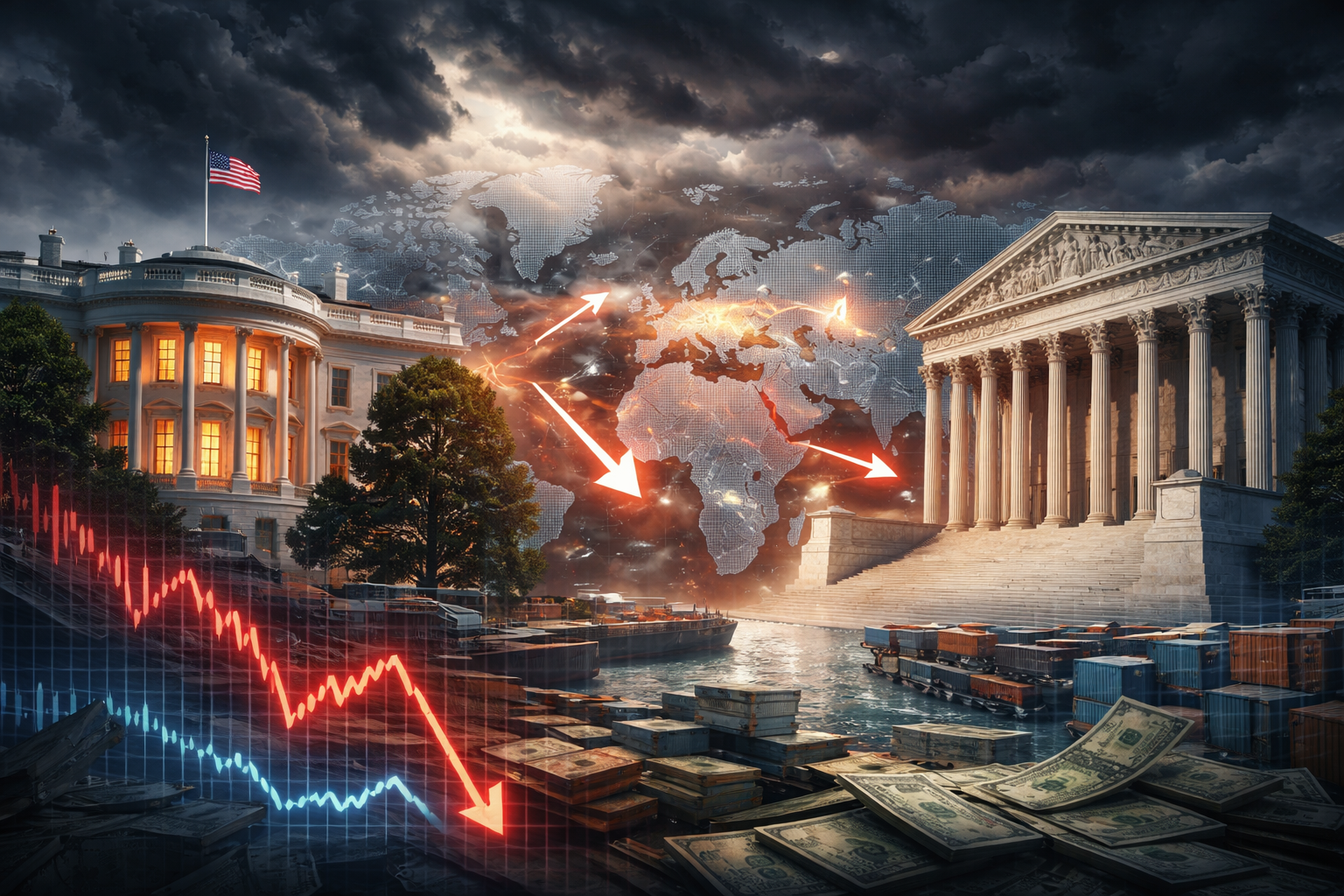
Tariff War, Court Clash and Global Fallout: America Faces Economic and Political Turbulence
The United States has entered a period of intense political, economic and diplomatic uncertainty following a dramatic clash between the presidency and the Supreme Court over tariff powers, sending shockwaves across global markets and deepening domestic divisions.
From escalating trade tensions and falling markets to legal battles, diplomatic controversies and political scandals, the past 24 hours have underscored the fragile balance between executive authority, economic stability and international confidence in U.S. leadership.
Supreme Court Ruling Triggers Tariff Power Struggle
The central political story dominating the national conversation began with a Supreme Court decision declaring that tariffs imposed under the International Emergency Economic Powers Act (IEEPA) were unconstitutional.
Rather than signaling a pause in tariff actions, the ruling has triggered a direct confrontation between the executive branch and the judiciary. President Donald Trump responded by announcing a new 10% tariff on foreign imports shortly after the decision and later declared plans to raise that rate to 15%.
In multiple public statements and social media posts, the president insisted he retains the authority to impose tariffs and claimed the Supreme Court ruling actually strengthened his power. He argued that his administration can still leverage other legal tools to impose economic pressure on foreign nations and companies.
Trump warned that any country attempting to exploit what he described as confusion over U.S. tariff policy would face even steeper economic penalties. He further asserted that congressional approval is not necessary for tariff actions, stating that authority had already been granted through past legislation and reaffirmed by the court’s decision.
The remarks have intensified a growing constitutional debate over the limits of presidential power and the role of the judiciary in shaping economic policy.
Global Reaction and Trade Uncertainty
International reaction was swift and significant.
European Union officials expressed concern about what they described as “tariff chaos” emerging from Washington, warning that the lack of clarity around U.S. trade policy is undermining confidence among key partners.
The European Parliament moved to pause progress on a major transatlantic trade agreement until a comprehensive legal assessment of U.S. tariff authority is completed. Officials said they require firm assurances that existing agreements will be honored and that new tariffs will not violate international commitments.
India also postponed a planned diplomatic visit intended to finalize a bilateral trade agreement with the United States. The delay comes as India and the European Union recently concluded what analysts describe as the largest free trade zone in the world, a move expected to strengthen economic ties between the two regions and potentially shift trade dynamics away from the U.S.
Trade experts warn that prolonged uncertainty over American tariff policy could encourage other nations to deepen alliances that exclude the United States, weakening its influence in global commerce.
Markets React to Economic and Political Instability
Financial markets responded sharply to the unfolding developments.
Major stock indexes fell amid growing investor anxiety over trade instability, legal uncertainty and the potential long-term impact of artificial intelligence on employment and corporate profitability.
Economists say markets are particularly sensitive to unpredictable tariff policies because they directly affect supply chains, import costs and corporate planning. Businesses that rely on international trade now face difficulty forecasting expenses and revenues, leading to cautious investment and hiring decisions.
Public opinion appears to mirror market unease.
Recent polling indicates a majority of Americans disapprove of the administration’s handling of tariffs and believe current economic policies are hurting the economy. A proposed plan to distribute $2,000 “tariff dividend” checks to Americans is now widely viewed by analysts as unlikely to materialize due to legal and fiscal obstacles.
Most Americans also believe the president must comply with Supreme Court rulings, highlighting widespread concern about constitutional boundaries and the rule of law.
Institutional and Political Tensions Intensify
The New York City Bar Association issued a strong statement condemning attacks on the judiciary, describing them as a dangerous challenge to the independence of the courts and the constitutional system of checks and balances.
Legal experts warn that escalating rhetoric against the judiciary could erode public trust in institutions and deepen political polarization.
House Speaker Mike Johnson acknowledged that Congress currently lacks consensus to enact sweeping tariff legislation. He noted that the absence of legislative support is shifting attention toward executive actions and legal battles rather than cooperative policymaking.
Meanwhile, President Trump continues to dismiss unfavorable polling data and has reiterated claims of widespread election irregularities in past votes. His comments have reignited debates over election integrity and political messaging in the digital age.
A recent analysis of social media activity revealed that thousands of accounts promoting certain political narratives may be fake or coordinated, raising concerns about misinformation and artificial amplification of public opinion.
Diplomatic and Security Developments Abroad
Diplomatic tensions also escalated overseas.
The U.S. ambassador to France and Monaco, Charles Kushner, has reportedly been barred from contact with members of the French government following alleged breaches of diplomatic protocol. French officials cited repeated refusals to attend scheduled meetings and concerns over interference in domestic political matters.
The development marks a rare breakdown in diplomatic engagement between long-standing allies and underscores growing friction between the U.S. and European partners.
Security concerns intensified after an armed individual was shot and killed outside Mar-a-Lago following an unauthorized entry attempt. Federal authorities confirmed that an investigation is underway into the incident and its possible motivations.
In a separate operation, U.S. Southern Command reported striking another small vessel suspected of involvement in narcotics trafficking, bringing the total number of fatalities from such operations to at least 137. Officials maintain the operations target criminal networks, though some observers continue to question the lack of publicly presented evidence in certain cases.
Controversies and Investigations Dominate Headlines
Domestic political controversies added to the turbulent news cycle.
A federal judge blocked the public release of a special counsel report related to classified documents retained after the 2021 presidential transition. While such reports are typically made public, the decision has fueled speculation about the report’s contents and potential political implications.
Calls for transparency are growing, with some analysts arguing that withholding the report only increases public suspicion.
Representative Tony Gonzales is also facing mounting pressure after allegations surfaced that he engaged in an inappropriate relationship with a staff member. While he has denied wrongdoing, the controversy has intensified scrutiny on congressional ethics and workplace conduct. Party leadership has so far maintained support, citing the narrow balance of power in the House.
Another controversy emerged after video surfaced showing FBI Director Kash Patel celebrating with members of the U.S. Olympic hockey team in a locker room following their gold medal victory. Critics within the law enforcement community have questioned the optics and professionalism of the scene, particularly regarding the use of official travel resources.
Nation Awaits Major Address
Amid mounting political and economic tension, the nation is preparing for a major State of the Union address scheduled for tomorrow.
The president has indicated the speech will be lengthy and wide-ranging, focusing on economic policy, national security and political priorities. However, several lawmakers have announced plans to boycott the address and instead attend alternative events critical of the administration.
The planned absences reflect deep divisions within Washington and signal a potentially contentious political season ahead.
As the United States navigates legal battles over executive authority, strained international partnerships and domestic political controversy, the events of the past 24 hours highlight a period of heightened uncertainty.
Markets, allies and citizens alike are watching closely as the country approaches another pivotal moment in its political and economic trajectory.
