


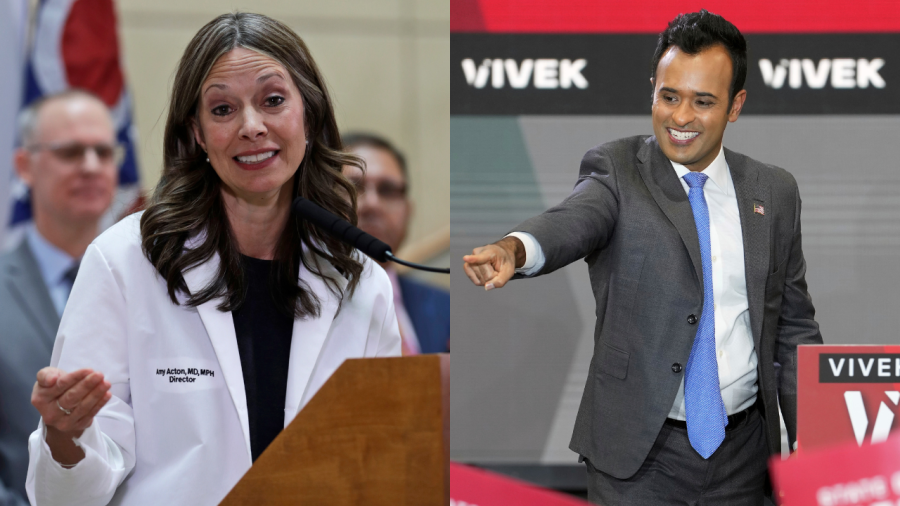

Campaign Finance in Ohio Governor’s Race Highlights Diverging Strategies of Ramaswamy and Acton
COLUMBUS, Ohio — As the Ohio gubernatorial race unfolds, stark differences in campaign finance strategies between Republican candidate Vivek Ramaswamy and Democrat Amy Acton are coming to light. Recent state records reveal that Ramaswamy, a high-profile entrepreneur, has allocated a significant portion of his campaign funds to travel and consulting fees, while Acton, a former state health director, has focused her spending on media and public relations. This divergence could have substantial implications for both candidates as they vie for one of the most watched contests in the state.
Ramaswamy, who garnered national attention for his bold stances on various issues, has reportedly spent over $2.5 million throughout his campaign. The Republican candidate’s strategy appears to hinge on building his personal brand across Ohio, utilizing extensive travel to connect with voters directly and consulting with political strategists to craft his message. As a relative newcomer to the political arena, his approach reflects a familiar narrative in modern campaigns, where candidates invest heavily in outreach to establish recognition and rapport.
Conversely, Acton has taken a more traditional route in her campaign financing. She has spent approximately $2.2 million, with nearly half going towards media buys and public relations efforts. The commitment to bolstering her public image comes as no surprise; Acton previously gained nationwide acclaim for her leadership during the COVID-19 pandemic, and she aims to leverage that familiarity as she seeks to distinguish herself from Ramaswamy. Media outreach is crucial in shaping voter perceptions, and Acton appears to be banking on targeted messaging to resonate with potential supporters.
This financial snapshot underscores deeper trends in the Ohio governor’s race. Acton’s investment in media aligns with a classic Democratic strategy: engaging voters through personalized narratives and compelling advertising. In contrast, Ramaswamy’s focus on travel mirrors an increasing trend among Republican candidates who prioritize face-to-face interactions and grassroots efforts, especially in an era where traditional media consumption has shifted dramatically.
Political analysts suggest that each candidate’s spending habits reveal not only their priorities but also their understanding of the voter base in Ohio. Ramaswamy’s travel-heavy approach might resonate with constituents who appreciate a hands-on candidate willing to visit their communities, while Acton’s media-centric strategy could appeal to those seeking a candidate who effectively communicates her vision and values.
Furthermore, as election day draws near, these financial strategies will continue to play a pivotal role in shaping the narrative around each candidate. The magnitude of Acton’s media spending—and its efficacy—could directly influence voter turnout, particularly among demographics that rely on digital and televised outreach for information. Meanwhile, Ramaswamy’s ability to make lasting connections during his travels may enhance his appeal, potentially giving him an edge in swing regions of the state.
The financial dynamics have also raised questions about the broader implications for Ohio and national politics. With both candidates making significant investments, the implications extend beyond the governor’s race itself. This contest may set the tone for future electoral strategies, culminating in a delicate balance between personal outreach and media engagement.
As Ohio prepares to head to the polls, the question remains: which strategy will prevail? The state, often regarded as a bellwether for national sentiment, could provide crucial lessons for political campaigns in other regions.
Regardless of the outcome, the investments made by Ramaswamy and Acton will likely reverberate through their political careers, influencing how they interact with voters and structure future campaigns.
With both candidates intensifying their efforts, observers will be keenly watching how their financial strategies unfold in the coming weeks. As the gubernatorial race heats up, the effectiveness of differing campaign approaches in resonating with voters could very well reshape the landscape of political campaigning in Ohio and inspire future challengers in states across the country.
