


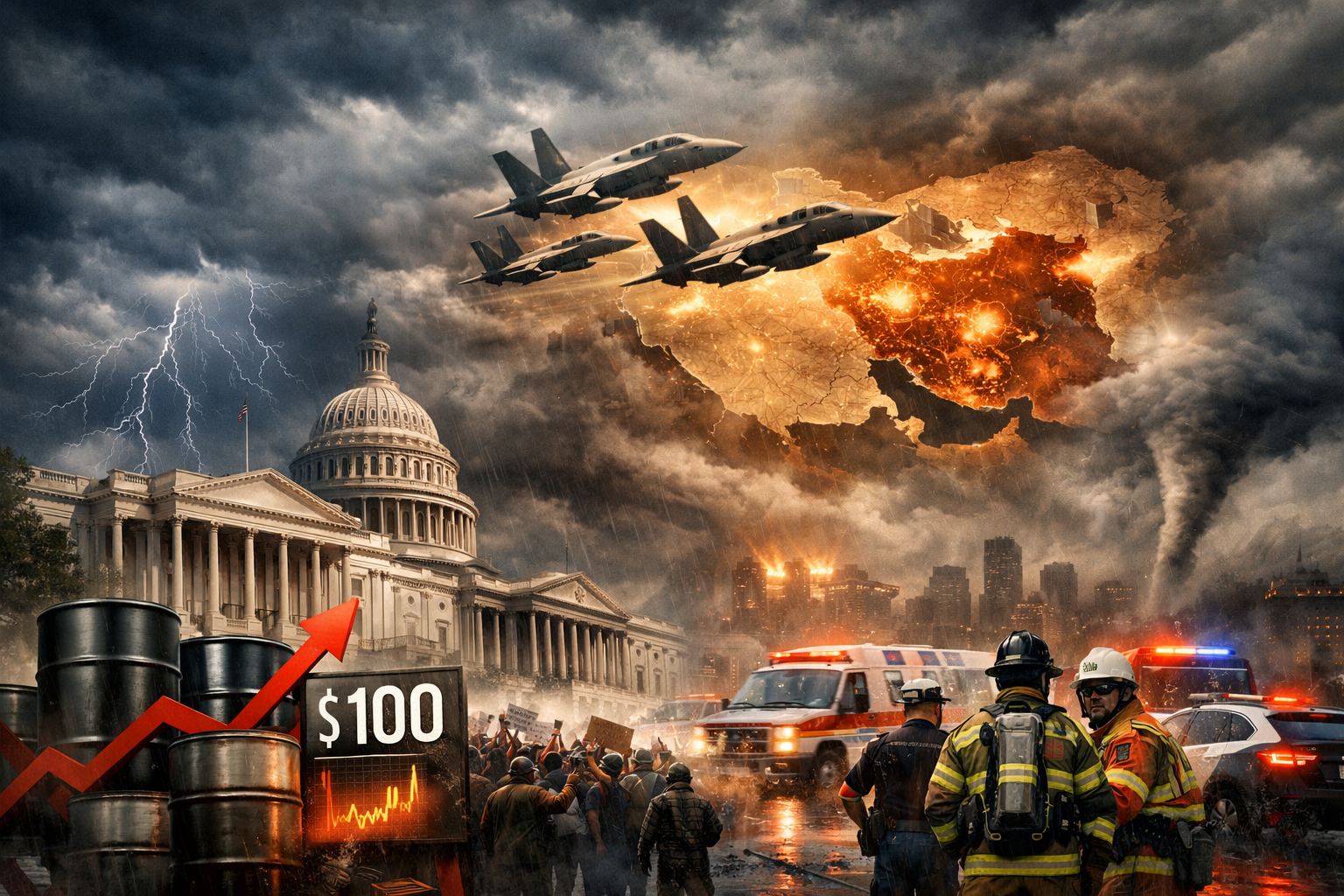

America in the Last 24 Hours
War, Energy Shock, Court Battles and Weather Extremes Shape U.S. Headlines
The United States has experienced a turbulent 24 hours marked by escalating geopolitical tensions, economic concerns, domestic security developments and severe weather threats across several regions. From the intensifying conflict involving the United States, Israel and Iran to court rulings and disruptions to aviation and immigration security, the day’s developments underscore a period of heightened uncertainty both domestically and internationally.
Middle East Conflict Dominates U.S. Foreign Policy
The most consequential development remains the escalating conflict involving the United States, Israel and Iran. The confrontation has expanded beyond localized strikes into a broader regional crisis that could reshape global security dynamics.
American and Israeli forces have reportedly conducted targeted strikes against Iranian-linked military infrastructure, while Iran has responded with threats against U.S. bases and allies in the Middle East. The crisis has raised concerns among global leaders that the confrontation could evolve into a wider regional war.
President Donald Trump has urged allied nations to strengthen naval patrols around the Strait of Hormuz, a strategic maritime corridor through which roughly one-fifth of the world’s oil supply passes. U.S. officials warn that any disruption to this route could significantly affect global energy markets.
Iranian officials have also warned Gulf states hosting U.S. military facilities that they may be considered legitimate targets if the conflict continues to escalate. Diplomatic channels remain active, but analysts believe the risk of miscalculation remains high.
Oil Prices Surge as Energy Markets React
The geopolitical tension has already had immediate economic consequences. Global oil prices have surged past $100 per barrel amid fears of supply disruption in the Persian Gulf.
For American consumers, the spike could translate into higher gasoline prices and renewed inflationary pressure. Economists warn that energy shocks often ripple across the broader economy, affecting transportation, manufacturing and household budgets.
Energy analysts note that Nigeria and other oil-producing nations may experience increased revenue from higher crude prices, but such gains could be offset by broader instability in global markets.
The energy crisis also comes at a time when several economies are still struggling to fully stabilize after pandemic-era disruptions and recent inflation cycles.
Federal Court Blocks Trump Education Data Policy
Domestically, the U.S. legal system saw a significant development as a federal judge temporarily blocked a policy proposed by the Trump administration concerning the collection of race-related data from colleges and universities.
The policy would have required institutions of higher learning to submit expanded demographic reporting related to student admissions and outcomes. Critics argued that the move could potentially be used to influence education policy in ways that might affect diversity programs.
The federal court ruling prevents the policy from taking effect while legal challenges proceed. The decision represents the latest in a series of courtroom battles involving federal authority over education policy.
Legal analysts expect the issue could eventually reach higher courts if the administration continues to pursue the proposal.
Convictions in Texas Immigration Facility Attack
In another significant development, a federal jury convicted eight individuals involved in an attack on an immigration detention facility in Texas.
Authorities described the incident as a coordinated attack targeting the facility used by U.S. Immigration and Customs Enforcement (ICE). Prosecutors argued that the defendants attempted to damage federal property and intimidate government officials.
The Justice Department said the convictions highlight growing concerns about politically motivated violence targeting government institutions. The case has drawn national attention as debates over immigration enforcement continue to dominate political discourse.
Security agencies say they remain vigilant about threats against federal facilities.
Dallas Police Confrontation Leaves Fugitive Dead
Meanwhile, law enforcement in Dallas reported that a fugitive wanted in connection with multiple criminal allegations was shot and killed during a confrontation with police officers.
Authorities said the suspect had been under investigation and was believed to pose an immediate threat at the time officers attempted to detain him. The situation escalated into an armed confrontation, resulting in the fatal shooting.
Investigations into the circumstances surrounding the incident remain ongoing. Police officials said body camera footage and witness testimony will be reviewed as part of the inquiry.
The event has reignited discussions around law enforcement tactics and accountability in police encounters.
Flight Disruptions Affect Washington-Area Airports
Travelers in the U.S. capital region also experienced disruptions after the Federal Aviation Administration issued a temporary ground stop affecting major airports around Washington, D.C.
The halt temporarily prevented aircraft from departing due to operational concerns, creating delays across the national air traffic system.
The FAA later lifted the restriction and normal operations resumed, but the incident caused cascading delays for travelers and airlines across multiple states.
Transportation officials said investigations are underway to determine the precise cause of the disruption.
Extreme Weather Threatens Several Regions
At the same time, meteorologists are warning about extreme weather conditions affecting different parts of the United States.
Weather systems across the country are producing a rare mix of conditions:
• Severe snowstorms and freezing temperatures across parts of the Midwest and Northeast
• A heat dome pushing temperatures above normal in the Southwest
• Heavy rainfall and flooding threats in Hawaii
• Potential tornado activity across sections of the central United States
Climate scientists say such extreme patterns highlight the increasing volatility of seasonal weather patterns.
Emergency services across several states remain on alert as the weather systems continue to develop.
A Nation Facing Global and Domestic Pressures
Taken together, the developments of the past 24 hours illustrate the complex challenges facing the United States today.
From international military tensions to domestic political disputes and extreme weather threats, policymakers must navigate a rapidly evolving landscape that carries implications for both national security and economic stability.
The global impact of the Middle East conflict remains the dominant factor shaping the day’s headlines. With energy markets already reacting and diplomatic tensions rising, the coming days could prove pivotal in determining whether the crisis stabilizes or escalates further.
For Americans watching events unfold, the intersection of international conflict, economic uncertainty and domestic political debates serves as a reminder of how interconnected modern global affairs have become.
