


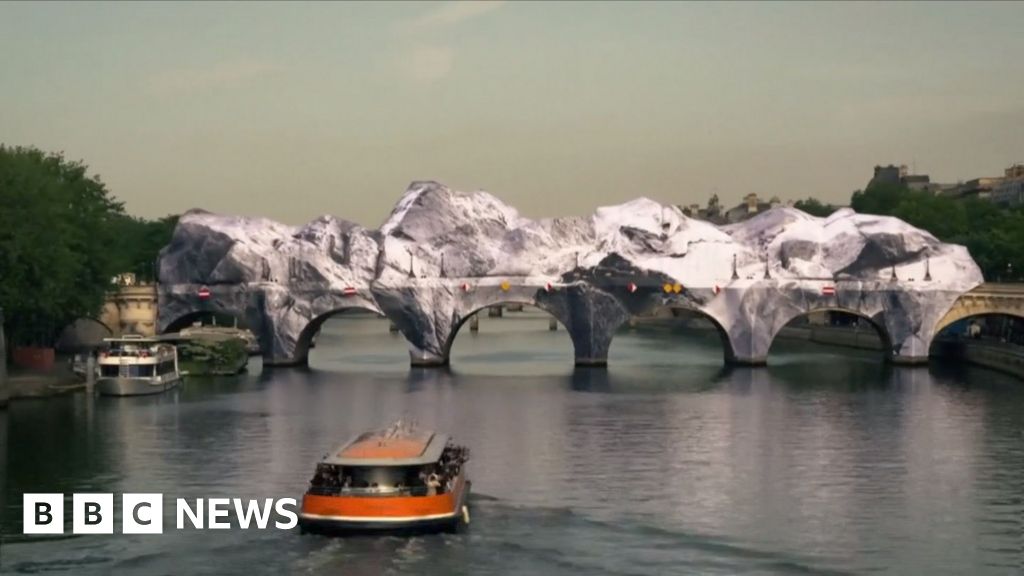

Paris’ Iconic Pont Neuf Transformed into a Staggering Inflatable Cave: Art Meets Urban Landscape in Stunning Display
By [Your Name], Global Security & Culture Correspondent
A Daring Metamorphosis Under the Cover of Night
In the pre-dawn hours of Thursday, one of Paris’ most historic landmarks underwent a surreal transformation. The 17th-century Pont Neuf, the oldest standing bridge across the Seine, was shrouded in an enormous inflatable cave structure—an audacious artistic intervention that left early-morning commuters and residents stunned. Time-lapse footage captured the bridge’s metamorphosis, as its classical stone arches disappeared beneath a sprawling, textured installation resembling the mouth of a cavern. Titled La Caverne (“The Cave”), the work by renowned French artist JR challenges perceptions of urban space, blending raw, primal aesthetics with the refined grandeur of Parisian architecture.
The installation, which opens to the public on June 6, is more than a visual spectacle—it’s a statement on the intersection of art, public space, and collective memory in an era where cities worldwide grapple with preserving heritage while embracing bold contemporary expression.
The Artist’s Vision: Contrast, Fear, and Fascination
JR, a pseudonymous artist celebrated for his large-scale, socially engaged works, described La Caverne as an exploration of duality. “I wanted to juxtapose the rough and the wild with the refined elegance of Paris,” he told AP News. The installation, stretching 120 meters in length and reaching heights of up to 18 meters, evokes both awe and unease. “There’s a kind of unknown—fear of entering a cave, but also fascination,” JR added, hinting at the psychological tension embedded in the piece.
This is not the artist’s first intervention in Paris. His past projects, including a massive optical illusion at the Louvre Pyramid and a participatory portrait series in the city’s banlieues, have cemented his reputation as a provocateur of public art. Yet La Caverne stands apart—its scale and temporary nature raise questions about permanence, ownership, and the role of art in redefining civic identity.
Global Context: Art as Urban Disruption and Diplomacy
JR’s work arrives at a time when cities worldwide are increasingly becoming canvases for large-scale, often controversial artistic interventions. From The Gates in New York’s Central Park to Ai Weiwei’s politically charged installations, urban art projects spark debates about aesthetics, accessibility, and the commodification of public space. In Paris, where preservation laws are stringent, La Caverne’s approval signals a willingness to experiment—even if temporarily—with the city’s rigid architectural norms.
Beyond aesthetics, such installations carry geopolitical undertones. In an era of rising nationalism, public art can serve as a soft-power tool, reinforcing a city’s global cultural influence. Paris, still recovering from pandemic-era tourism declines and security challenges, may view La Caverne as a statement of resilience—a reminder that the city remains a crucible of innovation despite its deep historical roots.
Why This Matters: Security, Spectacle, and the Public Realm
The logistical feat of installing La Caverne overnight underscores the intersection of art and urban security. Major public installations require meticulous planning, often involving municipal authorities, law enforcement, and private contractors. In a city like Paris, where terror threats remain a concern, any large-scale disruption—even an artistic one—demands rigorous risk assessment.
Yet the project also highlights a broader tension: the balance between spectacle and daily life. While some residents may welcome the bridge’s temporary reinvention, others could see it as an imposition, a disruption to their familiar landscape. This dichotomy mirrors global debates over gentrification, tourism, and who ultimately controls public spaces in increasingly crowded cities.
A Fleeting Monument with Lasting Questions
La Caverne will remain in place until June 28, a brief but unforgettable chapter in Pont Neuf’s storied history. Its impermanence is part of its power—a reminder that even the most enduring landmarks are subject to reinterpretation.
As visitors step inside the inflatable cave, they’ll confront JR’s intended paradox: the thrill of the unknown and the comfort of the familiar. In a world where cities are both battlegrounds and sanctuaries, La Caverne challenges us to rethink how art can reshape—if only for a moment—the spaces we thought we knew.
For Paris, and for global audiences watching, the question lingers: What does it mean to see the old through new eyes? The answer, like the cave itself, may be as elusive as it is compelling.
