


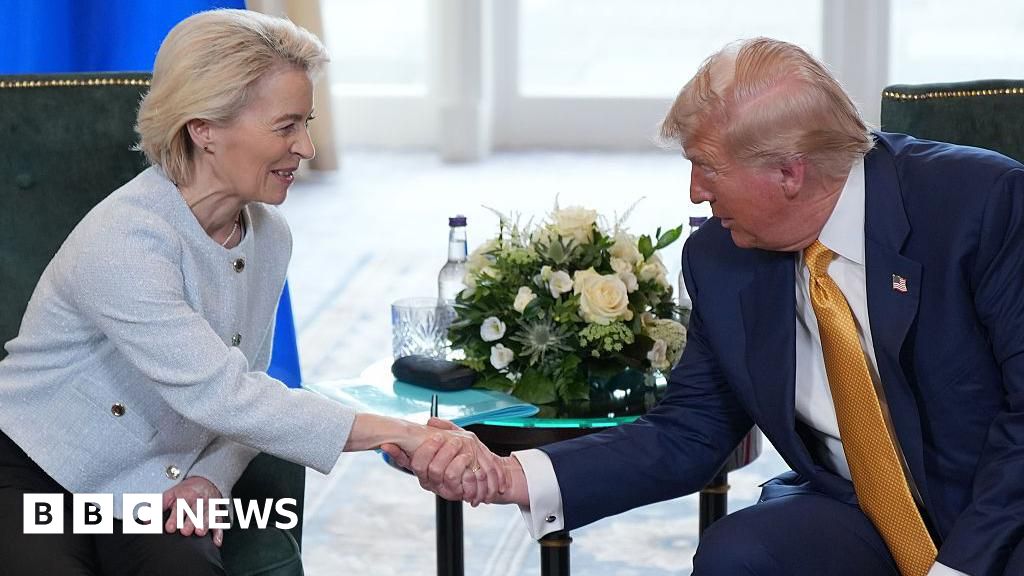

Europe’s New Defense Pact: A Shield Against External Pressures
In an increasingly fractured global landscape, the European Union has taken a decisive step to safeguard its autonomy and economic interests. A newly unveiled defense agreement includes a clause that allows for its suspension if external actors—particularly the Trump administration—are found to undermine its objectives or threaten its territorial integrity. This move underscores Europe’s growing determination to protect its sovereignty amidst rising geopolitical tensions and economic coercion.
The timing of this clause is critical. As the world grapples with shifting alliances, trade wars, and the resurgence of power politics, Europe is positioning itself as a bulwark against unilateral actions that could destabilize its member states. This development highlights the EU’s resolve to assert its independence in a world where traditional alliances are increasingly strained.
A Clause Born of Necessity
The inclusion of this specific clause reflects the EU’s evolving strategy to counter external pressures. The agreement explicitly states that it can be suspended if the Trump administration—or any other foreign power—engages in actions deemed detrimental to EU objectives. These include undermining the deal’s goals, discriminating against European businesses, threatening member states’ territorial integrity, or resorting to economic coercion.
This provision is not merely a theoretical safeguard but a direct response to recent geopolitical dynamics. The Trump administration’s approach to international relations, characterized by tariffs, sanctions, and strained alliances, has often put European nations in precarious positions. The EU’s decision to embed this clause in its defense pact signals a willingness to protect its economic and political interests from such pressures.
Global Context: A World in Flux
The EU’s move comes at a time of profound global uncertainty. The rise of populist leaders, the erosion of multilateral institutions, and the increasing use of economic tools as weapons of statecraft have reshaped the international order. Nations are increasingly prioritizing their own interests over collective security, leading to a fragmented global system.
Europe, long reliant on the United States as a key ally, now finds itself navigating a more complex landscape. The Trump administration’s transactional approach to foreign policy, coupled with its willingness to leverage economic measures against allies, has forced European leaders to rethink their strategic posture. This defense pact, with its suspension clause, is a manifestation of that reassessment.
Why This Matters Globally
The implications of this agreement extend far beyond Europe. It represents a broader shift in how nations are responding to the challenges of a multipolar world. As economic coercion becomes a more common tool of statecraft, countries are seeking mechanisms to insulate themselves from external interference.
For the United States, this development raises questions about the future of transatlantic relations. While Washington and Brussels have historically been close allies, the inclusion of this clause suggests that Europe is preparing for a future where such alliances may no longer be taken for granted.
For other global powers, particularly China and Russia, the pact could serve as a model for how regions can assert their autonomy in an era of great power competition. It also underscores the growing importance of regional blocs in maintaining stability and resisting external pressures.
The Human Impact: Protecting Citizens and Economies
At its core, this agreement is about safeguarding the well-being of Europe’s citizens and economies. By embedding protections against economic coercion and external interference, the EU is ensuring that its member states can pursue policies that benefit their populations without fear of reprisal.
For businesses, this clause offers a layer of security in an unpredictable global market. European economic operators, often caught in the crossfire of international trade disputes, can now operate with greater confidence that their interests will be defended.
For ordinary citizens, the pact reinforces the EU’s commitment to stability and prosperity. In a world where geopolitical tensions can have direct consequences on daily life, this agreement provides a measure of reassurance that Europe is equipped to navigate these challenges.
A Defining Moment for Europe
This defense pact, with its protective clause, marks a defining moment in Europe’s evolution as a geopolitical actor. It signals a shift from reliance on external powers to a more assertive, independent stance. While the clause is framed as a safeguard against potential threats, it also serves as a statement of Europe’s growing confidence in its ability to shape its own destiny.
As the global order continues to evolve, the EU’s approach may well serve as a blueprint for other regions seeking to balance autonomy with interdependence. In an era of uncertainty, Europe’s willingness to take bold steps to protect its interests offers a glimpse of how nations can navigate the complexities of a changing world.
Closing Thoughts: A New Era of European Resilience
The inclusion of this clause in Europe’s defense pact is more than a technical detail—it is a symbol of the continent’s resilience in the face of external pressures. It reflects a recognition that, in today’s world, autonomy must be actively defended. By taking this step, the EU is not only protecting its member states but also setting a precedent for how regions can assert their sovereignty in an interconnected yet fragmented global system.
As the world watches Europe chart this new course, one thing is clear: the era of unquestioned alliances is giving way to a more nuanced, self-reliant approach to global security. In this context, Europe’s defense pact is not just a shield against external threats—it is a declaration of its readiness to shape its own future.
