


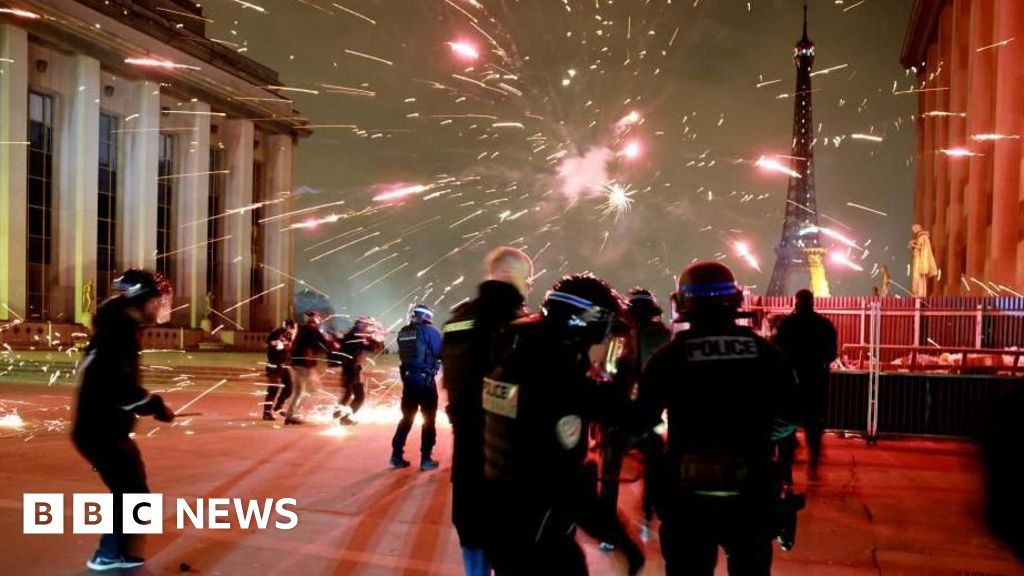

Paris Celebrations Turn Violent as Football Fans Clash with Police
Chaos in the Streets After PSG Secures Champions League Final Spot
Paris erupted in a mix of euphoria and chaos late Tuesday night as Paris Saint-Germain (PSG) secured their place in the UEFA Champions League final. Thousands of fans flooded the Champs-Élysées, waving flags, igniting flares, and chanting in celebration of their team’s historic victory. But what began as a jubilant gathering quickly descended into violence, with clashes between riot police and overzealous supporters leaving streets littered with debris and broken glass. The unrest underscores the volatile intersection of sports, politics, and public safety—a recurring issue in major cities hosting high-stakes matches.
From Jubilation to Confrontation
PSG’s dramatic 1-0 victory over Borussia Dortmund sent shockwaves through the football world, marking only the second time the French club has reached the Champions League final. As the final whistle blew, spontaneous celebrations broke out across Paris, with fans honking car horns and singing club anthems late into the night.
However, the mood shifted rapidly as a faction of supporters clashed with law enforcement. Riot police deployed tear gas and water cannons to disperse crowds after projectiles were thrown and storefronts vandalized. Authorities reported at least a dozen arrests, with minor injuries on both sides. While most fans dispersed peacefully, the disturbances raised familiar concerns about crowd control during major sporting events.
A Global Pattern of Post-Match Unrest
The scenes in Paris are not isolated. Football-related violence has surged in recent years, from the deadly stampede in Indonesia (2022) to the riots following Morocco’s World Cup semifinal loss (2022). Experts point to a combination of factors: the emotional intensity of elite competitions, pre-existing tensions between fans and police, and the influence of alcohol.
France, in particular, has a fraught history with football-related disorder. The 2016 UEFA Euro final saw similar clashes, and the 2022 Champions League final in Paris was marred by organizational failures and police brutality allegations. Tuesday’s incidents suggest that despite increased security measures, the risk of unrest remains high.
Why This Matters Beyond Football
The fallout from such disturbances extends far beyond sports. Major events like the Champions League final attract global attention, shaping perceptions of host cities and nations. With the 2024 Summer Olympics just weeks away, Paris is under intense scrutiny—any repeat of Tuesday’s chaos could fuel doubts about France’s ability to manage large-scale events.
Moreover, the financial stakes are enormous. UEFA and sponsors rely on smooth operations to protect their investments; violence threatens broadcasting deals and tourism revenue. For local businesses, post-match destruction can mean costly repairs and lost income.
Authorities Under Pressure Ahead of Final
With PSG set to face Real Madrid or Bayern Munich in the June 1 final at London’s Wembley Stadium, Parisian officials now face urgent questions. Will they impose stricter measures for public screenings? Can police balance crowd safety with civil liberties?
London’s Metropolitan Police, meanwhile, are preparing for their own security challenge. Wembley has seen its share of fan trouble, including the disorder at the Euro 2020 final. Lessons from Paris will likely influence their strategy.
A Test for Football’s Governing Bodies
UEFA has long grappled with how to curb fan violence without stifling passion. Stiffer penalties, alcohol bans, and enhanced surveillance have had mixed results. Some argue that deeper societal issues—such as economic inequality and mistrust of authorities—fuel these incidents far more than sport itself.
As PSG’s fans dream of their first Champions League title, the broader question remains: Can the beautiful game shed its darker side?
Conclusion: More Than Just a Game
Football has the power to unite cities and nations—but also to expose their fractures. The scenes in Paris serve as a stark reminder that behind the spectacle of elite sport lies a complex web of security, politics, and human emotion. As the world watches the Champions League final next month, the focus won’t just be on the players, but on whether the celebrations stay peaceful—or spiral into chaos once more.
For now, Paris is left to clean up, reflect, and hope that next time, victory brings only joy—not destruction.
