


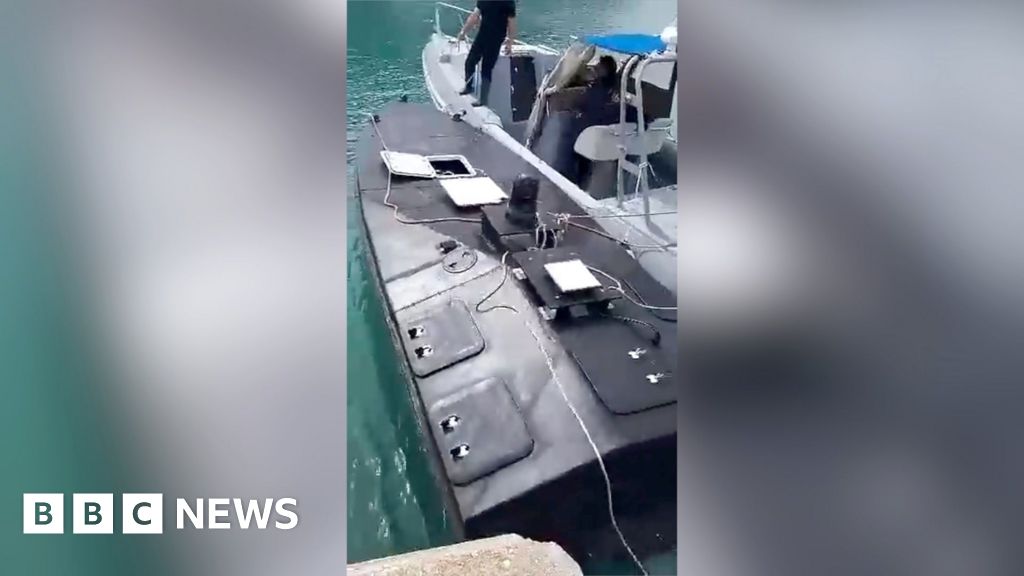

Mystery Drone Boat Discovered in Cave Raises Questions Amid Global Tensions
In a remote coastal cave, fishermen stumbled upon an unmanned vessel on Thursday, triggering a cascade of speculation and concern about its origins and purpose. The sleek, technologically advanced craft, suspected to be of Ukrainian origin, has ignited debates among security experts and governments worldwide. As tensions between Ukraine and Russia remain at a boiling point, the discovery of such a vessel—potentially designed for military use—underscores the growing role of unmanned systems in modern warfare and raises urgent questions about the shifting dynamics of global security.
The Discovery: A Coastal Mystery
The vessel was found by local fishermen in a secluded cave along a stretch of coastline, its precise location withheld for security reasons. Initial reports describe the craft as approximately 5 meters long, outfitted with advanced navigation systems and what appears to be modular payload capabilities. Its design suggests it could be remotely operated or programmed for autonomous missions, making it a potential tool for reconnaissance or offensive operations.
While no definitive markings link the vessel to a specific country, experts analyzing its design point to similarities with Ukrainian naval drones, which have gained prominence in the ongoing conflict with Russia. These unmanned systems have been used extensively in the Black Sea, targeting Russian naval assets and infrastructure with increasing effectiveness.
Global Context: The Rise of Unmanned Warfare
The discovery comes at a time when unmanned military systems—ranging from drones to robotic vehicles—are reshaping the battlefield. Both state and non-state actors are investing heavily in these technologies, drawn by their cost-effectiveness, versatility, and ability to minimize human casualties.
Ukraine has been at the forefront of this shift, employing naval drones to counter Russia’s superior naval forces in the Black Sea. These vessels have proven instrumental in disabling Russian ships, disrupting supply lines, and deterring aggression. The use of such technology has not only leveled the playing field but also introduced new challenges for global maritime security.
Meanwhile, Russia has responded by enhancing its anti-drone capabilities and deploying its own unmanned systems, escalating an arms race in unmanned technologies. This competition extends beyond Eastern Europe, with nations like the United States, China, and Iran rapidly advancing their drone capabilities.
Why It Matters: Implications for Global Security
The discovery of the unmanned vessel highlights several critical issues for international security. First, it underscores the proliferation of unmanned systems, which are increasingly accessible to both state and non-state actors. This democratization of military technology raises concerns about its potential misuse in conflicts, terrorism, or maritime piracy.
Second, the incident raises questions about the vessel’s intended mission. Was it lost during a reconnaissance operation, or was it deliberately hidden for future use? The answers could provide insight into Ukraine’s strategic operations or, alternatively, suggest the involvement of other actors seeking to exploit regional tensions.
Finally, the discovery underscores the vulnerabilities of global maritime infrastructure. Unattended vessels could be repurposed for sabotage, smuggling, or other illicit activities, posing a threat to commercial shipping lanes and coastal communities.
Global Reactions and Next Steps
The discovery has prompted swift reactions from governments and security analysts. Ukrainian officials have yet to confirm or deny ownership of the vessel, while Russian authorities have seized the opportunity to accuse Ukraine of escalating hostilities. NATO member states, meanwhile, are closely monitoring the situation, recognizing the broader implications for European and global security.
Experts call for a thorough investigation to determine the vessel’s origins, capabilities, and intended use. Such an inquiry could provide valuable intelligence on the evolving tactics and technologies in modern warfare. Additionally, the incident underscores the need for international agreements to regulate the use of unmanned systems, ensuring they are deployed responsibly and transparently.
A New Era of Warfare
The discovery of the unmanned vessel in a remote cave is a stark reminder of how warfare is evolving in the 21st century. As unmanned systems become more sophisticated and widespread, they are redefining the rules of engagement, blurring the lines between peace and conflict, and challenging traditional notions of security.
For Ukraine, such technologies have been a game-changer, enabling a smaller, outgunned force to stand up to a major military power. For the world, they represent both an opportunity and a threat—a tool for innovation and defense, but also a potential catalyst for instability and escalation.
As governments and international organizations grapple with these challenges, the discovery serves as a wake-up call. In an era defined by rapid technological advancement, the need for vigilance, cooperation, and foresight has never been greater. The unmanned vessel found in the cave is not just a relic of a distant conflict; it is a harbinger of the future, urging the global community to confront the complexities of a new age of warfare.
