



Dramatic Rescue in Northern Italy: Firefighters Save Stranded Wolf Amid Growing Human-Wildlife Tensions
By [Your Name], Global Security and Environment Correspondent
A Desperate Struggle for Survival
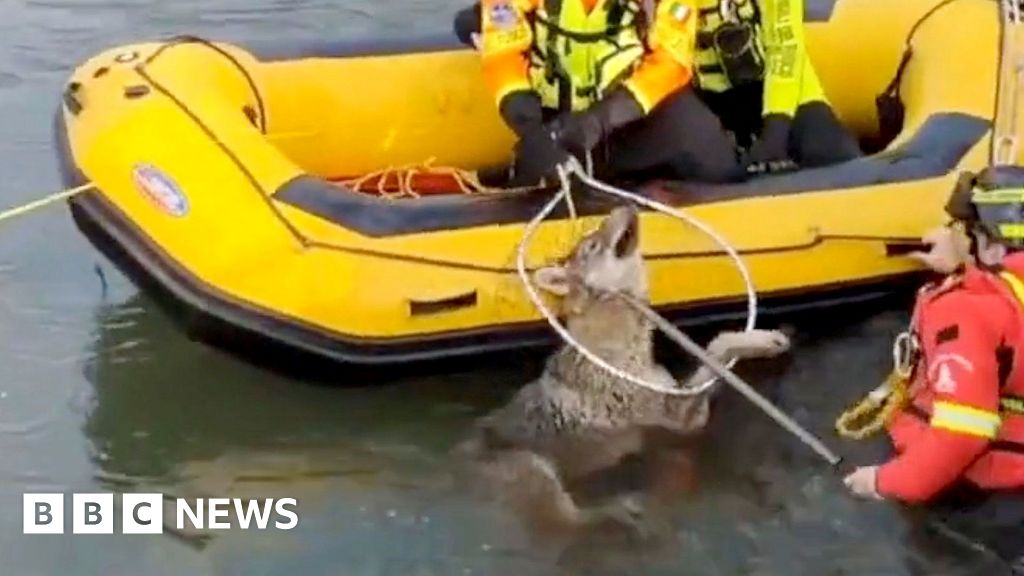
Under the dim light of dawn in San Giovanni Lupatoto, a small town in Italy’s Veneto region, a lone wolf fought for its life. Trapped in a fast-moving canal, the exhausted animal clung to the shadows beneath a footbridge, its fur slick with water, its paws slipping against the concrete. For hours, the wolf—a symbol of Europe’s rewilding successes and its ongoing conflicts—struggled to stay above the current. Then, the whir of rescue boats broke through the tension. Firefighters from Italy’s elite river rescue unit moved swiftly, sedating the terrified animal before hauling it to safety. The dramatic operation, captured on video, underscores a growing global challenge: as wildlife populations rebound, clashes with humans are becoming more frequent—and more perilous.
The Rescue: A Race Against Time
The rescue unfolded early this week when locals spotted the distressed wolf trapped in the canal. Firefighters from the Verona Provincial Command deployed specialized water rescue teams, navigating the narrow waterways to reach the animal. “It was clear the wolf was exhausted and disoriented,” said Marco Rizzi, a spokesperson for the fire brigade. “Without intervention, it would have drowned or been swept away.” Using nets and tranquilizers, the team carefully secured the female wolf before transporting her to a veterinary clinic. Authorities confirmed she suffered no serious injuries and will soon be released back into the wild.
Italy’s Wolf Population: A Conservation Success Story
The rescued wolf is one of an estimated 3,300 now roaming Italy, according to the latest national survey conducted in 2021. Once nearly driven to extinction by hunting and habitat loss, wolves have rebounded dramatically since gaining legal protection in the 1970s. Today, around 950 inhabit the Alpine region, while others thrive in the Apennine Mountains and rural areas. Their resurgence is part of a broader European trend, with wolf populations increasing by 25% over the past decade in countries like Germany, France, and Spain.
But this success has come at a cost. Farmers report rising livestock attacks, fueling tensions between conservationists and rural communities. In France, the government has authorized wolf culls despite protests, while in Switzerland, debates rage over whether to relax hunting restrictions. Italy, too, faces pressure to balance protection with pragmatism. “Wolves are a vital part of our ecosystem, but their growing numbers require new strategies to prevent conflict,” said Dr. Sofia Bianchi, a wildlife biologist at the University of Milan.
Why This Rescue Matters Globally
The incident in Veneto is more than a local curiosity—it reflects a worldwide dilemma. As climate change and habitat destruction push animals into human-dominated landscapes, encounters like this will only increase. In India, leopards stray into urban areas; in North America, bears raid suburban trash cans; and in Africa, elephants clash with farmers over dwindling land. Each interaction tests humanity’s ability to coexist with the natural world.
For Italy, the wolf’s rescue is a microcosm of broader environmental and political debates. The country’s far-right government, led by Prime Minister Giorgia Meloni, has faced criticism for rolling back green policies while also pledging to protect rural livelihoods. Meanwhile, the European Union is drafting new biodiversity laws that could further restrict hunting and land use—a move opposed by agricultural lobbies.
The Road Ahead: Coexistence or Conflict?
As the rescued wolf recovers, experts say her story should serve as a wake-up call. “We need better infrastructure—wildlife corridors, secure livestock enclosures, and public education—to reduce these confrontations,” said Bianchi. Some regions are already experimenting with solutions: in Trentino, drones monitor wolf packs to alert farmers, while in Tuscany, compensation programs reimburse herders for lost livestock.
Yet the deeper challenge remains philosophical. Can modern societies make space for apex predators, or will fear and economics dictate their fate? The answer will shape not just Italy’s wilderness but the future of global conservation efforts.
A Symbol of Hope—And a Warning
As the wolf prepares to return to the wild, its ordeal lingers as a poignant reminder. Humanity’s relationship with nature is at a crossroads, marked by both compassion and conflict. The firefighters who braved the canal demonstrated that coexistence is possible—but their heroics alone won’t solve the larger crisis. In an era of climate upheaval and vanishing habitats, the world must decide: will we protect the wild, or will we force it to the brink once more? For now, at least, this wolf has been given a second chance. The question is whether we’ll extend that grace to the rest of the natural world.
—Reporting contributed by [Your Name] with additional research from [Your Team].
